



CD39L1/ENTPD2 Protein, Mouse (HEK293, His)

Based on 1 Customer Validation
In the nervous system, CD39L1/ENTPD2 protein crucially regulates purinergic neurotransmission by proficiently hydrolyzing ATP and other nucleotides. Remarkably, it exhibits marginal hydrolysis of ADP, emphasizing its specificity and significant role in precisely modulating purinergic signaling pathways. CD39L1/ENTPD2 Protein, Mouse (HEK293, His) is the recombinant mouse-derived CD39L1/ENTPD2 protein, expressed by HEK293 , with C-6*His labeled tag.
- Species: Mouse
- Source: HEK293
-
Storage:Stored at -80°C for 1 year from date of receipt. It is stable at -20°C for 3 months after opening. It is recommended to freeze aliquots at -80°C for extended storage. Avoid repeated freeze-thaw cycles.


To place orders, for customer services and technical support, please contact: MedChemExpress USA
Tel: 609-228-6898 E-mail: [email protected] [email protected]


-
 Biological Activity
-
Technical Parameters
-
Product Properties
- Documentation
- Help & FAQs




Biological Activity
Description
In the nervous system, CD39L1/ENTPD2 protein crucially regulates purinergic neurotransmission by proficiently hydrolyzing ATP and other nucleotides. Remarkably, it exhibits marginal hydrolysis of ADP, emphasizing its specificity and significant role in precisely modulating purinergic signaling pathways. CD39L1/ENTPD2 Protein, Mouse (HEK293, His) is the recombinant mouse-derived CD39L1/ENTPD2 protein, expressed by HEK293 , with C-6*His labeled tag.
Background
In the nervous system, CD39L1/ENTPD2 protein plays a crucial role in regulating purinergic neurotransmission by hydrolyzing ATP and other nucleotides. While demonstrating proficiency in the hydrolysis of various nucleotides, it notably exhibits a marginal extent of hydrolysis for ADP. This specificity suggests that CD39L1/ENTPD2 contributes to the precise modulation of purinergic signaling pathways, highlighting its significance in fine-tuning neurotransmission processes within the nervous system.
Verified Bioactivity
The enzyme activity of this recombinant protein is testing in progress, we cannot offer a guarantee yet.
MCE Validation Data
-
Purity - SDS-PAGE
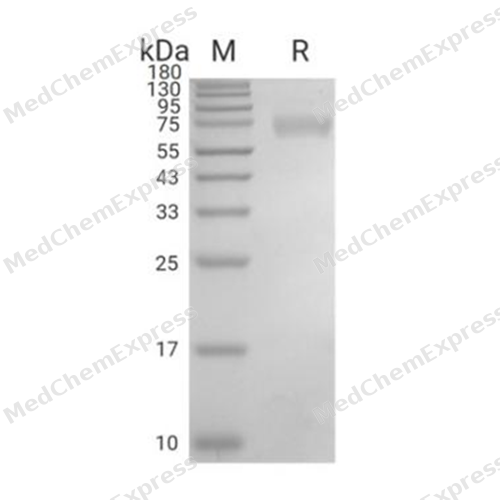
Purity - SDS-PAGE


Technical Parameters
-
Species Mouse
-
Source HEK293
-
Tag C-6*His
-
Accession
O55026 (C26-S462)
-
Molecular Construction
-
N-term
-
Entpd2 (C26-S462)
Accession # O55026 -
6*His
-
C-term
-
-
Protein Length
Extracellular Domain
-
Synonyms
ENTPD2; Ecto-ATPDase 2; Prev. CD39L1; E-NTPDase 2; NTPDase-2; NTPDase 2; Ecto-ATP Diphosphohydrolase 2; CD39-Like-1; CD39 Antigen-Like 1; Ecto-ATPase; Ectonucleoside Triphosphate Diphosphohydrolase 2; Ecto-ATPase 2
-
AA Sequence
CVPTQDVREPPALKYGIVLDAGSSHTSMFVYKWPADKENDTGIVGQHSSCDVRGGGISSYANDPSRAGQSLVECLEQALRDVPKDRYASTPLYLGATAGMRLLNLTSPEATAKVLEAVTQTLTRYPFDFRGARILSGQDEGVFGWVTANYLLENFIKYGWVGRWIRPRKGTLGAMDLGGASTQITFETTSPSEDPDNEVHLRLYGQHYRVYTHSFLCYGRDQVLQRLLASALQIHRFHPCWPKGYSTQVLLREVYQSPCTMGQRPQTFNSSATVSLSGTSNAALCRDLVSGLFNISSCPFSQCSFNGVFQPPVAGNFIAFSAFYYTVDFLKTVMGLPVGTLKQLEDATETTCNQTWAELQARVPGQQTRLPDYCAVAMFIHQLLSRGYRFDERSFRGVVFEKKAADTAVGWALGYMLNLTNLIPADLPGLRKGTHFS
-
Predicted Molecular Mass
49.2 kDa
-
Molecular Weight
Approximately 63-90 kDa, based on SDS-PAGE under reducing conditions.
-
Glycosylation
Yes
-
Purity
≥ 95%, as determined by reducing SDS-PAGE.


Product Properties
Solution
Supplied as a 0.22 μm filtered solution of 50 mM Tris,10 mM CaCl2,150 mM NaCl, 10% glycerol, pH 7.5.
Note: For SPR assay, please replace the buffer. Primary amine components (e.g., Tris, imidazole) can affect protein-coupled chips.
<1 EU/μg, determined by LAL method.
Stored at -80°C for 1 year from date of receipt. It is stable at -20°C for 3 months after opening. It is recommended to freeze aliquots at -80°C for extended storage. Avoid repeated freeze-thaw cycles.
Shipping with dry ice.


Documentation
-
Data Sheet (238 KB)
-
SDS (252 KB)
- English - EN (252 KB)
- Français - FR (252 KB)
- Deutsch - DE (252 KB)
- Norwegian - NO (252 KB)
- Español - ES (252 KB)
- Swedish - SV (252 KB)
- Italian - IT (252 KB)
- Korean - KR (252 KB)
- Portuguese - PT (252 KB)
-
Handling Instructions (2659 KB)

Calculators
Concentration (start) × Volume (start) = Concentration (final) × Volume (final)


 Powered by Bioz

