



CD47 Protein, Mouse (HEK293)

Based on 1 Customer Validation
The CD47 protein, also known as integrin-associated protein (IAP), is an immune checkpoint protein. CD47 binds to membrane integrins and binds ligands platelet reaction-protein-1 (TSP-1) and signal regulatory protein alpha (SIRP伪). CD47 is a potential therapeutic target for some cancers and is also used to treat pulmonary fibrosis. CD47 Protein, Mouse (HEK293) is the recombinant mouse-derived CD47 protein, expressed by HEK293 , with tag free.
- Species: Mouse
- Source: HEK293
-
Storage:Stored at -20°C for 2 years from date of receipt. After reconstitution, it is stable at 4°C for 1 week or -20°C for longer (with carrier protein). It is recommended to freeze aliquots at -20°C or -80°C for extended storage.


To place orders, for customer services and technical support, please contact: MedChemExpress USA
Tel: 609-228-6898 E-mail: [email protected] [email protected]


-
 Biological Activity
-
Technical Parameters
-
Product Properties
- Documentation
- References
- Help & FAQs




Biological Activity
Description
The CD47 protein, also known as integrin-associated protein (IAP), is an immune checkpoint protein. CD47 binds to membrane integrins and binds ligands platelet reaction-protein-1 (TSP-1) and signal regulatory protein alpha (SIRP伪). CD47 is a potential therapeutic target for some cancers and is also used to treat pulmonary fibrosis. CD47 Protein, Mouse (HEK293) is the recombinant mouse-derived CD47 protein, expressed by HEK293 , with tag free.
Background
CD47, also known as integrin-associated protein (IAP), is a transmembrane protein encoded by the CD47 gene. CD47 belongs to the immunoglobulin superfamily and binds to membrane integrins and ligands platelet reactive protein-1 (TSP-1) and signal regulatory protein α (SIRPα). CD47 is involved in a variety of biological processes, including signal transduction, cardiovascular homeostasis, inflammation, apoptosis, angiogenesis, cell self-renewal, and immune regulation. In addition, CD47 is also important in memory formation and synaptic plasticity in the hippocampus. As a receptor for SIRPA, it prevents immature dendritic cells from maturing and inhibits the production of cytokines by mature dendritic cells. Interaction with SIRPG enhances cell-cell adhesion, T-cell proliferation, and T-cell activation. CD47 positively regulates FAS-dependent T cell apoptosis and inhibits angiogenesis. It may also be involved in metabolic dysregulation during normal aging, regulating wound healing and stem cell self-renewal. CD47 may play a role in cell membrane transport, integrin-dependent signal transduction, and prevention of premature clearance of red blood cells. It interacts with THBS1, SIRPA, FAS/CD95, SIRPG, UBQLN1, UBQLN2, and fibrinogen. Activation of the CD47 receptor induces the proliferation of human astrocytoma cells through an AKt-dependent pathway. CD47 is a potential therapeutic target for some cancers and is also used to treat pulmonary fibrosis[1][2][3].
Verified Bioactivity
Measured by its binding ability in a functional ELISA. Immobilized Mouse CD47 at 10 μg/mL (100 μL/well) can bind Biotinylated Mouse SIRP alpha. The ED50 for this effect is ≤1.14 μg/mL, corresponding to a specific activity is ≥877.2 Unit/mg.
MCE Validation Data
-
Bioactivity - ELISA
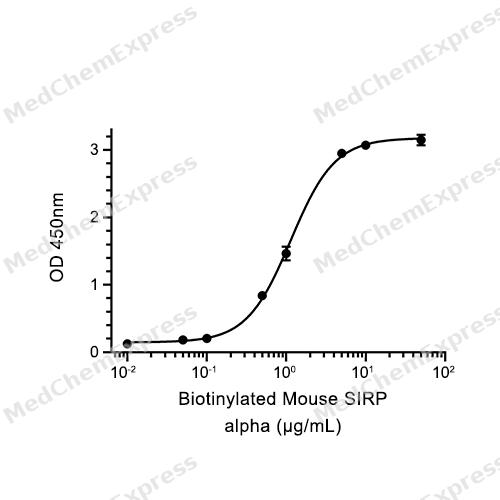
Bioactivity - ELISA


Technical Parameters
-
Species Mouse
-
Source HEK293
-
Tag Tag Free
-
Accession
Q61735-1/ADQ12919.1 (Q19-K140)
-
Gene ID16423
-
Molecular Construction
-
N-term
-
CD47 (Q19-K140)
Accession # Q61735-1/ADQ12919.1 -
C-term
-
-
Protein Length
Extracellular Domain
-
Synonyms
CD47; Antigen Identified By Monoclonal Antibody 1D8; Prev. MER6; Integrin-Associated Protein; Leukocyte Surface Antigen CD47; Rh-Related Antigen; IAP; CD47 Glycoprotein; Antigenic Surface Determinant Protein OA3; Integrin-Associated Signal Transducer; OA3
-
AA Sequence
QLLFSNVNSIEFTSCNETVVIPCIVRNVEAQSTEEMFVKWKLNKSYIFIYDGNKNSTTTDQNFTSAKISVSDLINGIASLKMDKRDAMVGNYTCEVTELSREGKTVIELKNRTVSWFSPNEK
-
Predicted Molecular Mass
13.8 kDa
-
Molecular Weight
Approximately 27-34 kDa, based on SDS-PAGE under reducing conditions.
-
Glycosylation
Yes
-
Purity
≥ 95%, as determined by reducing SDS-PAGE.


Product Properties
Lyophilized powder.
Lyophilized from a 0.22 μm filtered solution of 20 mM PB, 150 mM NaCl, pH 7.4.
<1 EU/μg, determined by LAL method.
It is not recommended to reconstitute to a concentration less than 100 μg/mL in ddH2O. For long term storage it is recommended to add a carrier protein (0.1% BSA, 5% HSA, 10% FBS or 5% Trehalose).
Stored at -20°C for 2 years from date of receipt. After reconstitution, it is stable at 4°C for 1 week or -20°C for longer (with carrier protein). It is recommended to freeze aliquots at -20°C or -80°C for extended storage.
Room temperature in continental US; may vary elsewhere.


Documentation
-
Data Sheet (263 KB)
-
SDS (251 KB)
- English - EN (251 KB)
- Français - FR (251 KB)
- Deutsch - DE (251 KB)
- Norwegian - NO (251 KB)
- Español - ES (251 KB)
- Swedish - SV (251 KB)
- Italian - IT (251 KB)
- Korean - KR (251 KB)
- Portuguese - PT (251 KB)
-
Handling Instructions (2659 KB)


References
[1]. Sick E, et al. Activation of CD47 receptors causes proliferation of human astrocytoma but not normal astrocytes via an Akt-dependent pathway. Glia. 2011 Feb;59(2):308-19. [Content Brief]
[2]. Ghantous L, et al. The DNA damage response pathway regulates the expression of the immune checkpoint CD47. Commun Biol. 2023 Mar 7;6(1):245. [Content Brief]
[3]. Sick E, et al. CD47 update: a multifaceted actor in the tumour microenvironment of potential therapeutic interest. Br J Pharmacol. 2012 Dec;167(7):1415-30. [Content Brief]

Calculators
Concentration (start) × Volume (start) = Concentration (final) × Volume (final)


 Powered by Bioz

