



CLEC-1/CLEC1A Protein, Mouse (HEK293, hFc)

Based on 1 Customer Validation
CLEC-1/CLEC1A proteins belong to the CTL/CTLD superfamily and are known for their diverse functions in cell adhesion, signaling, glycoprotein turnover, inflammation, and immune responses. It is involved in potentially regulating dendritic cell function. CLEC-1/CLEC1A Protein, Mouse (HEK293, hFc) is the recombinant mouse-derived CLEC-1/CLEC1A protein, expressed by HEK293 , with N-hFc labeled tag.
- Species: Mouse
- Source: HEK293
-
Storage:Stored at -20°C for 2 years from date of receipt. After reconstitution, it is stable at 4°C for 1 week or -20°C for longer (with carrier protein). It is recommended to freeze aliquots at -20°C or -80°C for extended storage.


To place orders, for customer services and technical support, please contact: MedChemExpress USA
Tel: 609-228-6898 E-mail: [email protected] [email protected]


-
 Biological Activity
-
Technical Parameters
-
Product Properties
- Documentation
- Help & FAQs




Biological Activity
Description
CLEC-1/CLEC1A proteins belong to the CTL/CTLD superfamily and are known for their diverse functions in cell adhesion, signaling, glycoprotein turnover, inflammation, and immune responses. It is involved in potentially regulating dendritic cell function. CLEC-1/CLEC1A Protein, Mouse (HEK293, hFc) is the recombinant mouse-derived CLEC-1/CLEC1A protein, expressed by HEK293 , with N-hFc labeled tag.
Background
The C-type lectin-like domain-containing protein 1 (CLEC1A) is a member of the C-type lectin/C-type lectin-like domain (CTL/CTLD) superfamily, known for its diverse functions, including cell adhesion, cell-cell signaling, glycoprotein turnover, and roles in inflammation and immune response. This protein is implicated in the potential regulation of dendritic cell function. Situated on chromosome 12p13 in the natural killer gene complex region, CLEC1A is closely linked to other members of the CTL/CTLD superfamily. Alternative splicing gives rise to multiple transcript variants, contributing to the functional diversity of this gene. With biased expression observed in placenta (RPKM 18.1), lung (RPKM 3.8), and 10 other tissues, CLEC1A underscores its potential role in various physiological contexts.
Verified Bioactivity
Measured by its ability to bind fluorescein-conjugated E.coli Bioparticles. The ED50 for this effect is 2.703 μg/mL, corresponding to a specific activity is 3.70×10² units/mg.
MCE Validation Data
-
Purity - SDS-PAGE
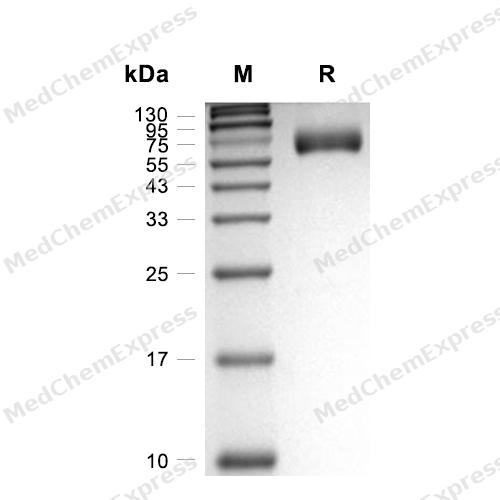
Purity - SDS-PAGE


Technical Parameters
-
Species Mouse
-
Source HEK293
-
Tag N-hFc
-
Accession
Q8BWY2 (Q73-Q269)
-
Molecular Construction
-
N-term
-
hFc
-
CLEC-1 (Q73-Q269)
Accession # Q8BWY2 -
C-term
-
-
Protein Length
Extracellular Domain
-
Synonyms
CLEC1A; CDNA FLJ34670 Fis, Clone LIVER2001076, Highly Similar To C-Type Lectin Domain Family 1 Member A; C-Type Lectin Domain Family 1 Member A; C-Type Lectin Domain Family 1, Member A, Isoform CRA_c; CLEC-1; C-Type Lectin Domain Family 1, Member A; CLEC1
-
AA Sequence
QFYQLSNIQQDSITEKDEKLGNMSRQLQSLQAQNRKLIETLQQVAVKLCRELYNKSGGHRCSPCPEKWKWYGDKCYQFYKESKNWQSCEYFCLADNATMLKISTQEELDFAMPQSYSEFFYSYWTGLSRNGSGKAWLWTDGTPYSFELFEIIIDPTNLRNRDCMTIFNGKAYSKDCKELRRCACERIAGRVVPGELQ
-
Molecular Weight
Approximately 58-80 kDa, based on SDS-PAGE under reducing conditions, due to the glycosylation.
-
Glycosylation
Yes
-
Purity
≥ 95%, as determined by reducing SDS-PAGE.


Product Properties
Lyophilized powder.
Lyophilized from a 0.22 μm filtered solution of PBS, pH 7.4.
<1 EU/μg, determined by LAL method.
It is not recommended to reconstitute to a concentration less than 100 μg/mL in ddH2O. For long term storage it is recommended to add a carrier protein (0.1% BSA, 5% HSA, 10% FBS or 5% Trehalose).
Stored at -20°C for 2 years from date of receipt. After reconstitution, it is stable at 4°C for 1 week or -20°C for longer (with carrier protein). It is recommended to freeze aliquots at -20°C or -80°C for extended storage.
Room temperature in continental US; may vary elsewhere.


Documentation
-
Data Sheet (237 KB)
-
SDS (251 KB)
- English - EN (251 KB)
- Français - FR (251 KB)
- Deutsch - DE (251 KB)
- Norwegian - NO (251 KB)
- Español - ES (251 KB)
- Swedish - SV (251 KB)
- Italian - IT (251 KB)
- Korean - KR (251 KB)
- Portuguese - PT (251 KB)
-
Handling Instructions (2659 KB)

Calculators
Concentration (start) × Volume (start) = Concentration (final) × Volume (final)


 Powered by Bioz

