



CLSTN1 Protein, Human (HEK293, His)

Based on 1 Customer Validation
The CLSTN1 protein acts as a postsynaptic adhesion molecule and promotes excitatory and inhibitory synapse formation by binding to presynaptic neurotoxins.It acts as a cell adhesion molecule on the postsynaptic membrane and forms an association with neurotoxin-α on the presynaptic membrane.CLSTN1 Protein, Human (HEK293, His) is the recombinant human-derived CLSTN1 protein, expressed by HEK293 , with C-His labeled tag.
- Species: Human
- Source: HEK293
-
Storage:Stored at -20°C for 2 years from date of receipt. After reconstitution, it is stable at 4°C for 1 week or -20°C for longer (with carrier protein). It is recommended to freeze aliquots at -20°C or -80°C for extended storage.


To place orders, for customer services and technical support, please contact: MedChemExpress USA
Tel: 609-228-6898 E-mail: [email protected] [email protected]


-
 Biological Activity
-
Technical Parameters
-
Product Properties
- Documentation
- Help & FAQs




Biological Activity
Description
The CLSTN1 protein acts as a postsynaptic adhesion molecule and promotes excitatory and inhibitory synapse formation by binding to presynaptic neurotoxins.It acts as a cell adhesion molecule on the postsynaptic membrane and forms an association with neurotoxin-α on the presynaptic membrane.CLSTN1 Protein, Human (HEK293, His) is the recombinant human-derived CLSTN1 protein, expressed by HEK293 , with C-His labeled tag.
Background
CLSTN1 Protein functions as a postsynaptic adhesion molecule, fostering both excitatory and inhibitory synapse formation by binding to presynaptic neurexins. In the realm of synapse development, CLSTN1 acts as a cell adhesion molecule at the postsynaptic membrane, forming associations with neurexin-alpha at the presynaptic membrane. Beyond its role in synapse formation, CLSTN1 serves as a molecular adapter, participating in axonal anterograde transport by promoting KLC1 association with vesicles. Moreover, it engages in complex formation with APBA2 and APP, stabilizing APP metabolism and enhancing APBA2-mediated suppression of beta-APP40 secretion, contributing to the regulation of intracellular APP maturation. As the intracellular fragment AlcICD, CLSTN1 plays a role in suppressing APBB1-dependent transactivation stimulated by APP C-terminal intracellular fragment (AICD), potentially by competing with AICD for APBB1-binding. These diverse functions underscore the versatile role of CLSTN1 in orchestrating molecular events critical for synapse development and intracellular signaling.
Verified Bioactivity
Measured by the ability of the immobilized protein to support the adhesion of Neuro-2A mouse neuroblastoma cells. The ED50 for this effect is 1.104 μg/mL, corresponding to a specific activity is 905.797 units/mg.
MCE Validation Data
-
Purity - SDS-PAGE
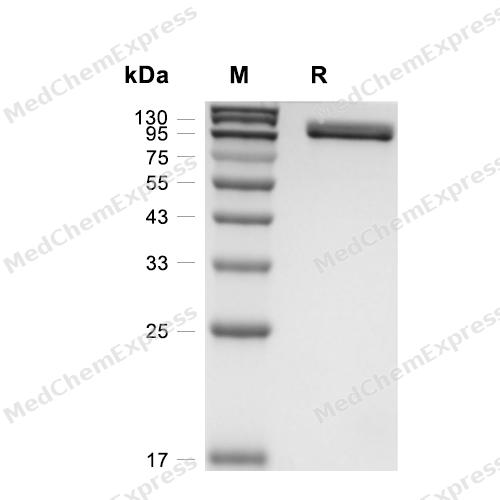
Purity - SDS-PAGE


Technical Parameters
-
Species Human
-
Source HEK293
-
Tag C-10*His
-
Accession
O94985-1 (A29-T859)
-
Molecular Construction
-
N-term
-
CLSTN1 (M1-T859)
Accession # O94985 -
His
-
C-term
-
-
Protein Length
Extracellular Domain
-
Synonyms
CLSTN1; Calsyntenin-1; Calsyntenin 1; ALC-ALPHA; KIAA0911; XB31alpha; CDHR12; Alcalpha1; CSTN1; Alcalpha2; Alzheimer-Related Cadherin-Like Protein; Alc-Alpha; Cadherin-Related Family Member 12; CST-1; Non-Classical Cadherin XB31alpha; CS1; Alcadein-Alpha
-
AA Sequence
ARVNKHKPWLEPTYHGIVTENDNTVLLDPPLIALDKDAPLRFAESFEVTVTKEGEICGFKIHGQNVPFDAVVVDKSTGEGVIRSKEKLDCELQKDYSFTIQAYDCGKGPDGTNVKKSHKATVHIQVNDVNEYAPVFKEKSYKATVIEGKQYDSILRVEAVDADCSPQFSQICSYEIITPDVPFTVDKDGYIKNTEKLNYGKEHQYKLTVTAYDCGKKRATEDVLVKISIKPTCTPGWQGWNNRIEYEPGTGALAVFPNIHLETCDEPVASVQATVELETSHIGKGCDRDTYSEKSLHRLCGAAAGTAELLPSPSGSLNWTMGLPTDNGHDSDQVFEFNGTQAVRIPDGVVSVSPKEPFTISVWMRHGPFGRKKETILCSSDKTDMNRHHYSLYVHGCRLIFLFRQDPSEEKKYRPAEFHWKLNQVCDEEWHHYVLNVEFPSVTLYVDGTSHEPFSVTEDYPLHPSKIETQLVVGACWQEFSGVENDNETEPVTVASAGGDLHMTQFFRGNLAGLTLRSGKLADKKVIDCLYTCKEGLDLQVLEDSGRGVQIQAHPSQLVLTLEGEDLGELDKAMQHISYLNSRQFPTPGIRRLKITSTIKCFNEATCISVPPVDGYVMVLQPEEPKISLSGVHHFARAASEFESSEGVFLFPELRIISTITREVEPEGDGAEDPTVQESLVSEEIVHDLDTCEVTVEGEELNHEQESLEVDMARLQQKGIEVSSSELGMTFTGVDTMASYEEVLHLLRYRNWHARSLLDRKFKLICSELNGRYISNEFKVEVNVIHTANPMEHANHMAAQPQFVHPEHRSFVDLSGHNLANPHPFAVVPST
-
Predicted Molecular Mass
93 kDa
-
Molecular Weight
Approximately 95-130 kDa,based on SDS-PAGE under reducing conditions,due to the glycosylation.
-
Glycosylation
Yes
-
Purity
≥ 95%, as determined by reducing SDS-PAGE.


Product Properties
Lyophilized powder
Lyophilized from a 0.2 μm filtered solution of PBS, pH 7.4.
<1 EU/μg, determined by LAL method.
It is not recommended to reconstitute to a concentration less than 100 μg/mL in ddH2O. For long term storage it is recommended to add a carrier protein (0.1% BSA, 5% HSA, 10% FBS or 5% Trehalose).
Stored at -20°C for 2 years from date of receipt. After reconstitution, it is stable at 4°C for 1 week or -20°C for longer (with carrier protein). It is recommended to freeze aliquots at -20°C or -80°C for extended storage.
Room temperature in continental US; may vary elsewhere.


Documentation
-
Data Sheet (241 KB)
-
SDS (251 KB)
- English - EN (251 KB)
- Français - FR (251 KB)
- Deutsch - DE (251 KB)
- Norwegian - NO (251 KB)
- Español - ES (251 KB)
- Swedish - SV (251 KB)
- Italian - IT (251 KB)
- Korean - KR (251 KB)
- Portuguese - PT (251 KB)
-
Handling Instructions (2659 KB)

Calculators
Concentration (start) × Volume (start) = Concentration (final) × Volume (final)


 Powered by Bioz

