



Desmin/DES Protein, Human (His)

Based on 1 Customer Validation
Desmin is a muscle-specific type III intermediate filament that is critical for muscle structural integrity. It forms myofibrils, interconnects Z-disks and strengthens muscle fibers. Desmin/DES Protein, Human (His) is the recombinant human-derived Desmin/DES protein, expressed by E. coli , with N-6*His labeled tag.
- Species: Human
- Source: E. coli
-
Storage:Stored at -20°C for 2 years from date of receipt. After reconstitution, it is stable at 4°C for 1 week or -20°C for longer (with carrier protein). It is recommended to freeze aliquots at -20°C or -80°C for extended storage.


To place orders, for customer services and technical support, please contact: MedChemExpress USA
Tel: 609-228-6898 E-mail: [email protected] [email protected]


-
 Biological Activity
-
Technical Parameters
-
Product Properties
- Documentation
- Help & FAQs




Biological Activity
Description
Desmin is a muscle-specific type III intermediate filament that is critical for muscle structural integrity. It forms myofibrils, interconnects Z-disks and strengthens muscle fibers. Desmin/DES Protein, Human (His) is the recombinant human-derived Desmin/DES protein, expressed by E. coli , with N-6*His labeled tag.
Background
Desmin, a muscle-specific type III intermediate filament, is indispensable for maintaining the structural integrity and optimal function of muscles. It plays a crucial role in forming myofibrils and interconnecting Z-disks, providing strength to muscle fibers during activity. In adult striated muscle, Desmin contributes to the fibrous network that links myofibrils to each other and to the plasma membrane at the periphery of Z-line structures. Additionally, Desmin may serve as a sarcomeric microtubule-anchoring protein by associating with detyrosinated tubulin-alpha chains, resulting in buckled microtubules and increased mechanical resistance to contraction. Beyond its structural functions, Desmin participates in the transcriptional regulation of the NKX2-5 gene during cardiomyogenesis and in cardiac side population stem cells. Moreover, it plays a role in maintaining the optimal conformation of nebulette on heart muscle sarcomeres, facilitating the binding and recruitment of cardiac alpha-actin. Desmin engages in various interactions with proteins such as DST, MTM1, EPPK1, CRYAB, NEB, NEBL, ASB2, PLEC, and PKP1, highlighting its multifaceted involvement in molecular networks essential for muscle physiology.
MCE Validation Data
-
Purity - SDS-PAGE
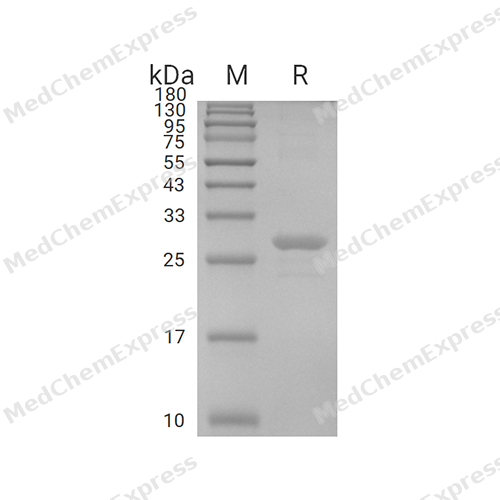
Purity - SDS-PAGE


Technical Parameters
-
Species Human
-
Source E. coli
-
Tag N-6*His
-
Accession
P17661 (V261-L470)
-
Molecular Construction
-
N-term
-
6*His
-
Desmin (V261-L470)
Accession # P17661 -
C-term
-
-
Protein Length
Partial
-
Synonyms
DES; CMD1I; Desmin; Cardiomyopathy, Dilated 1F (Autosomal Dominant); LGMD2R; Epididymis Secretory Sperm Binding Protein; CSM1; LGMD1D; CSM2; LGMD1E; Intermediate Filament Protein; CDCD3; Cardiomyopathy, Dilated 1I
-
AA Sequence
VEMDMSKPDLTAALRDIRAQYETIAAKNISEAEEWYKSKVSDLTQAANKNNDALRQAKQEMMEYRHQIQSYTCEIDALKGTNDSLMRQMRELEDRFASEASGYQDNIARLEEEIRHLKDEMARHLREYQDLLNVKMALDVEIATYRKLLEGEESRINLPIQTYSALNFRETSPEQRGSEVHTKKTVMIKTIETRDGEVVSEATQQQHEVL
-
Predicted Molecular Mass
26.7 kDa
-
Molecular Weight
Approximately 30 kDa, based on SDS-PAGE under reducing conditions.
-
Purity
≥ 90%, as determined by reducing SDS-PAGE.


Product Properties
Lyophilized powder.
Lyophilized from a 0.22 μm filtered solution of PBS, pH 7.4.
<1 EU/μg, determined by LAL method.
It is not recommended to reconstitute to a concentration less than 100 μg/mL in ddH2O. For long term storage it is recommended to add a carrier protein (0.1% BSA, 5% HSA, 10% FBS or 5% Trehalose).
Stored at -20°C for 2 years from date of receipt. After reconstitution, it is stable at 4°C for 1 week or -20°C for longer (with carrier protein). It is recommended to freeze aliquots at -20°C or -80°C for extended storage.
Room temperature in continental US; may vary elsewhere.


Documentation
-
Data Sheet (236 KB)
-
SDS (251 KB)
- English - EN (251 KB)
- Français - FR (251 KB)
- Deutsch - DE (251 KB)
- Norwegian - NO (251 KB)
- Español - ES (251 KB)
- Swedish - SV (251 KB)
- Italian - IT (251 KB)
- Korean - KR (251 KB)
- Portuguese - PT (251 KB)
-
Handling Instructions (2659 KB)

Calculators
Concentration (start) × Volume (start) = Concentration (final) × Volume (final)


 Powered by Bioz

