



DPEP2 Protein, Human (HEK293, His)

Based on 1 Customer Validation
The DPEP2 protein functions as a dipeptidase capable of hydrolyzing leukotriene D4 (LTD4) into leukotriene E4 (LTE4) and cysteinyl diglycine. In addition to its dipeptidase activity, DPEP2 serves as a modulator of macrophage inflammatory responses by acting as a modulator of the NF-kappaB inflammatory signaling pathway. DPEP2 Protein, Human (HEK293, His) is the recombinant human-derived DPEP2 protein, expressed by HEK293 , with C-His labeled tag.
- Species: Human
- Source: HEK293
-
Storage:Stored at -20°C for 2 years from date of receipt. After reconstitution, it is stable at 4°C for 1 week or -20°C for longer (with carrier protein). It is recommended to freeze aliquots at -20°C or -80°C for extended storage.


To place orders, for customer services and technical support, please contact: MedChemExpress USA
Tel: 609-228-6898 E-mail: [email protected] [email protected]


-
 Biological Activity
-
Technical Parameters
-
Product Properties
- Documentation
- Help & FAQs




Biological Activity
Description
The DPEP2 protein functions as a dipeptidase capable of hydrolyzing leukotriene D4 (LTD4) into leukotriene E4 (LTE4) and cysteinyl diglycine. In addition to its dipeptidase activity, DPEP2 serves as a modulator of macrophage inflammatory responses by acting as a modulator of the NF-kappaB inflammatory signaling pathway. DPEP2 Protein, Human (HEK293, His) is the recombinant human-derived DPEP2 protein, expressed by HEK293 , with C-His labeled tag.
Background
DPEP2 (Dipeptidase 2) is a versatile protein with dipeptidase activity, exhibiting the ability to hydrolyze leukotriene D4 (LTD4) into leukotriene E4 (LTE4), as well as cleave cystinyl-bis-glycine. Beyond its enzymatic functions, DPEP2 possesses an independent role in modulating macrophage inflammatory responses by acting as a regulator of the NF-kappaB inflammatory signaling pathway. This dual functionality suggests that DPEP2 plays a multifaceted role in cellular processes, participating both in the metabolism of bioactive lipids and in the regulation of key inflammatory pathways, showcasing its importance in immune and inflammatory responses.
Verified Bioactivity
The enzyme activity of this recombinant protein is testing in progress, we cannot offer a guarantee yet.
MCE Validation Data
-
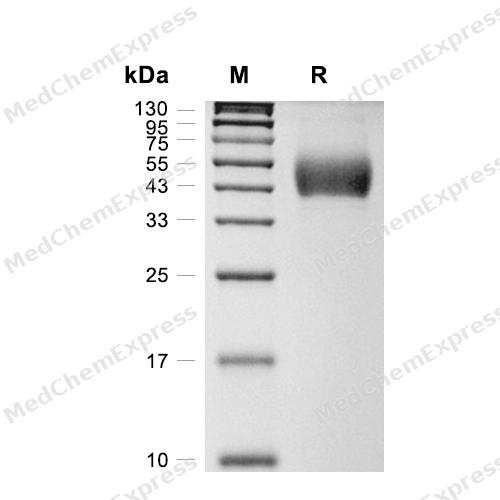
Purity - SDS-PAGE
Purity - SDS-PAGE


Technical Parameters
-
Species Human
-
Source HEK293
-
Tag C-6*His
-
Accession
Q9H4A9-2 (A33-S376)
-
Molecular Construction
-
N-term
-
DPEP2 (A33-S376)
Accession # Q9H4A9-2 -
His
-
C-term
-
-
Protein Length
Partial
-
Synonyms
DPEP2; Dipeptidase; Dipeptidase 2; MBD2
-
AA Sequence
AYTTPGPPRAQFWSAYVPCQTQDRDALRLTLEQIDLIRRMCASYSELELVTSAKALNDTQKLACLIGVEGGHSLDNSLSILRTFYMLGVRYLTLTHTCNTPWAESSAKGVHSFYNNISGLTDFGEKVVAEMNRLGMMVDLSHVSDAVARRALEVSQAPVIFSHSAARGVCNSARNVPDDILQLLKKNGGVVMVSLSMGVIQCNPSANVSTVADHFDHIKAVIGSKFIGIGGDYDGAGKFPQGLEDVSTYPVLIEELLSRGWSEEELQGVLRGNLLRVFRQVEKVQEENKWQSPLEDKFPDEQLSSSCHSDLSRLRQRQSLTSGQELTEIPIHWTAKLPAKWSVS
-
Molecular Weight
Approximately 47 kDa, based on SDS-PAGE under reducing conditions.
-
Glycosylation
Yes
-
Purity
≥ 90%, as determined by reducing SDS-PAGE.


Product Properties
Lyophilized powder.
Lyophilized from a 0.22 μm filtered solution of PBS, pH 7.4.
<1 EU/μg, determined by LAL method.
It is not recommended to reconstitute to a concentration less than 100 μg/mL in ddH2O. For long term storage it is recommended to add a carrier protein (0.1% BSA, 5% HSA, 10% FBS or 5% Trehalose).
Stored at -20°C for 2 years from date of receipt. After reconstitution, it is stable at 4°C for 1 week or -20°C for longer (with carrier protein). It is recommended to freeze aliquots at -20°C or -80°C for extended storage.
Room temperature in continental US; may vary elsewhere.


Documentation
-
Data Sheet (237 KB)
-
SDS (251 KB)
- English - EN (251 KB)
- Français - FR (251 KB)
- Deutsch - DE (251 KB)
- Norwegian - NO (251 KB)
- Español - ES (251 KB)
- Swedish - SV (251 KB)
- Italian - IT (251 KB)
- Korean - KR (251 KB)
- Portuguese - PT (251 KB)
-
Handling Instructions (2659 KB)

Calculators
Concentration (start) × Volume (start) = Concentration (final) × Volume (final)


 Powered by Bioz

