



EGR1/ZNF225 Protein, Human (His)
Based on 1 publication(s) in Google Scholar
The EGR1/ZNF225 protein is a multifunctional transcriptional regulator that binds to the EGR site in the promoter of target genes and is independent of cytosine methylation. It controls the transcription of multiple target genes, affecting responses to growth factors, DNA damage, and ischemia. EGR1/ZNF225 Protein, Human (His) is the recombinant human-derived EGR1/ZNF225 protein, expressed by E. coli , with N-6*His labeled tag.
- Species: Human
- Source: E. coli
-
Storage:Stored at -20°C for 2 years from date of receipt. After reconstitution, it is stable at 4°C for 1 week or -20°C for longer (with carrier protein). It is recommended to freeze aliquots at -20°C or -80°C for extended storage.


To place orders, for customer services and technical support, please contact: MedChemExpress USA
Tel: 609-228-6898 E-mail: [email protected] [email protected]


-
 Biological Activity
-
Technical Parameters
-
Product Properties
- Documentation
- Help & FAQs




Biological Activity
Description
The EGR1/ZNF225 protein is a multifunctional transcriptional regulator that binds to the EGR site in the promoter of target genes and is independent of cytosine methylation. It controls the transcription of multiple target genes, affecting responses to growth factors, DNA damage, and ischemia. EGR1/ZNF225 Protein, Human (His) is the recombinant human-derived EGR1/ZNF225 protein, expressed by E. coli , with N-6*His labeled tag.
Background
EGR1/ZNF225, a transcriptional regulator, exhibits a versatile role in the cell, recognizing and binding to the DNA sequence 5'-GCG(T/G)GGGCG-3' (EGR-site) within target gene promoters. Regardless of cytosine methylation status, it binds double-stranded target DNA. Functionally, EGR1/ZNF225 governs the transcription of numerous target genes, playing a crucial role in modulating responses to growth factors, DNA damage, and ischemia. It contributes to the intricate balance of cell survival, proliferation, and death, activating the expression of key regulators like p53/TP53 and TGFB1 to prevent tumor formation. Essential for mitotic progress and hepatocyte proliferation after partial hepatectomy, EGR1/ZNF225 also mediates responses to ischemia and hypoxia, influencing the expression of inflammatory proteins such as IL1B and CXCL2. Moreover, it participates in the regulation of luteinizing hormone biosynthesis in the pituitary. Additionally, EGR1/ZNF225 orchestrates the rhythmic expression of clock genes like BMAL1, PER2, and NR1D1 in the liver, impacting circadian rhythms. Its dynamic interactions with SNAI1 and SP1 under 12-O-tetradecanoylphorbol-13-acetate (TPA) induction add further complexity to its regulatory network.
Verified Bioactivity
Measured by its ability to down regulate the expression of TNF-α in THP-1 cells treated with LPS.
MCE Validation Data
-
Purity - SDS-PAGE
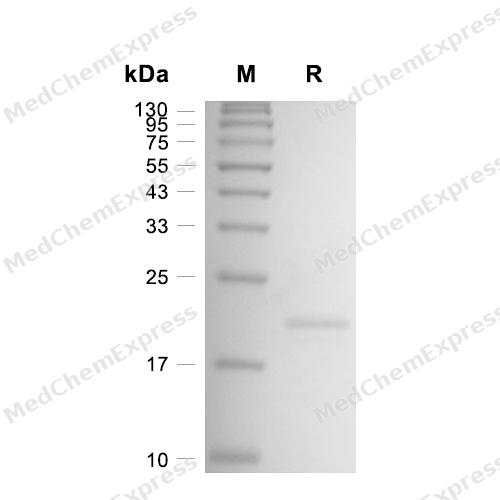
Purity - SDS-PAGE
-
Bioactivity - Cell-Based Assay
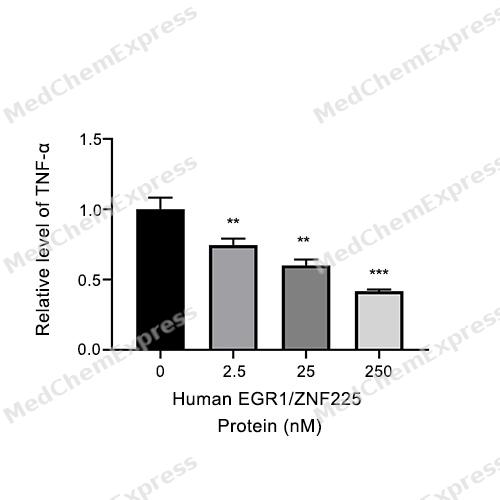
Bioactivity - Cell-Based Assay


Publications (1)
-
Journal Impact Factor
-
Most Recent


Technical Parameters
-
Species Human
-
Source E. coli
-
Tag N-6*His
-
Accession
P18146 (Q282-S433)
-
Molecular Construction
-
N-term
-
6*His
-
EGR1 (Q282-S433)
Accession # P18146 -
C-term
-
-
Protein Length
Partial
-
Synonyms
EGR1; TIS8; Early Growth Response 1; Transcription Factor Zif268; NGFI-A; Zinc Finger Protein Krox-24; AT225; Zinc Finger Protein 225; Nerve Growth Factor-Induced Protein A; Zinc Finger Gene 225; Early Growth Response Protein 1; ZNF225; Transcription Fact
-
AA Sequence
QQPSLTPLSTIKAFATQSGSQDLKALNTSYQSQLIKPSRMRKYPNRPSKTPPHERPYACPVESCDRRFSRSDELTRHIRIHTGQKPFQCRICMRNFSRSDHLTTHIRTHTGEKPFACDICGRKFARSDERKRHTKIHLRQKDKKADKSVVAS
-
Molecular Weight
Approximately 19 kDa, based on SDS-PAGE under reducing conditions.
-
Purity
≥ 95%, as determined by reducing SDS-PAGE.


Product Properties
Lyophilized powder
1.Lyophilized from a 0.22 μm filtered solution of 20 mM PB, 150 mM NaCl, pH 7.4.
2.Lyophilized from a 0.22 μm filtered solution of PBS, pH 7.4, 8% trehalose.
Please refer to the lot-specific COA for specific buffer information.
<1 EU/μg, determined by LAL method.
It is not recommended to reconstitute to a concentration less than 100 μg/mL in ddH2O. For long term storage it is recommended to add a carrier protein (0.1% BSA, 5% HSA, 10% FBS or 5% Trehalose).
Stored at -20°C for 2 years from date of receipt. After reconstitution, it is stable at 4°C for 1 week or -20°C for longer (with carrier protein). It is recommended to freeze aliquots at -20°C or -80°C for extended storage.
Room temperature in continental US; may vary elsewhere.


Documentation
-
Data Sheet (237 KB)
-
SDS (252 KB)
- English - EN (252 KB)
- Français - FR (252 KB)
- Deutsch - DE (252 KB)
- Norwegian - NO (252 KB)
- Español - ES (252 KB)
- Swedish - SV (252 KB)
- Italian - IT (252 KB)
- Korean - KR (252 KB)
- Portuguese - PT (252 KB)
-
Handling Instructions (2659 KB)

Calculators
Concentration (start) × Volume (start) = Concentration (final) × Volume (final)


 Powered by Bioz

