



FGF-23 Protein, Mouse (R179Q, HEK293, His)
Based on 1 Customer Validation
FGF-23 protein is a key regulator that maintains phosphate homeostasis by inhibiting tubular phosphate transport and reducing SLC34A1 levels. It directly inhibits PTH secretion, regulates vitamin D metabolism, and negatively affects osteoblast differentiation and matrix mineralization. FGF-23 Protein, Mouse (R179Q, HEK293, His) is the recombinant mouse-derived FGF-23 protein, expressed by HEK293 , with C-6*His labeled tag and R179Q mutation.
- Species: Mouse
- Source: HEK293
-
Storage:Stored at -20°C for 2 years from date of receipt. After reconstitution, it is stable at 4°C for 1 week or -20°C for longer (with carrier protein). It is recommended to freeze aliquots at -20°C or -80°C for extended storage.


To place orders, for customer services and technical support, please contact: MedChemExpress USA
Tel: 609-228-6898 E-mail: [email protected] [email protected]


-
 Biological Activity
-
Technical Parameters
-
Product Properties
- Documentation
- Help & FAQs




Biological Activity
Description
FGF-23 protein is a key regulator that maintains phosphate homeostasis by inhibiting tubular phosphate transport and reducing SLC34A1 levels. It directly inhibits PTH secretion, regulates vitamin D metabolism, and negatively affects osteoblast differentiation and matrix mineralization. FGF-23 Protein, Mouse (R179Q, HEK293, His) is the recombinant mouse-derived FGF-23 protein, expressed by HEK293 , with C-6*His labeled tag and R179Q mutation.
Background
FGF-23 protein serves as a key regulator in maintaining phosphate homeostasis by inhibiting renal tubular phosphate transport, primarily through the reduction of SLC34A1 levels. Additionally, it acts directly on the parathyroid to suppress PTH secretion and plays a pivotal role in vitamin-D metabolism regulation. FGF-23 serves as a negative regulator of osteoblast differentiation and matrix mineralization. Furthermore, it exhibits the ability to up-regulate EGR1 expression in the presence of KL and interacts with various fibroblast growth factor receptors (FGFRs), including FGFR1, FGFR2, FGFR3, and FGFR4. The interaction between FGF-23 and FGFRs is facilitated by KL and heparan sulfate glycosaminoglycans, acting as coreceptors.
Verified Bioactivity
Determined by its ability to stimulate the proliferation of murine NIH-3T3 cells. The ED50 for this effect is 0.2-0.5 μg/mL in the presence of 1 μg/mL murine Klotho and 100 μg/mL heparin.
MCE Validation Data
-
Purity - SDS-PAGE
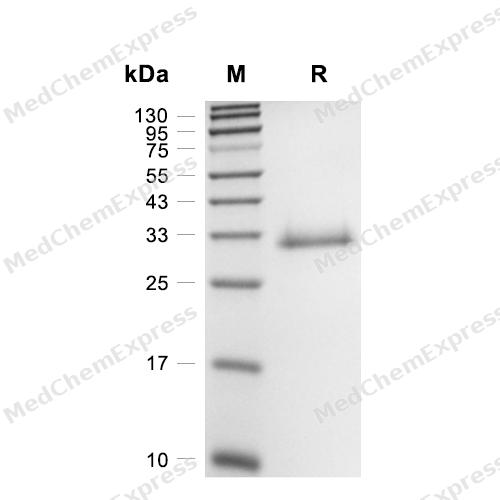
Purity - SDS-PAGE
-
Bioactivity - Cell-Based Assay
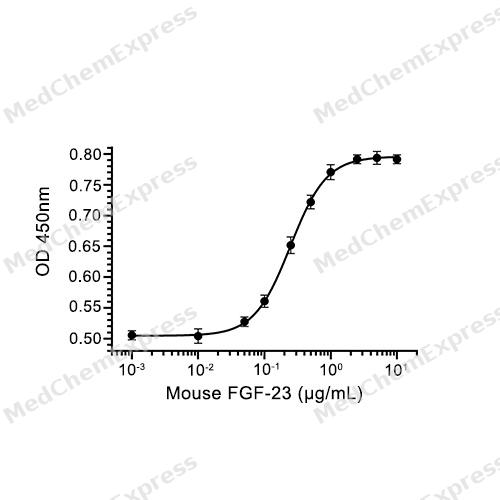
Bioactivity - Cell-Based Assay


Technical Parameters
-
Species Mouse
-
Source HEK293
-
Tag C-6*His
-
Accession
Q9EPC2 (Y25-V251, R179Q)
-
Gene ID64654
-
Molecular Construction
-
N-term
-
FGF-23 (Y25-V251, R179Q)
Accession # Q9EPC2 -
6*His
-
C-term
-
-
Protein Length
Full Length of Mature Protein
-
Synonyms
FGF23; FGF-23; Fibroblast Growth Factor 23; HFTC2; Phosphatonin; HPDR2; HYPF; PHPTC; Tumor-Derived Hypophosphatemia Inducing Factor; ADHR; Tumor-Derived Hypophosphatemia-Inducing Factor; FGFN
-
AA Sequence
YPDTSPLLGSNWGSLTHLYTATARTSYHLQIHRDGHVDGTPHQTIYSALMITSEDAGSVVITGAMTRRFLCMDLHGNIFGSLHFSPENCKFRQWTLENGYDVYLSQKHHYLVSLGRAKRIFQPGTNPPPFSQFLARRNEVPLLHFYTVRPRRHTQSAEDPPERDPLNVLKPRPRATPVPVSCSRELPSAEEGGPAASDPLGVLRRGRGDARGGAGGADRCRPFPRFV
-
Predicted Molecular Mass
25.3 kDa
-
Molecular Weight
Approximately 30-32 kDa, based on SDS-PAGE under reducing conditions, due to the glycosylation.
-
Glycosylation
Yes
-
Purity
≥ 95%, as determined by reducing SDS-PAGE.


Product Properties
Lyophilized powder.
Lyophilized from a 0.22 μm filtered solution of 20 mM MOPS, 150 mM NaCl, pH 7.4, 1 mM EDTA, 1 mM DTT, 8% trehalose.
<0.1 EU/μg, determined by LAL method.
It is not recommended to reconstitute to a concentration less than 100 μg/mL in PBS.
Stored at -20°C for 2 years from date of receipt. After reconstitution, it is stable at 4°C for 1 week or -20°C for longer (with carrier protein). It is recommended to freeze aliquots at -20°C or -80°C for extended storage.
Room temperature in continental US; may vary elsewhere.


Documentation
-
Data Sheet (237 KB)
-
SDS (252 KB)
- English - EN (252 KB)
- Français - FR (252 KB)
- Deutsch - DE (252 KB)
- Norwegian - NO (252 KB)
- Español - ES (252 KB)
- Swedish - SV (252 KB)
- Italian - IT (252 KB)
- Korean - KR (252 KB)
- Portuguese - PT (252 KB)
-
Handling Instructions (2659 KB)

Calculators
Concentration (start) × Volume (start) = Concentration (final) × Volume (final)


 Powered by Bioz

