



FHIT Protein, Human (His)

Based on 1 Customer Validation
FHIT protein has multiple enzymatic activities, including dinucleoside triphosphohydrolase, adenylate sulfatase and adenosine 5'-monophosphate amidase, and functions as a tumor suppressor. It regulates CTNNB1-mediated transcriptional activation, affecting key genes such as CCND1 and BIRC5. FHIT Protein, Human (His) is the recombinant human-derived FHIT protein, expressed by E. coli , with C-His labeled tag.
- Species: Human
- Source: E. coli
-
Storage:Stored at -20°C for 2 years from date of receipt. After reconstitution, it is stable at 4°C for 1 week or -20°C for longer (with carrier protein). It is recommended to freeze aliquots at -20°C or -80°C for extended storage.


To place orders, for customer services and technical support, please contact: MedChemExpress USA
Tel: 609-228-6898 E-mail: [email protected] [email protected]


-
 Biological Activity
-
Technical Parameters
-
Product Properties
- Documentation
- Help & FAQs




Biological Activity
Description
FHIT protein has multiple enzymatic activities, including dinucleoside triphosphohydrolase, adenylate sulfatase and adenosine 5'-monophosphate amidase, and functions as a tumor suppressor. It regulates CTNNB1-mediated transcriptional activation, affecting key genes such as CCND1 and BIRC5. FHIT Protein, Human (His) is the recombinant human-derived FHIT protein, expressed by E. coli , with C-His labeled tag.
Background
FHIT protein exhibits dinucleoside triphosphate hydrolase activity, specifically cleaving P(1)-P(3)-bis(5'-adenosyl) triphosphate (Ap3A) to generate AMP and ADP. Additionally, it displays adenylylsulfatase activity, hydrolyzing adenosine 5'-phosphosulfate into AMP and sulfate, as well as adenosine 5'-monophosphoramidase activity, breaking down purine nucleotide phosphoramidates like adenosine 5'-monophosphoramidate (AMP-NH2) to produce AMP and NH2. Acting as a tumor suppressor, FHIT plays a role in modulating transcriptional activation by CTNNB1, influencing the expression of critical genes related to cell proliferation and survival, such as CCND1 and BIRC5. Furthermore, FHIT participates in apoptosis induction through SRC and AKT1 signaling pathways, inhibits MDM2-mediated proteasomal degradation of p53/TP53, and contributes to p53/TP53-mediated apoptosis. The apoptotic effect may involve FHIT's ability to bind Ap3A or related compounds, and it can also be attributed, in part, to its mitochondrial form, which enhances mitochondrial calcium uptake and sensitizes low-affinity Ca(2+) transporters.
Verified Bioactivity
Measured by its ability to inhibit the proliferation of A549 cells. The ED50 for this effect is 0.1098 ng/mL, corresponding to a specific activity is 9.107×10⁶ units/mg.
MCE Validation Data
-
Purity - SDS-PAGE
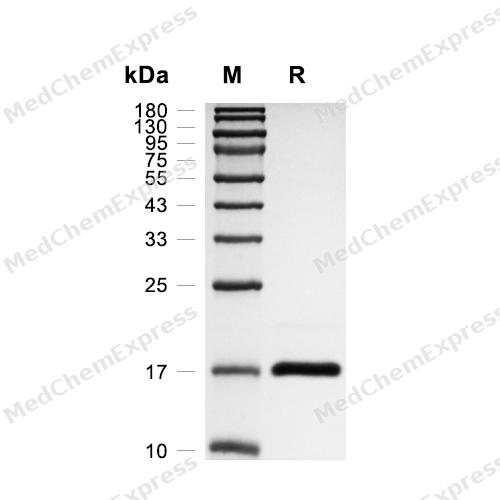
Purity - SDS-PAGE
-
Bioactivity - Cell-Based Assay
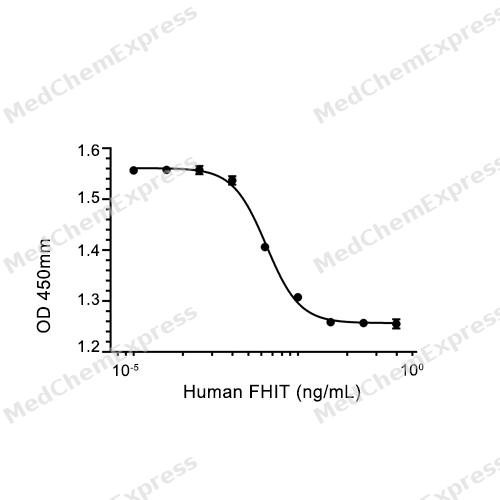
Bioactivity - Cell-Based Assay


Technical Parameters
-
Species Human
-
Source E. coli
-
Tag C-6*His
-
Accession
P49789 (M1-Q147)
-
Molecular Construction
-
N-term
-
FHIT (M1-Q147)
Accession # P49789 -
His
-
C-term
-
-
Protein Length
Full Length
-
Synonyms
FHIT; AP3A Hydrolase; Fragile Histidine Triad Diadenosine Triphosphatase; FRA3B; Bis(5'-Adenosyl)-Triphosphatase; Fragile Histidine Triad Protein; AP3Aase; Fragile Histidine Triad; Diadenosine 5',5'''-P1,P3-Triphosphate Hydrolase; Truncated Diadenosine Tr
-
AA Sequence
MSFRFGQHLIKPSVVFLKTELSFALVNRKPVVPGHVLVCPLRPVERFHDLRPDEVADLFQTTQRVGTVVEKHFHGTSLTFSMQDGPEAGQTVKHVHVHVLPRKAGDFHRNDSIYEELQKHDKEDFPASWRSEEEMAAEAAALRVYFQ
-
Molecular Weight
Approximately 18 kDa, based on SDS-PAGE under reducing conditions.
-
Purity
≥ 95%, as determined by reducing SDS-PAGE.


Product Properties
Lyophilized powder.
Lyophilized from a 0.22 μm filtered solution of 50 mM Tris-HCl, 300 mM NaCl, pH 8.0, 10% glycerol.
Note: For SPR assay, please replace the buffer. Primary amine components (e.g., Tris, imidazole) can affect protein-coupled chips.
<1 EU/μg, determined by LAL method.
It is not recommended to reconstitute to a concentration less than 100 μg/mL in ddH2O. For long term storage it is recommended to add a carrier protein (0.1% BSA, 5% HSA, 10% FBS or 5% Trehalose).
Stored at -20°C for 2 years from date of receipt. After reconstitution, it is stable at 4°C for 1 week or -20°C for longer (with carrier protein). It is recommended to freeze aliquots at -20°C or -80°C for extended storage.
Shipping with dry ice.


Documentation
-
Data Sheet (236 KB)
-
SDS (251 KB)
- English - EN (251 KB)
- Français - FR (251 KB)
- Deutsch - DE (251 KB)
- Norwegian - NO (251 KB)
- Español - ES (251 KB)
- Swedish - SV (251 KB)
- Italian - IT (251 KB)
- Korean - KR (251 KB)
- Portuguese - PT (251 KB)
-
Handling Instructions (2659 KB)

Calculators
Concentration (start) × Volume (start) = Concentration (final) × Volume (final)


 Powered by Bioz

