



Galectin-8/LGALS8 Protein, Rat (His)

Based on 1 Customer Validation
Galectin-8 belongs to the family of animal lectins that bind to different glycoconjugates. Galectin-8 inhibits MTOR and AMPK signaling pathways to induce autophagy in response to lysosomal damage. Galectin-8 is highly expressed in a variety of tumors. Galectin-8 Protein, Rat (His) is the recombinant rat-derived Galectin-8, expressed by E. coli, with N-6*His labeled tag. The total length of Galectin-8 Protein, Rat (His) is 316 a.a..
- Species: Rat
- Source: E. coli
-
Storage:Stored at -20°C for 2 years from date of receipt. After reconstitution, it is stable at 4°C for 1 week or -20°C for longer (with carrier protein). It is recommended to freeze aliquots at -20°C or -80°C for extended storage.


To place orders, for customer services and technical support, please contact: MedChemExpress USA
Tel: 609-228-6898 E-mail: [email protected] [email protected]


-
 Biological Activity
-
Technical Parameters
-
Product Properties
- Documentation
- References
- Help & FAQs




Biological Activity
Description
Galectin-8 belongs to the family of animal lectins that bind to different glycoconjugates. Galectin-8 inhibits MTOR and AMPK signaling pathways to induce autophagy in response to lysosomal damage. Galectin-8 is highly expressed in a variety of tumors. Galectin-8 Protein, Rat (His) is the recombinant rat-derived Galectin-8, expressed by E. coli, with N-6*His labeled tag. The total length of Galectin-8 Protein, Rat (His) is 316 a.a..
Background
Galectin-8 belongs to the family of animal lectins that bind to different glycoconjugates. As a secreted protein, Galectin-8 is found in body fluids or the serum of patients with breast cancer and those with colon cancer. Extracellular Galectin-8 promotes cell adhesion by binding to cell adhesion molecules such as integrins CD44, CD166 and Podoplanin. Galectin-8 performs its intracellular function by marking the vacuoles invaded by pathogens to be destroyed by autophagy. Galectin-8 inhibited MTOR and AMPK in response to lysosomal injury induced autophagy in membrane disturbances. Galectin-8 is highly expressed in a variety of tumors[1][2][3].
Verified Bioactivity
Measured by its binding ability in a functional ELISA. Immobilized SLC31A1 at 5 μg/mL (100 μL/well) can bind Rat Galectin-8. The ED50 for this effect is 3.773 μg/mL.
MCE Validation Data
-
Purity - SDS-PAGE
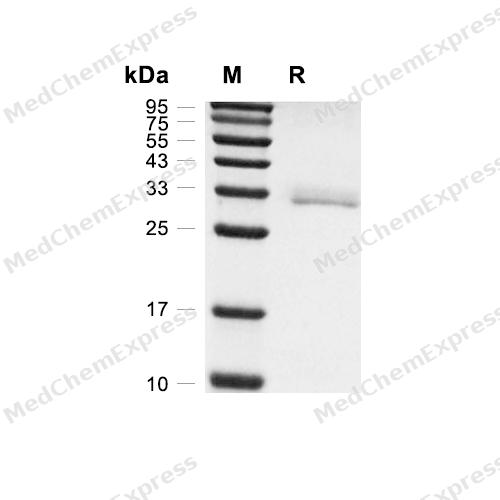
Purity - SDS-PAGE
-
Bioactivity - ELISA
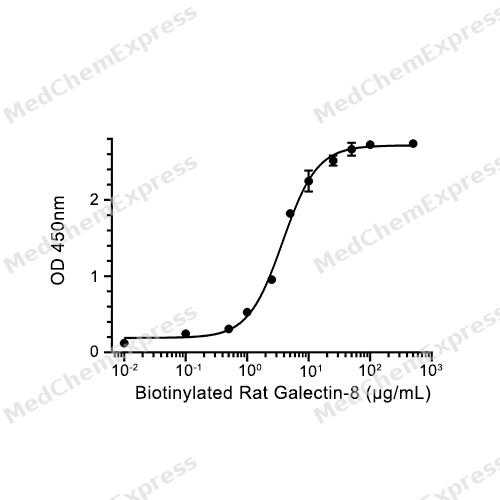
Bioactivity - ELISA


Technical Parameters
-
Species Rat
-
Source E. coli
-
Tag N-6*His
-
Accession
Q6IN24 (M1-W316)
-
Gene ID116641
-
Protein Length
Full Length
-
Synonyms
LGALS8; Galectin-8; Galectin 8; Po66-CBP; PCTA-1; Gal-8; Lectin, Galactoside-Binding, Soluble, 8; Po66 Carbohydrate Binding Protein; Prostate Carcinoma Tumor Antigen 1; Alternative Protein LGALS8; Po66 Carbohydrate-Binding Protein; Galectin; Galectin-8g;
-
AA Sequence
MLSLSNLQNIIYNPTIPYVSTITEQLKPGSLIVIRGHVPKDSERFQVDFQHGNSLKPRADVAFHFNPRFKRSNCIVCNTLTNEKWGWEEITHDMPFRKEKSFEIVIMVLKNKFQVAVNGKHILLYAHRINPEKIDTLGIYGKVNIHSIGFRFSSDLQSMETSTLGLTQISKENIQKSGKLHLSLPFEARLNASMGPGRTVVVKGEVNTNAKSFNVDLVAGRSRDIALHLNPRLNVKAFVRNSFLQDAWGEEERNITCFPFSSGMYFEMIIYCDVREFKVAVNGVHSLEYKHRFKDLSSIDTLAVDGDIRLLDVRSW
-
Predicted Molecular Mass
36.1 kDa
-
Molecular Weight
Approximately 34 kDa, based on SDS-PAGE under reducing conditions.
-
Purity
≥ 95%, as determined by reducing SDS-PAGE.


Product Properties
Lyophilized powder.
Lyophilized from a 0.22 μm filtered solution of PBS, pH 7.4, 10% glycerol.
<1 EU/μg, determined by LAL method.
It is not recommended to reconstitute to a concentration less than 100 μg/mL in ddH2O. For long term storage it is recommended to add a carrier protein (0.1% BSA, 5% HSA, 10% FBS or 5% Trehalose).
Stored at -20°C for 2 years from date of receipt. After reconstitution, it is stable at 4°C for 1 week or -20°C for longer (with carrier protein). It is recommended to freeze aliquots at -20°C or -80°C for extended storage.
Room temperature in continental US; may vary elsewhere.


Documentation
-
Data Sheet (264 KB)
-
SDS (251 KB)
- English - EN (251 KB)
- Français - FR (251 KB)
- Deutsch - DE (251 KB)
- Norwegian - NO (251 KB)
- Español - ES (251 KB)
- Swedish - SV (251 KB)
- Italian - IT (251 KB)
- Korean - KR (251 KB)
- Portuguese - PT (251 KB)
-
Handling Instructions (2659 KB)


References
[1]. Zick Y. Galectin-8, cytokines, and the storm. Biochem Soc Trans. 2022 Feb 28;50(1):135-149. [Content Brief]
[2]. Storti P, et al. Role of Galectins in Multiple Myeloma. Int J Mol Sci. 2017 Dec 17;18(12):2740. [Content Brief]
[3]. Jia J, et al. Galectins control MTOR and AMPK in response to lysosomal damage to induce autophagy. Autophagy. 2019 Jan;15(1):169-171. [Content Brief]

Calculators
Concentration (start) × Volume (start) = Concentration (final) × Volume (final)


 Powered by Bioz

