



GALNT10 Protein, Human (HEK293, His)

Based on 1 Customer Validation
GALNT10 protein assumes a crucial role in the initiation of O-linked oligosaccharide biosynthesis, facilitating the transfer of an N-acetyl-D-galactosamine residue to specific serine or threonine residues on protein receptors. With its catalytic activity, GALNT10 demonstrates specificity towards substrates such as Muc5Ac and EA2 peptides, contributing to the intricate process of protein glycosylation and subsequent cellular functions. GALNT10 Protein, Human (HEK293, His) is the recombinant human-derived GALNT10 protein, expressed by HEK293 , with N-His labeled tag.
- Species: Human
- Source: HEK293
-
Storage:Stored at -20°C for 2 years from date of receipt. After reconstitution, it is stable at 4°C for 1 week or -20°C for longer (with carrier protein). It is recommended to freeze aliquots at -20°C or -80°C for extended storage.


To place orders, for customer services and technical support, please contact: MedChemExpress USA
Tel: 609-228-6898 E-mail: [email protected] [email protected]


-
 Biological Activity
-
Technical Parameters
-
Product Properties
- Documentation
- Help & FAQs




Biological Activity
Description
GALNT10 protein assumes a crucial role in the initiation of O-linked oligosaccharide biosynthesis, facilitating the transfer of an N-acetyl-D-galactosamine residue to specific serine or threonine residues on protein receptors. With its catalytic activity, GALNT10 demonstrates specificity towards substrates such as Muc5Ac and EA2 peptides, contributing to the intricate process of protein glycosylation and subsequent cellular functions. GALNT10 Protein, Human (HEK293, His) is the recombinant human-derived GALNT10 protein, expressed by HEK293 , with N-His labeled tag.
Background
GALNT10, a member of the GALNT (N-acetylgalactosaminyltransferase) family, serves a pivotal role in the initiation of O-linked oligosaccharide biosynthesis. This enzyme catalyzes the transfer of an N-acetyl-D-galactosamine (GalNAc) residue to a serine or threonine residue on the protein receptor, marking the initial step in the glycosylation of proteins. GALNT10 exhibits its glycosyltransferase activity towards specific substrates such as Muc5Ac and EA2 peptide. Through this process, GALNT10 contributes to the diversification and modification of proteins by adding sugar moieties, thereby impacting various cellular functions and processes. The enzyme's specificity for certain substrates underscores its role in regulating glycosylation patterns in biological systems.
Verified Bioactivity
Measured by its ability to transfer GalNAc from UDP-GalNAc to peptide MUC5AC-3/13 that incubate at 37°C for 20 min. The specific activity is 688.65 pmol/min/μg.
MCE Validation Data
-
Purity - SDS-PAGE
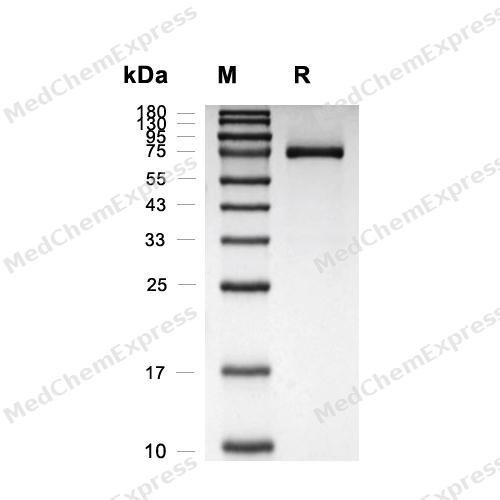
Purity - SDS-PAGE


Technical Parameters
-
Species Human
-
Source HEK293
-
Tag N-10*His
-
Accession
Q86SR1-1/NP_938080.1 (T39-N603)
-
Molecular Construction
-
N-term
-
His
-
GALNT10 (T39-N603)
Accession # Q86SR1-1/NP_938080.1 -
C-term
-
-
Protein Length
Partial
-
Synonyms
GALNT10; Polypeptide N-Acetylgalactosaminyltransferase; Polypeptide N-Acetylgalactosaminyltransferase 10; GalNAc Transferase 10; GalNAc-T10; Pp-GaNTase 10; UDP-N-Acetyl-Alpha-D-Galactosamine:Polypeptide N-Acetylgalactosaminyltransferase 10 (GalNAc-T10); P
-
AA Sequence
TPGGSGAAVAPAAGQGSHSRQKKTFFLGDGQKLKDWHDKEAIRRDAQRVGNGEQGRPYPMTDAERVDQAYRENGFNIYVSDKISLNRSLPDIRHPNCNSKRYLETLPNTSIIIPFHNEGWSSLLRTVHSVLNRSPPELVAEIVLVDDFSDREHLKKPLEDYMALFPSVRILRTKKREGLIRTRMLGASVATGDVITFLDSHCEANVNWLPPLLDRIARNRKTIVCPMIDVIDHDDFRYETQAGDAMRGAFDWEMYYKRIPIPPELQKADPSDPFESPVMAGGLFAVDRKWFWELGGYDPGLEIWGGEQYEISFKVWMCGGRMEDIPCSRVGHIYRKYVPYKVPAGVSLARNLKRVAEVWMDEYAEYIYQRRPEYRHLSAGDVAVQKKLRSSLNCKSFKWFMTKIAWDLPKFYPPVEPPAAAWGEIRNVGTGLCADTKHGALGSPLRLEGCVRGRGEAAWNNMQVFTFTWREDIRPGDPQHTKKFCFDAISHTSPVTLYDCHSMKGNQLWKYRKDKTLYHPVSGSCMDCSESDHRIFMNTCNPSSLTQQWLFEHTNSTVLEKFNRN
-
Molecular Weight
Approximately 64 kDa, based on SDS-PAGE under reducing conditions, due to the glycosylation.
-
Glycosylation
Yes
-
Purity
≥ 95%, as determined by reducing SDS-PAGE.


Product Properties
Lyophilized powder.
Lyophilized from a 0.22 μm filtered solution of PBS, pH 7.4.
<1 EU/μg, determined by LAL method.
It is not recommended to reconstitute to a concentration less than 100 μg/mL in ddH2O. For long term storage it is recommended to add a carrier protein (0.1% BSA, 5% HSA, 10% FBS or 5% Trehalose).
Stored at -20°C for 2 years from date of receipt. After reconstitution, it is stable at 4°C for 1 week or -20°C for longer (with carrier protein). It is recommended to freeze aliquots at -20°C or -80°C for extended storage.
Room temperature in continental US; may vary elsewhere.


Documentation
-
Data Sheet (239 KB)
-
SDS (251 KB)
- English - EN (251 KB)
- Français - FR (251 KB)
- Deutsch - DE (251 KB)
- Norwegian - NO (251 KB)
- Español - ES (251 KB)
- Swedish - SV (251 KB)
- Italian - IT (251 KB)
- Korean - KR (251 KB)
- Portuguese - PT (251 KB)
-
Handling Instructions (2659 KB)

Calculators
Concentration (start) × Volume (start) = Concentration (final) × Volume (final)


 Powered by Bioz

