



Granzyme H/GZMH Protein, Human (HEK293, His)

Based on 1 Customer Validation
The Granzyme H/GZMH protein, encoded by this gene, belongs to the peptidase S1 family. It is expressed in NK cells and plays a role in the cytotoxic arm of the innate immune response. It induces target cell death and cleaves substrates in infected cells. It is located on chromosome 14 and is broadly expressed, including in the spleen, bone marrow, and 21 other tissues. Granzyme H/GZMH Protein, Human (HEK293, His) is the recombinant human-derived Granzyme H/GZMH, expressed by HEK293, with C-His labeled tag. The total length of Granzyme H/GZMH Protein, Human (HEK293, His) is 228 a.a..
- Species: Human
- Source: HEK293
-
Storage:Stored at -20°C for 2 years from date of receipt. After reconstitution, it is stable at 4°C for 1 week or -20°C for longer (with carrier protein). It is recommended to freeze aliquots at -20°C or -80°C for extended storage.


To place orders, for customer services and technical support, please contact: MedChemExpress USA
Tel: 609-228-6898 E-mail: [email protected] [email protected]


-
 Biological Activity
-
Technical Parameters
-
Product Properties
- Documentation
- Help & FAQs




Biological Activity
Description
The Granzyme H/GZMH protein, encoded by this gene, belongs to the peptidase S1 family. It is expressed in NK cells and plays a role in the cytotoxic arm of the innate immune response. It induces target cell death and cleaves substrates in infected cells. It is located on chromosome 14 and is broadly expressed, including in the spleen, bone marrow, and 21 other tissues. Granzyme H/GZMH Protein, Human (HEK293, His) is the recombinant human-derived Granzyme H/GZMH, expressed by HEK293, with C-His labeled tag. The total length of Granzyme H/GZMH Protein, Human (HEK293, His) is 228 a.a..
Background
The Granzyme H/GZMH protein, a member of the peptidase S1 family of serine proteases, is encoded by this gene. Through alternative splicing, multiple transcript variants are produced, with at least one encoding a preproprotein that undergoes proteolytic processing to generate a chymotrypsin-like protease. Constitutively expressed in NK (natural killer) cells of the immune system, this protein is believed to have a role in the innate immune response's cytotoxic arm. It induces target cell death and directly cleaves substrates in pathogen-infected cells. This gene is located in a gene cluster on chromosome 14, alongside another member of the granzyme subfamily. The Granzyme H/GZMH protein exhibits broad expression, with notable levels found in tissues such as the spleen, bone marrow, and 21 other tissues.
Verified Bioactivity
Measured by its ability to cleave a peptide substrate, 100 µM Suc-FLF-SBzl, in the presence of 5,5’-Dithio-bis (2-nitrobenzoic acid) (DTNB). that incubate at room temperaturein kinetic mode for 5 minutes.The specific activity is >5,000 pmol/min/µg. (Activation description: The proenzyme needs to be activated by Mouse Cathepsin C (HY-P704018) for an activated form.)
MCE Validation Data
-
Purity - SDS-PAGE
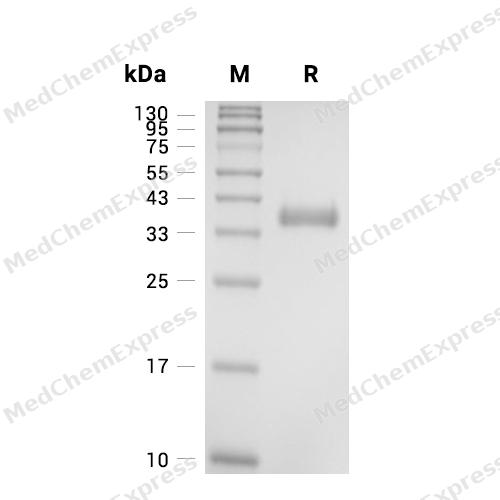
Purity - SDS-PAGE


Technical Parameters
-
Species Human
-
Source HEK293
-
Tag C-6*His
-
Accession
NP_219491.1 (E19-L246)
-
Molecular Construction
-
N-term
-
GZMH (E19-L246)
Accession # NP_219491.1 -
6*His
-
C-term
-
-
Protein Length
Full Length of Mature Protein
-
Synonyms
GZMH; Cytotoxic T-Lymphocyte Proteinase; Prev. CTSGL2; Granzyme H (Cathepsin G-Like 2, Protein H-CCPX); CCP-X; Cytotoxin Serine Protease-C; CSP-C; Cytotoxic Serine Protease C; CGL-2; Cathepsin G-Like 2; CTLA1; CGL2; Cathepsin G-Like 2, Protein H-CCPX; Gra
-
AA Sequence
EEIIGGHEAKPHSRPYMAFVQFLQEKSRKRCGGILVRKDFVLTAAHCQGSSINVTLGAHNIKEQERTQQFIPVKRPIPHPAYNPKNFSNDIMLLQLERKAKWTTAVRPLRLPSSKAQVKPGQLCSVAGWGYVSMSTLATTLQEVLLTVQKDCQCERLFHGNYSRATEICVGDPKKTQTGFKGDSGGPLVCKDVAQGILSYGNKKGTPPGVYIKVSHFLPWIKRTMKRL
-
Predicted Molecular Mass
26.3 kDa
-
Molecular Weight
Approximately 35-40 kDa, based on SDS-PAGE under reducing conditions, due to the glycosylation.
-
Purity
≥ 95%, as determined by reducing SDS-PAGE.


Product Properties
Lyophilized powder.
Lyophilized from a 0.22 μm filtered solution of 50 mM HEPES, 150 mM NaCl, pH 8.0, 0.1% Brij-35.
<1 EU/μg, determined by LAL method.
It is not recommended to reconstitute to a concentration less than 100 μg/mL in ddH2O. For long term storage it is recommended to add a carrier protein (0.1% BSA, 5% HSA, 10% FBS or 5% Trehalose).
Stored at -20°C for 2 years from date of receipt. After reconstitution, it is stable at 4°C for 1 week or -20°C for longer (with carrier protein). It is recommended to freeze aliquots at -20°C or -80°C for extended storage.
Room temperature in continental US; may vary elsewhere.


Documentation
-
Data Sheet (237 KB)
-
SDS (252 KB)
- English - EN (252 KB)
- Français - FR (252 KB)
- Deutsch - DE (252 KB)
- Norwegian - NO (252 KB)
- Español - ES (252 KB)
- Swedish - SV (252 KB)
- Italian - IT (252 KB)
- Korean - KR (252 KB)
- Portuguese - PT (252 KB)
-
Handling Instructions (2659 KB)

Calculators
Concentration (start) × Volume (start) = Concentration (final) × Volume (final)


 Powered by Bioz

