



GSTP1 Protein, Human (His, solution)

Based on 1 Customer Validation
The GSTP1 protein is critical for binding reduced glutathione to a variety of hydrophobic electrophiles, actively forming glutathione conjugates of PGA2 and PGJ2. Documented studies highlight its involvement in hepoxilin regioisomer synthesis, emphasizing the versatility of GSTP1 in processing substrates. GSTP1 Protein, Human (His) is the recombinant human-derived GSTP1 protein, expressed by E. coli , with N-10*His labeled tag.
- Species: Human
- Source: E. coli
-
Storage:Stored at -80°C for 1 year from date of receipt. It is stable at -20°C for 3 months after opening. It is recommended to freeze aliquots at -80°C for extended storage. Avoid repeated freeze-thaw cycles.


To place orders, for customer services and technical support, please contact: MedChemExpress USA
Tel: 609-228-6898 E-mail: [email protected] [email protected]


-
 Biological Activity
-
Technical Parameters
-
Product Properties
- Documentation
- Help & FAQs




Biological Activity
Description
The GSTP1 protein is critical for binding reduced glutathione to a variety of hydrophobic electrophiles, actively forming glutathione conjugates of PGA2 and PGJ2. Documented studies highlight its involvement in hepoxilin regioisomer synthesis, emphasizing the versatility of GSTP1 in processing substrates. GSTP1 Protein, Human (His) is the recombinant human-derived GSTP1 protein, expressed by E. coli , with N-10*His labeled tag.
Background
The GSTP1 protein plays a crucial role in the cellular process of conjugating reduced glutathione to a diverse range of exogenous and endogenous hydrophobic electrophiles. Specifically, GSTP1 is actively involved in the formation of glutathione conjugates for prostaglandin A2 (PGA2) and prostaglandin J2 (PGJ2), as documented in studies. Furthermore, GSTP1 participates in the synthesis of novel hepoxilin regioisomers, underscoring its versatility in handling various substrates. Beyond its role in detoxification, GSTP1 negatively regulates CDK5 activity by facilitating the translocation of p25/p35, serving as a crucial mechanism to prevent neurodegeneration.
Verified Bioactivity
Measured by the conjugation of reduced glutathione to 1-bromo-2, 4-dinitrobenzene that incubate at room temperature in kinetic mode for 5 minutes. The specific activity is >20000 pmol/min/μg.
MCE Validation Data
-
Purity - SDS-PAGE
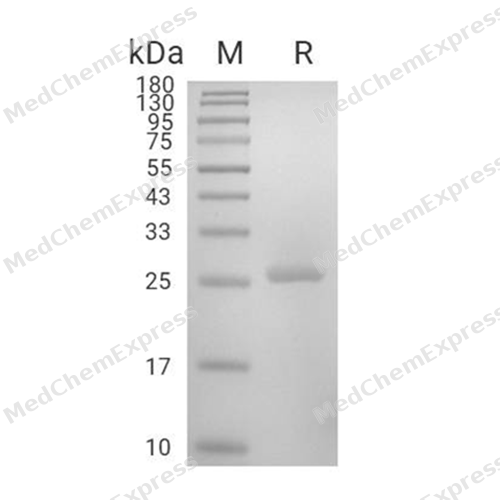
Purity - SDS-PAGE


Technical Parameters
-
Species Human
-
Source E. coli
-
Tag N-10*His
-
Accession
P09211 (P2-Q210)
-
Gene ID2950
-
Molecular Construction
-
N-term
-
10*His
-
GSTP1 (P2-Q210)
Accession # P09211 -
C-term
-
-
Protein Length
Full Length
-
Synonyms
GSTP1; Epididymis Secretory Protein Li 22; Prev. FAEES3; Glutathione Transferase; Prev. GST3; Deafness, X-Linked 7; Glutathione S-Transferase P; Mutant GSTP1; GST Class-Pi; HEL-S-22; GSTP; DFN7; GSTP1-1; PI; Fatty Acid Ethyl Ester Synthase III; Glutathion
-
AA Sequence
PPYTVVYFPVRGRCAALRMLLADQGQSWKEEVVTVETWQEGSLKASCLYGQLPKFQDGDLTLYQSNTILRHLGRTLGLYGKDQQEAALVDMVNDGVEDLRCKYISLIYTNYEAGKDDYVKALPGQLKPFETLLSQNQGGKTFIVGDQISFADYNLLDLLLIHEVLAPGCLDAFPLLSAYVGRLSARPKLKAFLASPEYVNLPINGNGKQ
-
Predicted Molecular Mass
24.6 kDa
-
Molecular Weight
Approximately 25-30 kDa, based on SDS-PAGE under reducing conditions.
-
Purity
≥ 95%, as determined by reducing SDS-PAGE.


Product Properties
Solution
Supplied as a 0.2 μm filtered solution of 20 mM Tris-HCl, 150 mM NaCl, pH 7.4, 1 mM DTT, 10% glycerol.
Note: For SPR assay, please replace the buffer. Primary amine components (e.g., Tris, imidazole) can affect protein-coupled chips.
<1 EU/μg, determined by LAL method.
Stored at -80°C for 1 year from date of receipt. It is stable at -20°C for 3 months after opening. It is recommended to freeze aliquots at -80°C for extended storage. Avoid repeated freeze-thaw cycles.
Shipping with dry ice.


Documentation
-
Data Sheet (236 KB)
-
SDS (251 KB)
- English - EN (251 KB)
- Français - FR (251 KB)
- Deutsch - DE (251 KB)
- Norwegian - NO (251 KB)
- Español - ES (251 KB)
- Swedish - SV (251 KB)
- Italian - IT (251 KB)
- Korean - KR (251 KB)
- Portuguese - PT (251 KB)
-
Handling Instructions (2659 KB)


Calculators
Concentration (start) × Volume (start) = Concentration (final) × Volume (final)
 Powered by Bioz

