



Haptoglobin Protein, Rat (HEK293, His)

Based on 1 Customer Validation
Haptoglobin is a positive regulator of collagen fibril production and may play a crucial role in extracellular matrix organization and remodeling.Its involvement extends to actively regulating MAP kinase activity, helping to increase adipocyte proliferation and reduce differentiation.Haptoglobin Protein, Rat (HEK293, His) is the recombinant rat-derived Haptoglobin protein, expressed by HEK293 , with C-His labeled tag.
- Species: Rat
- Source: HEK293
-
Storage:Stored at -80°C for 1 year from date of receipt. It is stable at -20°C for 3 months after opening. It is recommended to freeze aliquots at -80°C for extended storage. Avoid repeated freeze-thaw cycles.


To place orders, for customer services and technical support, please contact: MedChemExpress USA
Tel: 609-228-6898 E-mail: [email protected] [email protected]


-
 Biological Activity
-
Technical Parameters
-
Product Properties
- Documentation
- Help & FAQs




Biological Activity
Description
Haptoglobin is a positive regulator of collagen fibril production and may play a crucial role in extracellular matrix organization and remodeling.Its involvement extends to actively regulating MAP kinase activity, helping to increase adipocyte proliferation and reduce differentiation.Haptoglobin Protein, Rat (HEK293, His) is the recombinant rat-derived Haptoglobin protein, expressed by HEK293 , with C-His labeled tag.
Background
ACLP, functioning as a positive regulator of collagen fibrillogenesis, likely plays a crucial role in the organization and remodeling of the extracellular matrix. Its involvement extends to positively regulating MAP-kinase activity in adipocytes, contributing to increased adipocyte proliferation and diminished adipocyte differentiation. Furthermore, ACLP may serve as a positive regulator of NF-kappa-B activity in macrophages, facilitating the phosphorylation and subsequent degradation of I-kappa-B-alpha (NFKBIA), ultimately enhancing macrophage inflammatory responsiveness. Additionally, ACLP exhibits transcriptional repressor activity, suggesting its involvement in the modulation of gene expression.
MCE Validation Data
-
Purity - SDS-PAGE
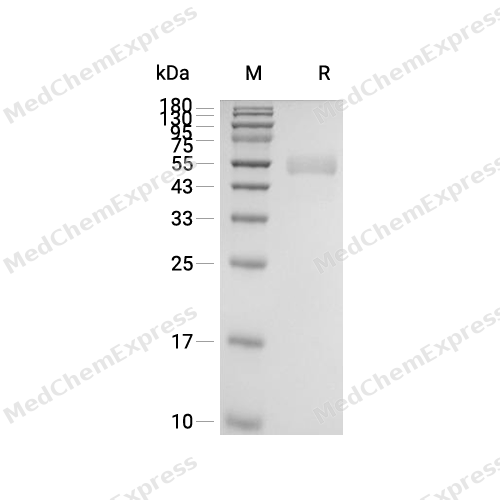
Purity - SDS-PAGE


Technical Parameters
-
Species Rat
-
Source HEK293
-
Tag C-His
-
Accession
P06866 (V19-N347)
-
Molecular Construction
-
N-term
-
Haptoglobin (V19-N347)
Accession # P06866 -
His
-
C-term
-
-
Protein Length
Full Length of Mature Protein
-
Synonyms
HP; Haptoglobin Alpha(2FS)-Beta; Haptoglobin; Haptoglobin Alpha(1S)-Beta; Zonulin; HP Protein; Haptoglobin, Alpha Polypeptide; HP2ALPHA2; Haptoglobin, Beta Polypeptide; HPA1S
-
AA Sequence
VELGNDATDIEDDSCPKPPEIANGYVEHLVRYRCRQFYKLQTEGDGIYTLNSEKQWVNPAAGDKLPKCEAVCGKPKHPVDQVQRIIGGSMDAKGSFPWQAKMISRHGLTTGATLISDQWLLTTAQNLFLNHSENATAKDIAPTLTLYVGKNQLVEIEKVVLHPERSVVDIGLIKLKQKVLVTEKVMPICLPSKDYVAPGRMGYVSGWGRNVNFRFTERLKYVMLPVADQEKCELHYEKSTVPEKKGAVSPVGVQPILNKHTFCAGLTKYEEDTCYGDAGSAFAVHDTEEDTWYAAGILSFDKSCAVAEYGVYVRATDLKDWVQETMAKN
-
Predicted Molecular Mass
38.1 kDa
-
Molecular Weight
Approximately 48-57 kDa, based on SDS-PAGE under reducing conditions, due to the glycosylation.
-
Glycosylation
Yes
-
Purity
≥ 90%, as determined by reducing SDS-PAGE.


Product Properties
Solution
Supplied as a 0.22 μm filtered solution of PBS, pH 7.4.
<1 EU/μg, determined by LAL method.
Stored at -80°C for 1 year from date of receipt. It is stable at -20°C for 3 months after opening. It is recommended to freeze aliquots at -80°C for extended storage. Avoid repeated freeze-thaw cycles.
Shipping with dry ice.


Documentation
-
Data Sheet (236 KB)
-
SDS (252 KB)
- English - EN (252 KB)
- Français - FR (252 KB)
- Deutsch - DE (252 KB)
- Norwegian - NO (252 KB)
- Español - ES (252 KB)
- Swedish - SV (252 KB)
- Italian - IT (252 KB)
- Korean - KR (252 KB)
- Portuguese - PT (252 KB)
-
Handling Instructions (2659 KB)

Calculators
Concentration (start) × Volume (start) = Concentration (final) × Volume (final)


 Powered by Bioz

