



HSPA5/GRP-78 Protein, Mouse (P.pastoris, His, solution)

Based on 1 Customer Validation
The HSPA5/GRP-78 protein is an endoplasmic reticulum chaperone involved in protein folding and quality control. It interacts with DNAJC10/ERdj5 to fold and degrade misfolded proteins. HSPA5/GRP-78 Protein, Mouse (P.pastoris, His, solution) is the recombinant mouse-derived HSPA5/GRP-78 protein, expressed by P. pastoris , with N-His labeled tag.
- Species: Mouse
- Source: P. pastoris
-
Storage:Stored at -80°C for 1 year from date of receipt. It is stable at -20°C for 3 months after opening. It is recommended to freeze aliquots at -80°C for extended storage. Avoid repeated freeze-thaw cycles.


To place orders, for customer services and technical support, please contact: MedChemExpress USA
Tel: 609-228-6898 E-mail: [email protected] [email protected]


-
 Biological Activity
-
Technical Parameters
-
Product Properties
- Documentation
- Help & FAQs




Biological Activity
Description
The HSPA5/GRP-78 protein is an endoplasmic reticulum chaperone involved in protein folding and quality control. It interacts with DNAJC10/ERdj5 to fold and degrade misfolded proteins. HSPA5/GRP-78 Protein, Mouse (P.pastoris, His, solution) is the recombinant mouse-derived HSPA5/GRP-78 protein, expressed by P. pastoris , with N-His labeled tag.
Background
HSPA5/GRP-78 Protein serves as a crucial endoplasmic reticulum chaperone, playing a pivotal role in protein folding and quality control within the endoplasmic reticulum lumen. It engages in correct protein folding and participates in the degradation of misfolded proteins, collaborating with DNAJC10/ERdj5 to facilitate the release of DNAJC10/ERdj5 from its substrate. Furthermore, HSPA5/GRP-78 acts as a key repressor of the ERN1/IRE1-mediated unfolded protein response (UPR). In the unstressed endoplasmic reticulum, it is recruited by DNAJB9/ERdj4 to the luminal region of ERN1/IRE1, disrupting the dimerization of ERN1/IRE1 and consequently inactivating it. The accumulation of misfolded proteins triggers the release of HSPA5/BiP from ERN1/IRE1, allowing for homodimerization and the subsequent activation of ERN1/IRE1. Additionally, HSPA5/GRP-78 plays an auxiliary role in the post-translational transport of small presecretory proteins across the endoplasmic reticulum and may function as an allosteric modulator for the SEC61 channel-forming translocon complex. It is suggested to cooperate with SEC62 to enable the productive insertion of these precursors into the SEC61 channel. The protein appears to specifically regulate the translocation of precursors with inhibitory residues in their mature region, which weaken channel gating. Beyond its role in protein folding, HSPA5/GRP-78 may also contribute to apoptosis and cell proliferation.
Verified Bioactivity
The enzyme activity of this recombinant protein is testing in progress, we cannot offer a guarantee yet.
MCE Validation Data
-
Purity - SDS-PAGE
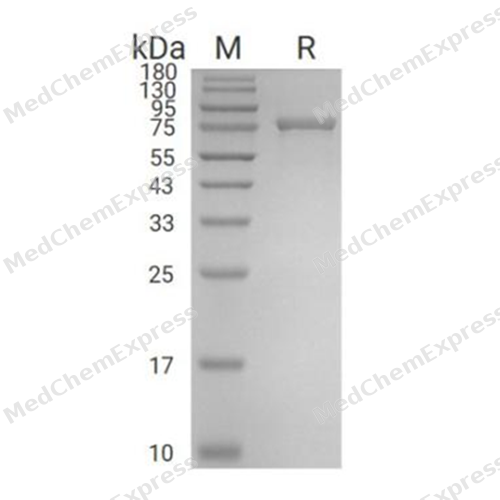
Purity - SDS-PAGE


Technical Parameters
-
Species Mouse
-
Source P. pastoris
-
Tag N-His
-
Accession
P20029 (E20-L655)
-
Molecular Construction
-
N-term
-
His
-
HSPA5 (E20-L655)
Accession # P20029 -
C-term
-
-
Protein Length
Full Length of Mature Protein
-
Synonyms
HSPA5; Heat Shock 70kDa Protein 5 (Glucose-Regulated Protein, 78kDa); Prev. GRP78; HSP70 Family Protein 5; BiP; Heat Shock 70kD Protein 5 (Glucose-Regulated Protein, 78kD); Immunoglobulin Heavy Chain-Binding Protein; Endoplasmic Reticulum Lumenal Ca(2+)-Binding Protein Grp78; Heat Shock Protein 70 Family Protein 5; Epididymis Secretory Sperm Binding Protein Li 89n; Heat Shock Protein Family A Member 5; Endoplasmic Reticulum Chaperone BIP; Endoplasmic Reticulum Chaperone BiP; HEL-S-89n; 78 KDa Glucose-Regulated Protein; GRP-78; Binding-Immunoglobulin Protein; Heat Shock Protein Family A (Hsp70) Member 5; Glucose-Regulated Protein, 78kDa
-
AA Sequence
EEEDKKEDVGTVVGIDLGTTYSCVGVFKNGRVEIIANDQGNRITPSYVAFTPEGERLIGDAAKNQLTSNPENTVFDAKRLIGRTWNDPSVQQDIKFLPFKVVEKKTKPYIQVDIGGGQTKTFAPEEISAMVLTKMKETAEAYLGKKVTHAVVTVPAYFNDAQRQATKDAGTIAGLNVMRIINEPTAAAIAYGLDKREGEKNILVFDLGGGTFDVSLLTIDNGVFEVVATNGDTHLGGEDFDQRVMEHFIKLYKKKTGKDVRKDNRAVQKLRREVEKAKRALSSQHQARIEIESFFEGEDFSETLTRAKFEELNMDLFRSTMKPVQKVLEDSDLKKSDIDEIVLVGGSTRIPKIQQLVKEFFNGKEPSRGINPDEAVAYGAAVQAGVLSGDQDTGDLVLLDVCPLTLGIETVGGVMTKLIPRNTVVPTKKSQIFSTASDNQPTVTIKVYEGERPLTKDNHLLGTFDLTGIPPAPRGVPQIEVTFEIDVNGILRVTAEDKGTGNKNKITITNDQNRLTPEEIERMVNDAEKFAEEDKKLKERIDTRNELESYAYSLKNQIGDKEKLGGKLSSEDKETMEKAVEEKIEWLESHQDADIEDFKAKKKELEEIVQPIISKLYGSGGPPPTGEEDTSEKDEL
-
Predicted Molecular Mass
72.5 kDa
-
Molecular Weight
75-80 kDa
-
Purity
≥ 90%, as determined by reducing SDS-PAGE.


Product Properties
Solution
Supplied as a 0.22 μm filtered solution of 20 mM Tris-HCl, 0.5M NaCl, pH 8.0, 50% glycerol.
Note: For SPR assay, please replace the buffer. Primary amine components (e.g., Tris, imidazole) can affect protein-coupled chips.
<1 EU/μg, determined by LAL method.
Stored at -80°C for 1 year from date of receipt. It is stable at -20°C for 3 months after opening. It is recommended to freeze aliquots at -80°C for extended storage. Avoid repeated freeze-thaw cycles.
Shipping with dry ice.


Documentation
-
Data Sheet (240 KB)
-
SDS (252 KB)
- English - EN (252 KB)
- Français - FR (252 KB)
- Deutsch - DE (252 KB)
- Norwegian - NO (252 KB)
- Español - ES (252 KB)
- Swedish - SV (252 KB)
- Italian - IT (252 KB)
- Korean - KR (252 KB)
- Portuguese - PT (252 KB)
-
Handling Instructions (2659 KB)

Calculators
Concentration (start) × Volume (start) = Concentration (final) × Volume (final)


 Powered by Bioz

