



IA2 Protein, Human (293a.a, N-His)

Based on 1 Customer Validation
The IA2 protein is critical in the vesicle-mediated secretion process and is essential for the accumulation of secretory vesicles in the hippocampus, pituitary gland, and pancreatic islets. IA2 is critical for insulin-related functions, ensuring normal levels of insulin-containing vesicles, preventing degradation and promoting glucose-stimulated insulin secretion. IA2 Protein, Human (293a.a, N-His) is the recombinant human-derived IA2 protein, expressed by E. coli , with N-6*His labeled tag.
- Species: Human
- Source: E. coli
-
Storage:Stored at -20°C for 2 years from date of receipt. After reconstitution, it is stable at 4°C for 1 week or -20°C for longer (with carrier protein). It is recommended to freeze aliquots at -20°C or -80°C for extended storage.


To place orders, for customer services and technical support, please contact: MedChemExpress USA
Tel: 609-228-6898 E-mail: [email protected] [email protected]


-
 Biological Activity
-
Technical Parameters
-
Product Properties
- Documentation
- Help & FAQs




Biological Activity
Description
The IA2 protein is critical in the vesicle-mediated secretion process and is essential for the accumulation of secretory vesicles in the hippocampus, pituitary gland, and pancreatic islets. IA2 is critical for insulin-related functions, ensuring normal levels of insulin-containing vesicles, preventing degradation and promoting glucose-stimulated insulin secretion. IA2 Protein, Human (293a.a, N-His) is the recombinant human-derived IA2 protein, expressed by E. coli , with N-6*His labeled tag.
Background
The IA2 protein plays a pivotal role in vesicle-mediated secretory processes, with essential functions extending across various tissues. It is required for the normal accumulation of secretory vesicles in key areas such as the hippocampus, pituitary, and pancreatic islets. Particularly crucial for insulin-related processes, IA2 is necessary for the accumulation of normal levels of insulin-containing vesicles, preventing their degradation and contributing to insulin secretion in response to glucose stimuli. IA2's influence also extends to neurotransmitter regulation in the brain, where it is required for the normal accumulation of norepinephrine, dopamine, and serotonin. Interestingly, in females, IA2 is uniquely indispensable for the normal accumulation and secretion of pituitary hormones like luteinizing hormone (LH) and follicle-stimulating hormone (FSH). Moreover, IA2 plays a role in maintaining normal levels of renin expression and release. Despite lacking intrinsic enzyme activity, IA2 may regulate catalytic active protein-tyrosine phosphatases, such as PTPRA, through dimerization. The intricate dynamics of IA2 are further highlighted in its interaction with ICA512-TMF, where it modulates the dynamics and exocytosis of insulin secretory granules, proposing a tethering mechanism to the actin cytoskeleton dependent on UTRN and regulated by ICA512-CFF dimerization.
MCE Validation Data
-
Purity - SDS-PAGE
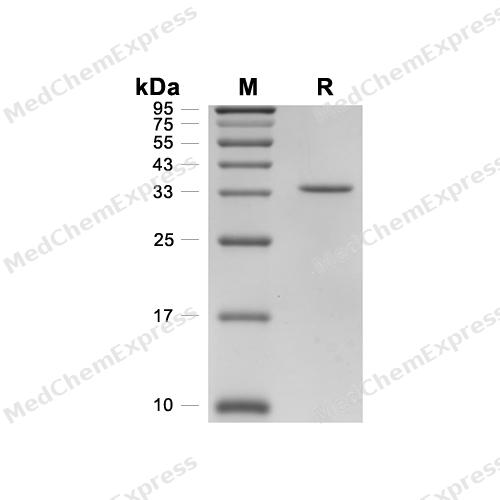
Purity - SDS-PAGE


Technical Parameters
-
Species Human
-
Source E. coli
-
Tag N-6*His
-
Accession
Q16849-1 (M687-Q979)
-
Molecular Construction
-
N-term
-
6*His
-
IA2 (M687-Q979)
Accession # Q16849-1 -
C-term
-
-
Protein Length
Partial
-
Synonyms
PTPRN; ICA 512; Protein Tyrosine Phosphatase Receptor Type N; Protein Tyrosine Phosphatase Receptor Type N Transcript Variant 1; ICA512; Protein Tyrosine Phosphatase, Receptor Type, N; Islet Cell Antigen 512; Protein Tyrosine Phosphatase-Like N; IA-2; Isl
-
AA Sequence
MDISTGHMILAYMEDHLRNRDRLAKEWQALCAYQAEPNTCATAQGEGNIKKNRHPDFLPYDHARIKLKVESSPSRSDYINASPIIEHDPRMPAYIATQGPLSHTIADFWQMVWESGCTVIVMLTPLVEDGVKQCDRYWPDEGASLYHVYEVNLVSEHIWCEDFLVRSFYLKNVQTQETRTLTQFHFLSWPAEGTPASTRPLLDFRRKVNKCYRGRSCPIIVHCSDGAGRTGTYILIDMVLNRMAKGVKEIDIAATLEHVRDQRPGLVRSKDQFEFALTAVAEEVNAILKALPQ
-
Predicted Molecular Mass
33.4 kDa
-
Molecular Weight
Approximately 35 kDa, based on SDS-PAGE under reducing conditions.
-
Purity
≥ 95%, as determined by reducing SDS-PAGE.


Product Properties
Lyophilized powder.
Lyophilized from a 0.22 μm filtered solution of 50 mM Tris-HCl, 300 mM NaCl, pH 7.4.
Note: For SPR assay, please replace the buffer. Primary amine components (e.g., Tris, imidazole) can affect protein-coupled chips.
<1 EU/μg, determined by LAL method.
It is not recommended to reconstitute to a concentration less than 100 μg/mL in ddH2O. For long term storage it is recommended to add a carrier protein (0.1% BSA, 5% HSA, 10% FBS or 5% Trehalose).
Stored at -20°C for 2 years from date of receipt. After reconstitution, it is stable at 4°C for 1 week or -20°C for longer (with carrier protein). It is recommended to freeze aliquots at -20°C or -80°C for extended storage.
Room temperature in continental US; may vary elsewhere.


Documentation
-
Data Sheet (237 KB)
-
SDS (252 KB)
- English - EN (252 KB)
- Français - FR (252 KB)
- Deutsch - DE (252 KB)
- Norwegian - NO (252 KB)
- Español - ES (252 KB)
- Swedish - SV (252 KB)
- Italian - IT (252 KB)
- Korean - KR (252 KB)
- Portuguese - PT (252 KB)
-
Handling Instructions (2659 KB)

Calculators
Concentration (start) × Volume (start) = Concentration (final) × Volume (final)


 Powered by Bioz

