



IgG1 Protein, Mouse (HEK293, C102S)

Based on 1 Customer Validation
IgG1 Protein is the most abundant Immunoglobulin G (IgG) subclass in human sera and is important for mediating antibody responses against viral pathogens. IgG1 enables antigen binding activity and immunoglobulin receptor binding activity. It acts upstream of or within several processes, including antibody-dependent cellular cytotoxicity, phagocytosis, and positive regulation of immune response. IgG1 Protein, Mouse (HEK293, C102S) is the recombinant mouse-derived IgG1 protein, expressed by HEK293 , with tag free.
- Species: Mouse
- Source: HEK293
-
Storage:Stored at -80°C for 1 year from date of receipt. It is stable at -20°C for 3 months after opening. It is recommended to freeze aliquots at -80°C for extended storage. Avoid repeated freeze-thaw cycles.


To place orders, for customer services and technical support, please contact: MedChemExpress USA
Tel: 609-228-6898 E-mail: [email protected] [email protected]


-
 Biological Activity
-
Technical Parameters
-
Product Properties
- Documentation
- Help & FAQs




Biological Activity
Description
IgG1 Protein is the most abundant Immunoglobulin G (IgG) subclass in human sera and is important for mediating antibody responses against viral pathogens. IgG1 enables antigen binding activity and immunoglobulin receptor binding activity. It acts upstream of or within several processes, including antibody-dependent cellular cytotoxicity, phagocytosis, and positive regulation of immune response. IgG1 Protein, Mouse (HEK293, C102S) is the recombinant mouse-derived IgG1 protein, expressed by HEK293 , with tag free.
Background
Ig gamma-1 chain C region secreted form (IgG1) is the most abundant Immunoglobulin G (IgG) subclass in human sera and is important for mediating antibody responses against viral pathogens. It does so by binding to soluble proteins and membrane protein antigens via its variable domain and concomitantly activating effector mechanisms of the innate immune system. IgG1 enables antigen binding activity and immunoglobulin receptor binding activity. It acts upstream of or within several processes, including antibody-dependent cellular cytotoxicity, phagocytosis, and positive regulation of immune response. IgG1 can effectively bind to C1q causing complement-dependent cytotoxicity (CDC) and can bind to each of the different Fc receptors resulting in antibody-dependent cell-mediated cytotoxicity (ADCC)[1].
Verified Bioactivity
Immobilized Human CD64 (HY-P70669) at 1 μg/mL (100 μL/well) can bind biotinylated Human IgG1. The ED50 for this effect is 68.82 ng/mL.
MCE Validation Data
-
Bioactivity - ELISA
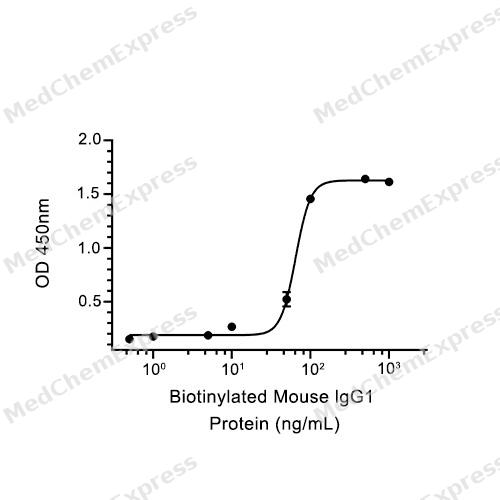
Bioactivity - ELISA


Technical Parameters
-
Species Mouse
-
Source HEK293
-
Tag Tag Free
-
Accession
P01868-1 (V98-K324, C102S)
-
Molecular Construction
-
N-term
-
IgG1 (V98-K324, C102S)
Accession # P01868-1 -
C-term
-
-
Protein Length
Partial
-
Synonyms
IGHG1; Ig Gamma-1 Chain C Region NIE; Immunoglobulin Heavy Constant Gamma 1 (G1m Marker); Ig Gamma-1 Chain C Region KOL; Constant Region Of Heavy Chain Of IgG1; Ig Gamma-1 Chain C Region EU; Immunoglobulin Heavy Constant Gamma 1; Ig Gamma-1 Chain C Region
-
AA Sequence
VPRDSGCKPCICTVPEVSSVFIFPPKPKDVLTITLTPKVTCVVVDISKDDPEVQFSWFVDDVEVHTAQTQPREEQFNSTFRSVSELPIMHQDWLNGKEFKCRVNSAAFPAPIEKTISKTKGRPKAPQVYTIPPPKEQMAKDKVSLTCMITDFFPEDITVEWQWNGQPAENYKNTQPIMNTNGSYFVYSKLNVQKSNWEAGNTFTCSVLHEGLHNHHTEKSLSHSPGK
-
Predicted Molecular Mass
25.8 kDa
-
Molecular Weight
Approximately 32 kDa, based on SDS-PAGE under reducing conditions, due to the glycosylation.
-
Glycosylation
Yes
-
Purity
≥ 95%, as determined by reducing SDS-PAGE.


Product Properties
Solution
Supplied as a 0.22 μm filtered solution of PBS, pH 7.4, 5% trehalose, 5% mannitol and 0.01% Tween 80.
<1 EU/μg, determined by LAL method.
Stored at -80°C for 1 year from date of receipt. It is stable at -20°C for 3 months after opening. It is recommended to freeze aliquots at -80°C for extended storage. Avoid repeated freeze-thaw cycles.
Shipping with dry ice.


Documentation
-
Data Sheet (236 KB)
-
SDS (251 KB)
- English - EN (251 KB)
- Français - FR (251 KB)
- Deutsch - DE (251 KB)
- Norwegian - NO (251 KB)
- Español - ES (251 KB)
- Swedish - SV (251 KB)
- Italian - IT (251 KB)
- Korean - KR (251 KB)
- Portuguese - PT (251 KB)
-
Handling Instructions (2659 KB)

Calculators
Concentration (start) × Volume (start) = Concentration (final) × Volume (final)


 Powered by Bioz

