



KIRREL3/NEPH2 Protein, Mouse (HEK293, His)
The KIRREL3/NEPH2 protein plays a critical role in the formation of precise synapses, particularly in hippocampal mossy fiber synapses, where it is responsible for coordinating mossy fiber filopodia. It acts in a homologous manner to stabilize filopodia contacts and facilitate subsequent synapse formation. KIRREL3/NEPH2 Protein, Mouse (HEK293, His) is the recombinant mouse-derived KIRREL3/NEPH2 protein, expressed by HEK293 , with C-His labeled tag.
- Species: Mouse
- Source: HEK293
-
Storage:Stored at -20°C for 2 years from date of receipt. After reconstitution, it is stable at 4°C for 1 week or -20°C for longer (with carrier protein). It is recommended to freeze aliquots at -20°C or -80°C for extended storage.


To place orders, for customer services and technical support, please contact: MedChemExpress USA
Tel: 609-228-6898 E-mail: [email protected] [email protected]


-
 Biological Activity
-
Technical Parameters
-
Product Properties
- Documentation
- Help & FAQs




Biological Activity
Description
The KIRREL3/NEPH2 protein plays a critical role in the formation of precise synapses, particularly in hippocampal mossy fiber synapses, where it is responsible for coordinating mossy fiber filopodia. It acts in a homologous manner to stabilize filopodia contacts and facilitate subsequent synapse formation. KIRREL3/NEPH2 Protein, Mouse (HEK293, His) is the recombinant mouse-derived KIRREL3/NEPH2 protein, expressed by HEK293 , with C-His labeled tag.
Background
The KIRREL3/NEPH2 protein emerges as a pivotal synaptic adhesion molecule essential for the precise formation of target-specific synapses, particularly notable at hippocampal mossy fiber synapses. Its significance extends to the orchestration of mossy fiber filopodia, critical synaptic structures linking dentate granule and GABA neurons. Functionally, KIRREL3/NEPH2 likely serves as a homophilic adhesion molecule, fostering trans-cellular interactions and playing a key role in stabilizing mossy fiber filipodia contacts, thereby facilitating subsequent synapse formation. Beyond the hippocampus, KIRREL3/NEPH2 is vital for the coalescence of vomeronasal sensory neuron axons. Moreover, it may play a role in the hematopoietic supportive capacity of stroma cells, with its secreted extracellular domain directly supporting hematopoietic stem cells. Functioning as a homodimer, KIRREL3/NEPH2 mediates homophilic interactions crucial for promoting cell adhesion. Additionally, it engages in a spectrum of protein-protein interactions, including the formation of heterodimers with NPHS1, interactions with NPHS2/podocin, CASK, MAP1B, MYO16, ATP1B1, SHMT2, and UFC1, underscoring its multifaceted and integral role in diverse cellular processes.
MCE Validation Data
-
Purity - SDS-PAGE
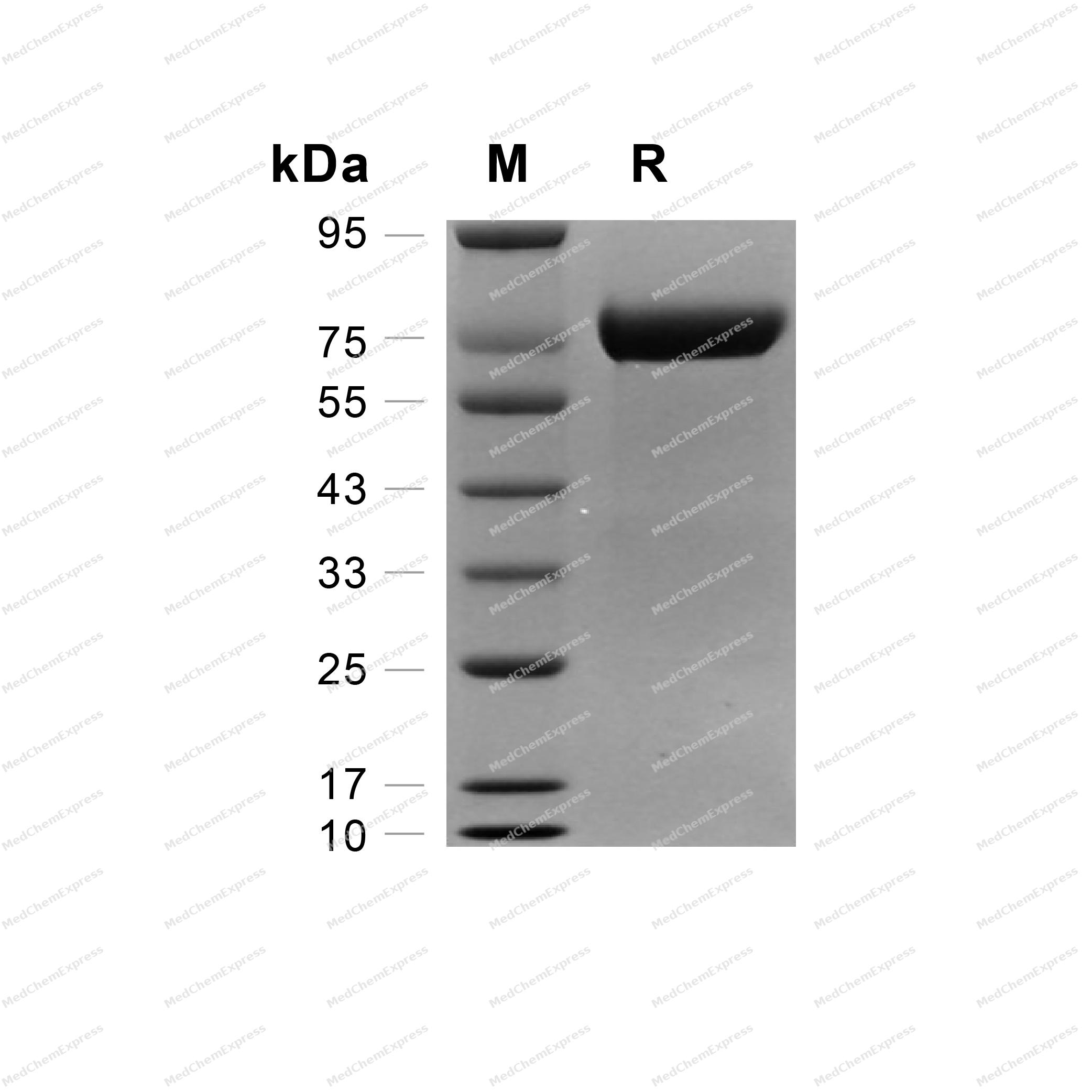
Purity - SDS-PAGE


Technical Parameters
-
Species Mouse
-
Source HEK293
-
Tag C-His
-
Accession
Q8BR86 (L22-A535)
-
Molecular Construction
-
N-term
-
KIRREL3 (L22-A535)
Accession # Q8BR86 -
His
-
C-term
-
-
Protein Length
Extracellular Domain
-
Synonyms
KIRREL3; Nephrin-Like Protein 2; Kirre Like Nephrin Family Adhesion Molecule 3; Kin Of IRRE Like 3 (Drosophila); NEPH2; Kin Of IRRE Like 3; KIAA1867; Nephrin-Like 2; KIRRE; PRO4502; Kin Of Irregular Chiasm-Like Protein 3; MRD4; Kin Of IRRE-Like Protein 3
-
AA Sequence
LQKRGCCLVLGYMAKDKFRRMNEGQVYSFSQQPQDQVVVSGQPVTLLCAIPEYDGFVLWIKDGLALGVGRDLSSYPQYLVVGNHLSGEHHLKILRAELQDDAVYECQAIQAAIRSRPARLTVLVPPDDPIILGGPVISLRAGDPLNLTCHADNAKPAASIIWLRKGEVINGATYSKTLLRDGKRESIVSTLFISPGDVENGQSIVCRATNKAIPGGKETSVTIDIQHPPLVNLSVEPQPVLEDNIVTFHCSAKANPAVTQYRWAKRGHIIKEASGELYRTTVDYTYFSEPVSCEVTNALGSTNLSRTVDVYFGPRMTSEPQSLLVDLGSDAVFSCAWIGNPSLTIVWMKRGSGVVLSNEKTLTLKSVRQEDAGKYVCRAVVPRVGAGEREVTLTVNGPPIISSTQTQHALHGEKGQIKCFIRSTPPPDRIAWSWKENVLESGTSGRYTVETVNTEEGVISTLTISNIVRADFQTIYNCTAWNSFGSDTEIIRLKEQGSEMKSGAGLEAESVPMA
-
Molecular Weight
Approximately 65 kDa, based on SDS-PAGE under reducing conditions.
-
Purity
≥ 95%, as determined by reducing SDS-PAGE.


Product Properties
Lyophilized powder
<1 EU/μg, determined by LAL method.
It is not recommended to reconstitute to a concentration less than 100 μg/mL in ddH2O.
Stored at -20°C for 2 years from date of receipt. After reconstitution, it is stable at 4°C for 1 week or -20°C for longer (with carrier protein). It is recommended to freeze aliquots at -20°C or -80°C for extended storage.
Room temperature in continental US; may vary elsewhere.


Documentation
-
Data Sheet (238 KB)
-
SDS (251 KB)
- English - EN (251 KB)
- Français - FR (251 KB)
- Deutsch - DE (251 KB)
- Norwegian - NO (251 KB)
- Español - ES (251 KB)
- Swedish - SV (251 KB)
- Italian - IT (251 KB)
- Korean - KR (251 KB)
- Portuguese - PT (251 KB)
-
Handling Instructions (2659 KB)

Calculators
Concentration (start) × Volume (start) = Concentration (final) × Volume (final)


 Powered by Bioz

