



LYNa Protein, Human (Active, sf9, GST)
Based on 1 Customer Validation
Lyn protein is a non-receptor tyrosine protein kinase that centrally mediates signals from diverse cell surface receptors, regulating immune responses, hematopoiesis, and integrin signaling. It acts as a negative or positive regulator depending on the context, affecting B cell responses, differentiation and inflammatory responses. LYNa Protein, Human (Active, sf9, GST) is the recombinant human-derived LYNa protein, expressed by Sf9 insect cells , with N-GST labeled tag.
- Species: Human
- Source: Sf9 insect cells
-
Storage:Stored at -80°C for 1 year from date of receipt. It is stable at -20°C for 3 months after opening. It is recommended to freeze aliquots at -80°C for extended storage. Avoid repeated freeze-thaw cycles.


To place orders, for customer services and technical support, please contact: MedChemExpress USA
Tel: 609-228-6898 E-mail: [email protected] [email protected]


-
 Biological Activity
-
Technical Parameters
-
Product Properties
- Documentation
- Help & FAQs




Biological Activity
Description
Lyn protein is a non-receptor tyrosine protein kinase that centrally mediates signals from diverse cell surface receptors, regulating immune responses, hematopoiesis, and integrin signaling. It acts as a negative or positive regulator depending on the context, affecting B cell responses, differentiation and inflammatory responses. LYNa Protein, Human (Active, sf9, GST) is the recombinant human-derived LYNa protein, expressed by Sf9 insect cells , with N-GST labeled tag.
Background
Lyn Protein, a non-receptor tyrosine-protein kinase, serves as a central mediator in transmitting signals from cell surface receptors, playing a crucial role in regulating innate and adaptive immune responses, hematopoiesis, growth factor and cytokine responses, integrin signaling, and the cellular response to DNA damage and genotoxic agents. Acting primarily as a negative regulator but also functioning as an activator depending on the cellular context, Lyn Protein is indispensable for initiating and terminating B-cell responses, influencing B-cell differentiation, proliferation, survival, apoptosis, and immune self-tolerance. It acts downstream of various immune receptors, including the B-cell receptor, CD79A, CD79B, CD5, CD19, CD22, FCER1, FCGR2, FCGR1A, TLR2, and TLR4, contributing to the inflammatory response to bacterial lipopolysaccharide. Lyn Protein also mediates responses to cytokines and growth factors in diverse hematopoietic cell types, playing a crucial role in integrin signaling. Its regulatory role encompasses cell proliferation, survival, differentiation, migration, adhesion, degranulation, and cytokine release. Lyn Protein down-regulates signaling pathways through phosphorylation of immunoreceptor tyrosine-based inhibitory motifs (ITIM), facilitating the recruitment of phosphatases such as PTPN6/SHP-1, PTPN11/SHP-2, and INPP5D/SHIP-1 to modulate signaling by dephosphorylation of kinases and substrates. Lyn Protein's multifaceted kinase activity extends to phosphorylating various substrates, including BTK, CBL, CD5, CD19, CD72, CD79A, CD79B, CSF2RB, DOK1, HCLS1, LILRB3/PIR-B, MS4A2/FCER1B, SYK, and TEC, showcasing its intricate involvement in diverse signaling cascades. It is also involved in the phosphorylation of SIRPA, PTPN6/SHP-1, PTPN11/SHP-2, INPP5D/SHIP-1, BCR-ABL fusion protein, FER, KIT, LPXN, SCIMP, CLNK, BCAR1/CAS, and NEDD9/HEF1, illustrating its extensive regulatory capacity in various cellular processes.
Verified Bioactivity
The specific activity was determined to be >30 nmol/min/mg using Poly(Glu,Tyr) 4:1 as substrate.
MCE Validation Data
-
Purity - SDS-PAGE
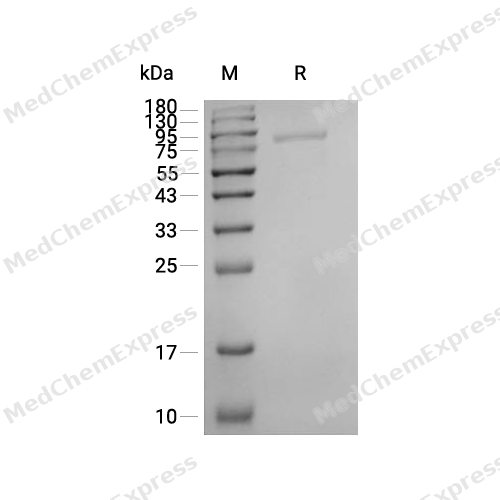
Purity - SDS-PAGE


Technical Parameters
-
Species Human
-
Source Sf9 insect cells
-
Tag N-GST
-
Accession
P07948-1/NP_002341.1 (M1-P512)
-
Molecular Construction
-
N-term
-
GST
-
Lyn (M1-P512)
Accession # P07948-1/NP_002341.1 -
C-term
-
-
Protein Length
Full Length of Isoform-1
-
Synonyms
LYN; Tyrosine-Protein Kinase Lyn; LYN Proto-Oncogene, Src Family Tyrosine Kinase; P53Lyn; JTK8; P56Lyn; V-Yes-1 Yamaguchi Sarcoma Viral Related Oncogene Homolog; Tyrosine-Protein Kinase; Lck/Yes-Related Novel Protein Tyrosine Kinase; SAIDV
-
AA Sequence
MGCIKSKGKDSLSDDGVDLKTQPVRNTERTIYVRDPTSNKQQRPVPESQLLPGQRFQTKDPEEQGDIVVALYPYDGIHPDDLSFKKGEKMKVLEEHGEWWKAKSLLTKKEGFIPSNYVAKLNTLETEEWFFKDITRKDAERQLLAPGNSAGAFLIRESETLKGSFSLSVRDFDPVHGDVIKHYKIRSLDNGGYYISPRITFPCISDMIKHYQKQADGLCRRLEKACISPKPQKPWDKDAWEIPRESIKLVKRLGAGQFGEVWMGYYNNSTKVAVKTLKPGTMSVQAFLEEANLMKTLQHDKLVRLYAVVTREEPIYIITEYMAKGSLLDFLKSDEGGKVLLPKLIDFSAQIAEGMAYIERKNYIHRDLRAANVLVSESLMCKIADFGLARVIEDNEYTAREGAKFPIKWTAPEAINFGCFTIKSDVWSFGILLYEIVTYGKIPYPGRTNADVMTALSQGYRMPRVENCPDELYDIMKMCWKEKAEERPTFDYLQSVLDDFYTATEGQYQQQP
-
Predicted Molecular Mass
84.8 kDa
-
Molecular Weight
Approximately 75 kDa, based on SDS-PAGE under reducing conditions.
-
Purity
≥ 90%, as determined by reducing SDS-PAGE.


Product Properties
Solution.
Supplied as a 0.22 μm filtered solution of 50 mM Tris, 100 mM NaCl, pH 8.0, 0.5 mM Reduced Glutathione, 10% glycerol, 0.5 mM PMSF.
Note: For SPR assay, please replace the buffer. Primary amine components (e.g., Tris, imidazole) can affect protein-coupled chips.
<1 EU/μg, determined by LAL method.
Please use rapid thawing with running water to thaw the protein.
Stored at -80°C for 1 year from date of receipt. It is stable at -20°C for 3 months after opening. It is recommended to freeze aliquots at -80°C for extended storage. Avoid repeated freeze-thaw cycles.
Shipping with dry ice.


Documentation
-
Data Sheet (239 KB)
-
SDS (251 KB)
- English - EN (251 KB)
- Français - FR (251 KB)
- Deutsch - DE (251 KB)
- Norwegian - NO (251 KB)
- Español - ES (251 KB)
- Swedish - SV (251 KB)
- Italian - IT (251 KB)
- Korean - KR (251 KB)
- Portuguese - PT (251 KB)
-
Handling Instructions (2659 KB)

Calculators
Concentration (start) × Volume (start) = Concentration (final) × Volume (final)


 Powered by Bioz

