



MICB Protein, Human (HEK293, His)
Based on 1 Customer Validation
MICB Protein, a heavily glycosylated ligand for NKG2D receptor, triggers cytolytic response in immune cells. It resembles MHC class I molecules but lacks association with beta-2-microglobulin or peptide binding. Alternative splicing leads to multiple transcript variants. MICB is widely expressed, especially in lymph nodes and bone marrow, highlighting its immune response role in diverse physiological contexts. MICB Protein, Human (HEK293, His) is the recombinant human-derived MICB protein, expressed by HEK293 , with C-His, C-6*His labeled tag.
- Species: Human
- Source: HEK293
-
Storage:Stored at -20°C for 2 years from date of receipt. After reconstitution, it is stable at 4°C for 1 week or -20°C for longer (with carrier protein). It is recommended to freeze aliquots at -20°C or -80°C for extended storage.


To place orders, for customer services and technical support, please contact: MedChemExpress USA
Tel: 609-228-6898 E-mail: [email protected] [email protected]


-
 Biological Activity
-
Technical Parameters
-
Product Properties
- Documentation
- Help & FAQs




Biological Activity
Description
MICB Protein, a heavily glycosylated ligand for NKG2D receptor, triggers cytolytic response in immune cells. It resembles MHC class I molecules but lacks association with beta-2-microglobulin or peptide binding. Alternative splicing leads to multiple transcript variants. MICB is widely expressed, especially in lymph nodes and bone marrow, highlighting its immune response role in diverse physiological contexts. MICB Protein, Human (HEK293, His) is the recombinant human-derived MICB protein, expressed by HEK293 , with C-His, C-6*His labeled tag.
Background
MICB encodes a heavily glycosylated protein that serves as a ligand for the NKG2D type II receptor. Upon binding, this ligand triggers the cytolytic response of various immune cells, including natural killer (NK) cells, CD8 alphabeta T cells, and gammadelta T cells expressing the receptor. Notably, MICB is stress-induced and shares similarities with MHC class I molecules, although it does not associate with beta-2-microglobulin or bind peptides. Alternative splicing generates multiple transcript variants, adding to the complexity of its functional repertoire. The expression of MICB is broad, with notable presence in lymph nodes, bone marrow, and various other tissues, underscoring its role in immune responses across diverse physiological contexts.
Verified Bioactivity
Immobilized Human NKG2D/CD314 (HY-P76512) at 2 μg/mL (100 μL/well) can bind Human MICB. The ED50 for this effect is 115.3 ng/mL.
MCE Validation Data
-
Bioactivity - ELISA
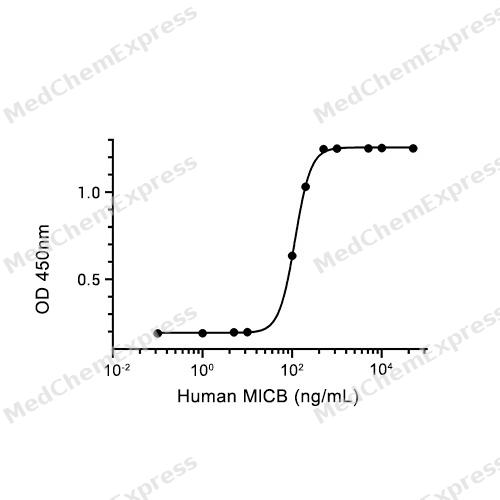
Bioactivity - ELISA


Technical Parameters
-
Species Human
-
Source HEK293
-
Tag C-6*His
-
Accession
NP_005922.2 (A23-G298)
-
Molecular Construction
-
N-term
-
MICB (A23-G298)
Accession # NP_005922.2 -
6*His
-
C-term
-
-
Protein Length
Partial Extracellular Domain
-
Synonyms
MICB; MHC Class I Chain-Related Protein; MHC Class I Polypeptide-Related Sequence B; Stress Inducible Class I Homolog; PERB11.2; MHC Class I Mic-B Antigen; MHC Class I Antigen-Related Protein B; MICB Protein; MHC Class I Chain-Related Protein B; MICB Anti
-
AA Sequence
AEPHSLRYNLMVLSQDGSVQSGFLAEGHLDGQPFLRYDRQKRRAKPQGQWAENVLGAKTWDTETEDLTENGQDLRRTLTHIKDQKGGLHSLQEIRVCEIHEDSSTRGSRHFYYDGELFLSQNLETQESTVPQSSRAQTLAMNVTNFWKEDAMKTKTHYRAMQADCLQKLQRYLKSGVAIRRTVPPMVNVTCSEVSEGNITVTCRASSFYPRNITLTWRQDGVSLSHNTQQWGDVLPDGNGTYQTWVATRIRQGEEQRFTCYMEHSGNHGTHPVPSG
-
Molecular Weight
Approximately 45-50 kDa, based on SDS-PAGE under reducing conditions, due to the glycosylation.
-
Glycosylation
Yes
-
Purity
≥ 95%, as determined by reducing SDS-PAGE.


Product Properties
Lyophilized powder.
Lyophilized from a 0.2 μm filtered solution of 20 mM PB, 150 mM NaCl, pH 7.4.
<1 EU/μg, determined by LAL method.
It is not recommended to reconstitute to a concentration less than 100 μg/mL in ddH2O. For long term storage it is recommended to add a carrier protein (0.1% BSA, 5% HSA, 10% FBS or 5% Trehalose).
Stored at -20°C for 2 years from date of receipt. After reconstitution, it is stable at 4°C for 1 week or -20°C for longer (with carrier protein). It is recommended to freeze aliquots at -20°C or -80°C for extended storage.
Room temperature in continental US; may vary elsewhere.


Documentation
-
Data Sheet (237 KB)
-
SDS (251 KB)
- English - EN (251 KB)
- Français - FR (251 KB)
- Deutsch - DE (251 KB)
- Norwegian - NO (251 KB)
- Español - ES (251 KB)
- Swedish - SV (251 KB)
- Italian - IT (251 KB)
- Korean - KR (251 KB)
- Portuguese - PT (251 KB)
-
Handling Instructions (2659 KB)

Calculators
Concentration (start) × Volume (start) = Concentration (final) × Volume (final)


 Powered by Bioz

