



MSP/MST1 Protein, Mouse (C677A, HEK293)
Based on 1 publication(s) in Google Scholar
The MSP/MST1 protein, encoded by this gene, is predicted to have receptor tyrosine kinase binding activity. It is involved in various processes, including embryo implantation, mammary duct growth, and regulation of mammary gland cell proliferation. The protein is mainly found in the vacuole and expressed in tissues like the esophagus, liver, pharynx, and stomach. Notably, the gene shows liver-biased expression in both adult and embryonic stages. MSP/MST1 Protein, Mouse (C677A, HEK293) is the recombinant mouse-derived MSP/MST1 protein, expressed by HEK293 , with tag free, and C677A mutation.
- Species: Mouse
- Source: HEK293
-
Storage:Stored at -20°C for 2 years from date of receipt. After reconstitution, it is stable at 4°C for 1 week or -20°C for longer (with carrier protein). It is recommended to freeze aliquots at -20°C or -80°C for extended storage.


To place orders, for customer services and technical support, please contact: MedChemExpress USA
Tel: 609-228-6898 E-mail: [email protected] [email protected]


-
 Biological Activity
-
Technical Parameters
-
Product Properties
- Documentation
- Help & FAQs




Biological Activity
Description
The MSP/MST1 protein, encoded by this gene, is predicted to have receptor tyrosine kinase binding activity. It is involved in various processes, including embryo implantation, mammary duct growth, and regulation of mammary gland cell proliferation. The protein is mainly found in the vacuole and expressed in tissues like the esophagus, liver, pharynx, and stomach. Notably, the gene shows liver-biased expression in both adult and embryonic stages. MSP/MST1 Protein, Mouse (C677A, HEK293) is the recombinant mouse-derived MSP/MST1 protein, expressed by HEK293 , with tag free, and C677A mutation.
Background
This gene, encoding the MSP/MST1 protein, is predicted to possess receptor tyrosine kinase binding activity. It plays a role upstream in various processes, including embryo implantation, mammary duct terminal end bud growth, and positive regulation of mammary gland epithelial cell proliferation. The protein is primarily located in the vacuole and is expressed in tissues such as esophagus epithelium, liver, liver parenchyma, pharynx epithelium, and stomach proventricular region epithelium. Notably, the gene exhibits biased expression in the liver of both adult and embryonic stages in the reference dataset.
Verified Bioactivity
Measured by its ability to inhibit the proliferation of Hela cell. The ED50 for this effect is 4.080 ng/ml, corresponding to a specific activity is 2.45×10^5 units/mg.
MCE Validation Data
-
Bioactivity - Cell-Based Assay
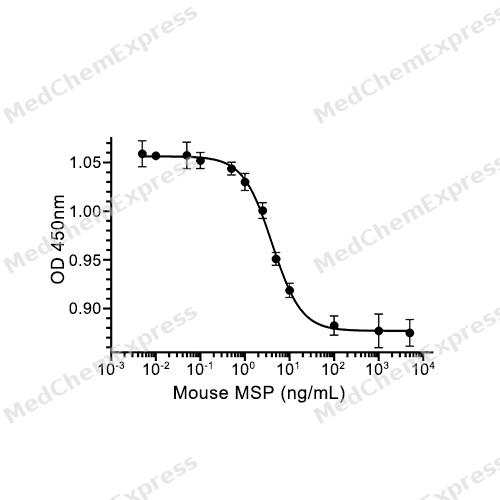
Bioactivity - Cell-Based Assay


Publications (1)
-
Journal Impact Factor
-
Most Recent
-
medRxiv
A liver-heart endocrine axis revealed by systems genetics and mediated by hepatocyte growth factor activator. [Abstract]2026 May 6:2026.05.05.26352474. PMID: 42145616


Technical Parameters
-
Species Mouse
-
Source HEK293
-
Tag Tag Free
-
Accession
P26928/NP_032269 (Q19-E716, C677A)
-
Molecular Construction
-
N-term
-
MSP (Q19-E716, C677A)
Accession # P26928/NP_032269 -
C-term
-
-
Protein Length
Full Length of Mature Protein
-
Synonyms
MST1; NF15S2; Prev. D3F15S2; Macrophage Stimulatory Protein; Prev. DNF15S2; Macrophage Stimulating 1 (Hepatocyte Growth Factor-Like); Prev. HGFL; Hepatocyte Growth Factor-Like Protein Homolog; MSP; Hepatocyte Growth Factor-Like; Hepatocyte Growth Factor-L
-
AA Sequence
QRSPLNDFQLFRGTELRNLLHTAVPGPWQEDVADAEECARRCGPLLDCRAFHYNMSSHGCQLLPWTQHSLHTQLYHSSLCHLFQKKDYVRTCIMDNGVSYRGTVARTAGGLPCQAWSRRFPNDHKYTPTPKNGLEENFCRNPDGDPRGPWCYTTNRSVRFQSCGIKTCREAVCVLCNGEDYRGEVDVTESGRECQRWDLQHPHSHPFQPEKFLDKDLKDNYCRNPDGSERPWCYTTDPNVEREFCDLPSCGPNLPPTVKGSKSQRRNKGKALNCFRGKGEDYRGTTNTTSAGVPCQRWDAQSPHQHRFVPEKYACKDLRENFCRNPDGSEAPWCFTSRPGLRMAFCHQIPRCTEELVPEGCYHGSGEQYRGSVSKTRKGVQCQHWSSETPHKPQFTPTSAPQAGLEANFCRNPDGDSHGPWCYTLDPDILFDYCALQRCDDDQPPSILDPPDQVVFEKCGKRVDKSNKLRVVGGHPGNSPWTVSLRNRQGQHFCGGSLVKEQWVLTARQCIWSCHEPLTGYEVWLGTINQNPQPGEANLQRVPVAKAVCGPAGSQLVLLKLERPVILNHHVALICLPPEQYVVPPGTKCEIAGWGESIGTSNNTVLHVASMNVISNQECNTKYRGHIQESEICTQGLVVPVGACEGDYGGPLACYTHDAWVLQGLIIPNRVCARPRWPAIFTRVSVFVDWINKVMQLE
-
Predicted Molecular Mass
53.7 kDa (α chain) & 25 kDa (β chain)
-
Molecular Weight
Approximately 92 kDa & 61 kDa & 37 kDa & 32 kDa under reduced (R) conditions, 82 kDa under non reducing (N) conditions, based on SDS-PAGE.
-
Glycosylation
Yes
-
Purity
≥ 95%, as determined by reducing SDS-PAGE.


Product Properties
Lyophilized powder.
Lyophilized from a 0.22 μm filtered solution of 20 mM PB, 150 mM NaCl, pH 7.4.
<1 EU/μg, determined by LAL method.
It is not recommended to reconstitute to a concentration less than 100 μg/mL in ddH2O. For long term storage it is recommended to add a carrier protein (0.1% BSA, 5% HSA, 10% FBS or 5% Trehalose).
Stored at -20°C for 2 years from date of receipt. After reconstitution, it is stable at 4°C for 1 week or -20°C for longer (with carrier protein). It is recommended to freeze aliquots at -20°C or -80°C for extended storage.
Room temperature in continental US; may vary elsewhere.


Documentation
-
Data Sheet (241 KB)
-
SDS (252 KB)
- English - EN (252 KB)
- Français - FR (252 KB)
- Deutsch - DE (252 KB)
- Norwegian - NO (252 KB)
- Español - ES (252 KB)
- Swedish - SV (252 KB)
- Italian - IT (252 KB)
- Korean - KR (252 KB)
- Portuguese - PT (252 KB)
-
Handling Instructions (2659 KB)

Calculators
Concentration (start) × Volume (start) = Concentration (final) × Volume (final)


 Powered by Bioz

