



NASP Protein, Human (HEK293, His)

Based on 1 Customer Validation
NASP Protein, Human (HEK293, His) is the recombinant human-derived NASP protein, expressed by HEK293, with C-10*His tag.
- Species: Human
- Source: HEK293
-
Storage:Stored at -20°C for 2 years from date of receipt. After reconstitution, it is stable at 4°C for 1 week or -20°C for longer (with carrier protein). It is recommended to freeze aliquots at -20°C or -80°C for extended storage.


To place orders, for customer services and technical support, please contact: MedChemExpress USA
Tel: 609-228-6898 E-mail: [email protected] [email protected]


-
 Biological Activity
-
Technical Parameters
-
Product Properties
- Documentation
- Help & FAQs




Biological Activity
Description
NASP Protein, Human (HEK293, His) is the recombinant human-derived NASP protein, expressed by HEK293, with C-10*His tag.
Background
NASP is a component of the histone chaperone network, which binds and stabilizes histone H3-H4 not bound to chromatin to maintain a soluble reservoir and modulate degradation by chaperone-mediated autophagy. It is required for DNA replication, normal cell cycle progression, and cell proliferation. NASP forms a cytoplasmic complex with HSP90 and H1 linker histones, stimulating HSP90 ATPase activity. Subsequently, NASP and H1 histones are released from the complex and translocate to the nucleus, where the histone is released for binding to DNA. By similar: NASP's involvement in the histone chaperone network and its interaction with HSP90 and H1 histones.
MCE Validation Data
-
Purity - SDS-PAGE
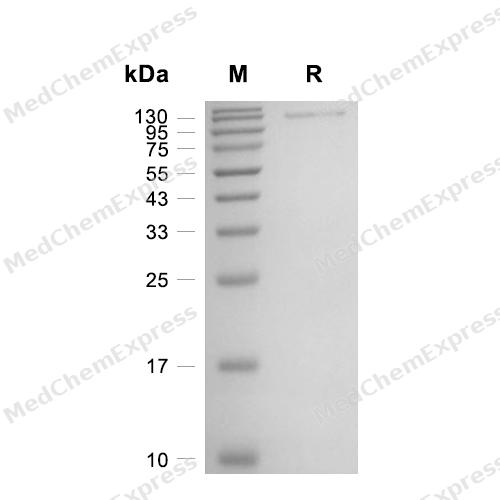
Purity - SDS-PAGE


Technical Parameters
-
Species Human
-
Source HEK293
-
Tag C-10*His
-
Accession
P49321-1 (M1-C788)
-
Gene ID4678
-
Molecular Construction
-
N-term
-
NASP (M1-C788)
Accession # P49321-1 -
His
-
C-term
-
-
Protein Length
Full Length of Isoform-1
-
Synonyms
NASP; FLJ35510; Nuclear Autoantigenic Sperm Protein; MGC19722; FLB7527; MGC20372; PRO1999; MGC2297; Nuclear Autoantigenic Sperm Protein (Histone-Binding); Histone H1-Binding Protein; NASP Histone Chaperone; NASP Protein; DKFZp547F162; HMDRA1; FLJ31599
-
AA Sequence
MAMESTATAAVAAELVSADKIEDVPAPSTSADKVESLDVDSEAKKLLGLGQKHLVMGDIPAAVNAFQEAASLLGKKYGETANECGEAFFFYGKSLLELARMENGVLGNALEGVHVEEEEGEKTEDESLVENNDNIDEEAREELREQVYDAMGEKEEAKKTEDKSLAKPETDKEQDSEMEKGGREDMDISKSAEEPQEKVDLTLDWLTETSEEAKGGAAPEGPNEAEVTSGKPEQEVPDAEEEKSVSGTDVQEECREKGGQEKQGEVIVSIEEKPKEVSEEQPVVTLEKQGTAVEVEAESLDPTVKPVDVGGDEPEEKVVTSENEAGKAVLEQLVGQEVPPAEESPEVTTEAAEASAVEAGSEVSEKPGQEAPVLPKDGAVNGPSVVGDQTPIEPQTSIERLTETKDGSGLEEKVRAKLVPSQEETKLSVEESEAAGDGVDTKVAQGATEKSPEDKVQIAANEETQEREEQMKEGEETEGSEEDDKENDKTEEMPNDSVLENKSLQENEEEEIGNLELAWDMLDLAKIIFKRQETKEAQLYAAQAHLKLGEVSVESENYVQAVEEFQSCLNLQEQYLEAHDRLLAETHYQLGLAYGYNSQYDEAVAQFSKSIEVIENRMAVLNEQVKEAEGSSAEYKKEIEELKELLPEIREKIEDAKESQRSGNVAELALKATLVESSTSGFTPGGGGSSVSMIASRKPTDGASSSNCVTDISHLVRKKRKPEEESPRKDDAKKAKQEPEVNGGSGDAVPSGNEVSENMEEEAENQAESRAAVEGTVEAGATVESTAC
-
Predicted Molecular Mass
85.2 kDa
-
Molecular Weight
Approximately 100-130 kDa, based on SDS-PAGE under reducing conditions.
-
Purity
≥ 95%, as determined by reducing SDS-PAGE.


Product Properties
Lyophilized powder.
Lyophilized from a 0.22 μm filtered solution of PBS, pH 7.4.
<1 EU/μg, determined by LAL method.
It is not recommended to reconstitute to a concentration less than 100 μg/mL in ddH2O. For long term storage it is recommended to add a carrier protein (0.1% BSA, 5% HSA, 10% FBS or 5% Trehalose).
Stored at -20°C for 2 years from date of receipt. After reconstitution, it is stable at 4°C for 1 week or -20°C for longer (with carrier protein). It is recommended to freeze aliquots at -20°C or -80°C for extended storage.
Room temperature in continental US; may vary elsewhere.


Documentation
-
Data Sheet (239 KB)
-
SDS (251 KB)
- English - EN (251 KB)
- Français - FR (251 KB)
- Deutsch - DE (251 KB)
- Norwegian - NO (251 KB)
- Español - ES (251 KB)
- Swedish - SV (251 KB)
- Italian - IT (251 KB)
- Korean - KR (251 KB)
- Portuguese - PT (251 KB)
-
Handling Instructions (2659 KB)

Calculators
Concentration (start) × Volume (start) = Concentration (final) × Volume (final)


 Powered by Bioz

