



Nucleoside phosphorylase/PNP Protein, Human (His)

Based on 1 Customer Validation
Nucleoside phosphorylase/PNP proteins play a vital role in cellular processes by catalyzing the phosphate breakdown of β-(deoxy)ribonucleosides, preferably 6-oxopurine nucleosides, such as inosine and guanosine. This enzymatic activity results in the formation of free purine bases and pentose 1-phosphate, highlighting the importance of this protein in regulating nucleoside degradation. Nucleoside phosphorylase/PNP Protein, Human (His) is the recombinant human-derived Nucleoside phosphorylase/PNP protein, expressed by E. coli , with C-10*His labeled tag.
- Species: Human
- Source: E. coli
-
Storage:Stored at -20°C for 2 years from date of receipt. After reconstitution, it is stable at 4°C for 1 week or -20°C for longer (with carrier protein). It is recommended to freeze aliquots at -20°C or -80°C for extended storage.


To place orders, for customer services and technical support, please contact: MedChemExpress USA
Tel: 609-228-6898 E-mail: [email protected] [email protected]


-
 Biological Activity
-
Technical Parameters
-
Product Properties
- Documentation
- Help & FAQs




Biological Activity
Description
Nucleoside phosphorylase/PNP proteins play a vital role in cellular processes by catalyzing the phosphate breakdown of β-(deoxy)ribonucleosides, preferably 6-oxopurine nucleosides, such as inosine and guanosine. This enzymatic activity results in the formation of free purine bases and pentose 1-phosphate, highlighting the importance of this protein in regulating nucleoside degradation. Nucleoside phosphorylase/PNP Protein, Human (His) is the recombinant human-derived Nucleoside phosphorylase/PNP protein, expressed by E. coli , with C-10*His labeled tag.
Background
The Nucleoside phosphorylase/PNP protein assumes a crucial role in cellular processes by catalyzing the phosphorolytic breakdown of N-glycosidic bonds in beta-(deoxy)ribonucleoside molecules. This enzymatic activity results in the formation of the corresponding free purine bases and pentose-1-phosphate, as documented in relevant literature. Notably, the protein exhibits a preference for 6-oxopurine nucleosides, such as inosine and guanosine. The substrate specificity of Nucleoside phosphorylase/PNP underscores its significance in the regulated degradation of nucleosides, providing insights into its role in maintaining cellular purine homeostasis and contributing to the overall dynamics of nucleotide metabolism.
Verified Bioactivity
Measured by the phosphorolysis of 7-methyl-6-thioguanosine. The specific activity is 4672.43 pmol/min/µg, as measured under the described conditions.
MCE Validation Data
-
Purity - SDS-PAGE
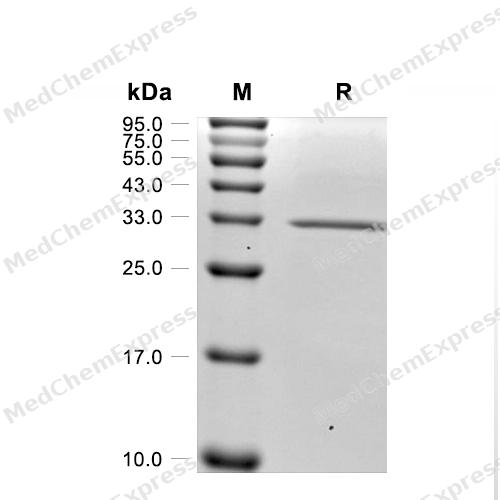
Purity - SDS-PAGE


Technical Parameters
-
Species Human
-
Source E. coli
-
Tag C-10*His
-
Accession
P00491 (M1-S289)
-
Molecular Construction
-
N-term
-
PNP (M1-S289)
Accession # P00491 -
10*His
-
C-term
-
-
Protein Length
Full Length
-
Synonyms
PNP; Epididymis Secretory Sperm Binding Protein Li 156an; Prev. NP; Purine-Nucleoside Phosphorylase; Inosine-Guanosine Phosphorylase; Nucleoside Phosphorylase; Inosine Phosphorylase; HEL-S-156an; PUNP; PRO1837; Purine Nucleoside Phosphorylase; Purine-Nucl
-
AA Sequence
MENGYTYEDYKNTAEWLLSHTKHRPQVAIICGSGLGGLTDKLTQAQIFDYGEIPNFPRSTVPGHAGRLVFGFLNGRACVMMQGRFHMYEGYPLWKVTFPVRVFHLLGVDTLVVTNAAGGLNPKFEVGDIMLIRDHINLPGFSGQNPLRGPNDERFGDRFPAMSDAYDRTMRQRALSTWKQMGEQRELQEGTYVMVAGPSFETVAECRVLQKLGADAVGMSTVPEVIVARHCGLRVFGFSLITNKVIMDYESLEKANHEEVLAAGKQAAQKLEQFVSILMASIPLPDKAS
-
Molecular Weight
Approximately 33-34 kDa, based on SDS-PAGE under reducing conditions.
-
Purity
≥ 95%, as determined by reducing SDS-PAGE.


Product Properties
Lyophilized powder.
1.Lyophilized from a 0.22 μm filtered solution of 50 mM MES, 50 mM Arg, 5% trehalose, 5% mannitol, 0.01% Tween 80.
2.Lyophilized from a 0.22 μm filtered solution of 50 mM Tris-HCl, 300 mM NaCl, 200 mM arginine, pH 8.0.
Please refer to the lot-specific COA for specific buffer information.
Note: For SPR assay, please replace the buffer. Primary amine components (e.g., Tris, imidazole) can affect protein-coupled chips.
<1 EU/μg, determined by LAL method.
It is not recommended to reconstitute to a concentration less than 100 μg/mL in ddH2O. For long term storage it is recommended to add a carrier protein (0.1% BSA, 5% HSA, 10% FBS or 5% Trehalose).
Stored at -20°C for 2 years from date of receipt. After reconstitution, it is stable at 4°C for 1 week or -20°C for longer (with carrier protein). It is recommended to freeze aliquots at -20°C or -80°C for extended storage.
Room temperature in continental US; may vary elsewhere.


Documentation
-
Data Sheet (237 KB)
-
SDS (252 KB)
- English - EN (252 KB)
- Français - FR (252 KB)
- Deutsch - DE (252 KB)
- Norwegian - NO (252 KB)
- Español - ES (252 KB)
- Swedish - SV (252 KB)
- Italian - IT (252 KB)
- Korean - KR (252 KB)
- Portuguese - PT (252 KB)
-
Handling Instructions (2659 KB)

Calculators
Concentration (start) × Volume (start) = Concentration (final) × Volume (final)


 Powered by Bioz

