



P4HB Protein, Human (His)
Based on 1 publication(s) in Google Scholar
The P4HB protein is a multifunctional entity that catalyzes disulfide bonding processes at the cell surface and within cells. As a reductase, it modifies outer surface proteins and participates in the formation of disulfide bonds in nascent proteins. P4HB Protein, Human (His) is the recombinant human-derived P4HB protein, expressed by E. coli , with N-6*His labeled tag.
- Species: Human
- Source: E. coli
-
Storage:Stored at -20°C for 2 years from date of receipt. After reconstitution, it is stable at 4°C for 1 week or -20°C for longer (with carrier protein). It is recommended to freeze aliquots at -20°C or -80°C for extended storage.


To place orders, for customer services and technical support, please contact: MedChemExpress USA
Tel: 609-228-6898 E-mail: [email protected] [email protected]


-
 Biological Activity
-
Technical Parameters
-
Product Properties
- Documentation
- Help & FAQs




Biological Activity
Description
The P4HB protein is a multifunctional entity that catalyzes disulfide bonding processes at the cell surface and within cells. As a reductase, it modifies outer surface proteins and participates in the formation of disulfide bonds in nascent proteins. P4HB Protein, Human (His) is the recombinant human-derived P4HB protein, expressed by E. coli , with N-6*His labeled tag.
Background
The P4HB protein, a multifunctional entity, catalyzes the intricate processes of forming, breaking, and rearranging disulfide bonds. Positioned at the cell surface, it acts as a reductase, cleaving disulfide bonds of proteins linked to the cell and potentially causing structural modifications of exofacial proteins. Intracellularly, P4HB is involved in forming and rearranging disulfide bonds of nascent proteins. At elevated concentrations, and under the phosphorylation influence of FAM20C, it functions as a chaperone, preventing the aggregation of misfolded proteins. Conversely, at lower concentrations, it exhibits anti-chaperone activity by facilitating aggregation. P4HB's versatility extends to its participation as a structural subunit in various enzymes such as prolyl 4-hydroxylase and microsomal triacylglycerol transfer protein MTTP. Furthermore, it serves as a receptor for LGALS9, with this interaction influencing disulfide reductase activity at the cell surface of Th2 T helper cells, altering the plasma membrane's redox state, and enhancing cell migration. This diverse range of functions underscores the pivotal role of P4HB in cellular processes, including protein folding, redox regulation, and cell migration.
Verified Bioactivity
1.Thiol Protein Reductase Activity is 0.001 /650nm/ min-2, determined by measuring the turbidityincrease at 650 nm due to insulin reduction.The activity is expressed as the ratio of the slope of a linear part of the turbidity curve to the lag tim.
2. Measured by its ability to promote aggregation of insulin in the presence of DTT. The specific activity is 9.375 A650/cm/min/mg.
MCE Validation Data
-
Purity - SDS-PAGE
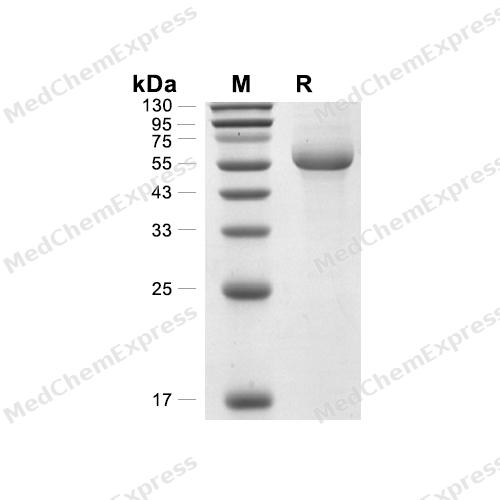
Purity - SDS-PAGE


Publications (1)
-
Journal Impact Factor
-
Most Recent
-
Oncogenesis
P4HB maintains Wnt-dependent stemness in glioblastoma stem cells as a precision therapeutic target and serum marker. [Abstract]2024 Nov 23;13(1):42. PMID: 39580454


Technical Parameters
-
Species Human
-
Source E. coli
-
Tag N-6*His
-
Accession
P07237 (A19-L508)
-
Molecular Construction
-
N-term
-
6*His
-
P4HB (A19-L508)
Accession # P07237 -
C-term
-
-
Protein Length
Full Length of Protein disulfide-isomerase Chain
-
Synonyms
P4HB; Protein Disulfide Isomerase Family A, Member 1; Prev. ERBA2L; Cellular Thyroid Hormone-Binding Protein; Prev. PO4DB; Prolyl 4-Hydroxylase, Beta Polypeptide; PDIA1; Collagen Prolyl 4-Hydroxylase Beta; PDI; Procollagen-Proline, 2-Oxoglutarate 4-Dioxyg
-
AA Sequence
APEEEDHVLVLRKSNFAEALAAHKYLLVEFYAPWCGHCKALAPEYAKAAGKLKAEGSEIRLAKVDATEESDLAQQYGVRGYPTIKFFRNGDTASPKEYTAGREADDIVNWLKKRTGPAATTLPDGAAAESLVESSEVAVIGFFKDVESDSAKQFLQAAEAIDDIPFGITSNSDVFSKYQLDKDGVVLFKKFDEGRNNFEGEVTKENLLDFIKHNQLPLVIEFTEQTAPKIFGGEIKTHILLFLPKSVSDYDGKLSNFKTAAESFKGKILFIFIDSDHTDNQRILEFFGLKKEECPAVRLITLEEEMTKYKPESEELTAERITEFCHRFLEGKIKPHLMSQELPEDWDKQPVKVLVGKNFEDVAFDEKKNVFVEFYAPWCGHCKQLAPIWDKLGETYKDHENIVIAKMDSTANEVEAVKVHSFPTLKFFPASADRTVIDYNGERTLDGFKKFLESGGQDGAGDDDDLEDLEEAEEPDMEEDDDQKAVKDEL
-
Molecular Weight
Approximately 56 kDa, based on SDS-PAGE under reducing conditions.
-
Purity
≥ 95%, as determined by reducing SDS-PAGE.


Product Properties
Lyophilized powder.
Lyophilized from a 0.22 μm filtered solution of 50 mM Tris-HCl, 300 mM NaCl, pH 7.4.
Note: For SPR assay, please replace the buffer. Primary amine components (e.g., Tris, imidazole) can affect protein-coupled chips.
<1 EU/μg, determined by LAL method.
It is not recommended to reconstitute to a concentration less than 100 μg/mL in ddH2O. For long term storage it is recommended to add a carrier protein (0.1% BSA, 5% HSA, 10% FBS or 5% Trehalose).
Stored at -20°C for 2 years from date of receipt. After reconstitution, it is stable at 4°C for 1 week or -20°C for longer (with carrier protein). It is recommended to freeze aliquots at -20°C or -80°C for extended storage.
Room temperature in continental US;may vary elsewhere.


Documentation
-
Data Sheet (239 KB)
-
SDS (252 KB)
- English - EN (252 KB)
- Français - FR (252 KB)
- Deutsch - DE (252 KB)
- Norwegian - NO (252 KB)
- Español - ES (252 KB)
- Swedish - SV (252 KB)
- Italian - IT (252 KB)
- Korean - KR (252 KB)
- Portuguese - PT (252 KB)
-
Handling Instructions (2659 KB)

Calculators
Concentration (start) × Volume (start) = Concentration (final) × Volume (final)


 Powered by Bioz

