



PAEP Protein, Human (HEK293, His)

Based on 1 Customer Validation
PAEP protein is a glycoprotein that regulates fertilization steps and exhibits immunomodulatory effects. PAEP Protein, Human (HEK293, His) is the recombinant human-derived PAEP protein, expressed by HEK293 , with N-10*His labeled tag.
- Species: Human
- Source: HEK293
-
Storage:Stored at -80°C for 1 year from date of receipt. It is stable at -20°C for 3 months after opening. It is recommended to freeze aliquots at -80°C for extended storage. Avoid repeated freeze-thaw cycles.


To place orders, for customer services and technical support, please contact: MedChemExpress USA
Tel: 609-228-6898 E-mail: [email protected] [email protected]


-
 Biological Activity
-
Technical Parameters
-
Product Properties
- Documentation
- Help & FAQs




Biological Activity
Description
PAEP protein is a glycoprotein that regulates fertilization steps and exhibits immunomodulatory effects. PAEP Protein, Human (HEK293, His) is the recombinant human-derived PAEP protein, expressed by HEK293 , with N-10*His labeled tag.
Background
The PAEP Protein, a glycoprotein, intricately regulates crucial steps during fertilization while also exerting immunomodulatory effects. In reproductive tissues, four distinct glycoforms—namely glycodelin-S, -A, -F, and -C—have been identified, each characterized by unique glycosylation patterns and biological activities. Glycodelin-A, for instance, exhibits both contraceptive and immunosuppressive activities. On the other hand, Glycodelin-C plays a role in stimulating the binding of spermatozoa to the zona pellucida. In contrast, Glycodelin-F serves to inhibit spermatozoa-zona pellucida binding and significantly suppresses the progesterone-induced acrosome reaction of spermatozoa. Additionally, Glycodelin-S, present in seminal plasma, maintains the uncapacitated state of human spermatozoa. The protein forms a homodimer, further emphasizing its structural complexity and functional diversity in orchestrating key events during fertilization and modulating immune responses.
MCE Validation Data
-
Purity - SDS-PAGE
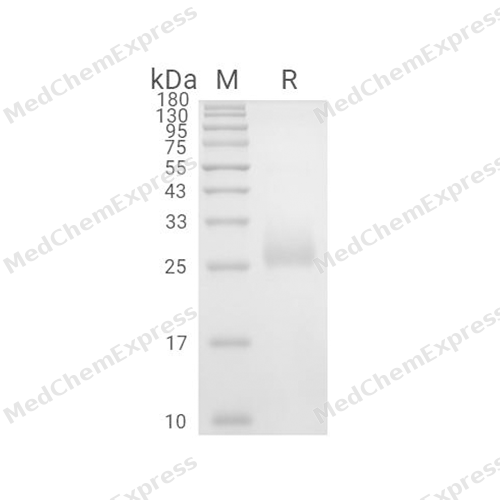
Purity - SDS-PAGE


Technical Parameters
-
Species Human
-
Source HEK293
-
Tag N-10*His
-
Accession
P09466-1 (M19-F180)
-
Molecular Construction
-
N-term
-
10*His
-
PAEP (M19-F180)
Accession # P09466-1 -
C-term
-
-
Protein Length
Full Length of Isoform-1
-
Synonyms
PAEP; PP14 Protein (Placental Protein 14); Progestagen Associated Endometrial Protein; Zona-Binding Inhibitory Factor-1; Glycodelin; Alpha Uterine Protein; PP14; Placental Protein 14; PAEG; Glycodelin-A; GD; Glycodelin-S; Progesterone-Associated Endometri
-
AA Sequence
MDIPQTKQDLELPKLAGTWHSMAMATNNISLMATLKAPLRVHITSLLPTPEDNLEIVLHRWENNSCVEKKVLGEKTENPKKFKINYTVANEATLLDTDYDNFLFLCLQDTTTPIQSMMCQYLARVLVEDDEIMQGFIRAFRPLPRHLWYLLDLKQMEEPCRF
-
Predicted Molecular Mass
20.2 kDa
-
Molecular Weight
Approximately 18 kDa, based on SDS-PAGE under reducing conditions.
-
Glycosylation
Yes
-
Purity
≥ 95%, as determined by reducing SDS-PAGE.


Product Properties
Solution
1.Supplied as a 0.22 μm filtered solution of 20 mM Tris-HCl, 150 mM NaCl, 30% glycerin, pH 8.0.
2.Supplied as a 0.22 μm filtered solution of 20 mM Tris-HCl, 150 mM NaCl, pH 8.0.
3.Supplied as a 0.22 μm filtered solution of 20 mM Tris-HCL, 150 mM NaCl, pH 8.0, 30% glycerol.
Note:For SPR assay, please replace the buffer. Primary amine components (e.g., Tris, imidazole) can affect protein-coupled chips.
Please refer to the lot-specific COA for specific buffer information.
<1 EU/μg, determined by LAL method.
Stored at -80°C for 1 year from date of receipt. It is stable at -20°C for 3 months after opening. It is recommended to freeze aliquots at -80°C for extended storage. Avoid repeated freeze-thaw cycles.
Shipping with dry ice.


Documentation
-
Data Sheet (236 KB)
-
SDS (252 KB)
- English - EN (252 KB)
- Français - FR (252 KB)
- Deutsch - DE (252 KB)
- Norwegian - NO (252 KB)
- Español - ES (252 KB)
- Swedish - SV (252 KB)
- Italian - IT (252 KB)
- Korean - KR (252 KB)
- Portuguese - PT (252 KB)
-
Handling Instructions (2659 KB)

Calculators
Concentration (start) × Volume (start) = Concentration (final) × Volume (final)


 Powered by Bioz

