



PDHA1 Protein, Human (His, Myc)

Based on 1 Customer Validation
The PDHA1 protein is an important component of the pyruvate dehydrogenase complex and is responsible for coordinating the conversion of pyruvate to acetyl-CoA and CO2. It establishes an important link between glycolysis and the tricarboxylic acid (TCA) cycle, ensuring seamless integration of metabolic pathways. PDHA1 Protein, Human (His, Myc) is the recombinant human-derived PDHA1 protein, expressed by E. coli, with C-Myc and N-10*His labeled tag.
- Species: Human
- Source: E. coli
-
Storage:Stored at -20°C for 2 years from date of receipt. After reconstitution, it is stable at 4°C for 1 week or -20°C for longer (with carrier protein). It is recommended to freeze aliquots at -20°C or -80°C for extended storage.


To place orders, for customer services and technical support, please contact: MedChemExpress USA
Tel: 609-228-6898 E-mail: [email protected] [email protected]


-
 Biological Activity
-
Technical Parameters
-
Product Properties
- Documentation
- Help & FAQs




Biological Activity
Description
The PDHA1 protein is an important component of the pyruvate dehydrogenase complex and is responsible for coordinating the conversion of pyruvate to acetyl-CoA and CO2. It establishes an important link between glycolysis and the tricarboxylic acid (TCA) cycle, ensuring seamless integration of metabolic pathways. PDHA1 Protein, Human (His, Myc) is the recombinant human-derived PDHA1 protein, expressed by E. coli, with C-Myc and N-10*His labeled tag.
Background
PDHA1 protein, a crucial constituent of the pyruvate dehydrogenase complex, plays a pivotal role in orchestrating the comprehensive conversion of pyruvate into acetyl-CoA and CO2. This enzymatic process establishes a fundamental link between the glycolytic pathway and the tricarboxylic acid (TCA) cycle, facilitating the seamless integration of metabolic pathways. PDHA1's catalytic function is essential for the efficient transformation of pyruvate, ensuring the flow of carbon substrates into the TCA cycle for subsequent energy generation and metabolic homeostasis within the cell.
MCE Validation Data
-
Purity - SDS-PAGE
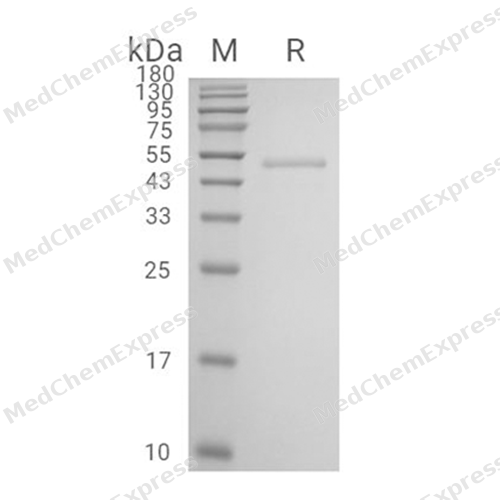
Purity - SDS-PAGE


Technical Parameters
-
Species Human
-
Source E. coli
-
Tag C-Myc;N-10*His
-
Accession
P08559-1 (A31-S390)
-
Gene ID5160
-
Molecular Construction
-
N-term
-
10*His
-
(A31-S390)
Accession # P08559-1 -
Myc
-
C-term
-
-
Protein Length
Full Length of Mature Protein
-
Synonyms
PDHA1; Pyruvate Dehydrogenase E1 Component Subunit Alpha, Testis-Specific Form, Mitochondrial; Prev. PDHA; Pyruvate Dehydrogenase E1 Component Subunit Alpha; Pyruvate Dehydrogenase E1 Component Subunit Alpha, Somatic Form, Mitochondrial; Pyruvate Dehydrog
-
AA Sequence
ANDATFEIKKCDLHRLEEGPPVTTVLTREDGLKYYRMMQTVRRMELKADQLYKQKIIRGFCHLCDGQEACCVGLEAGINPTDHLITAYRAHGFTFTRGLSVREILAELTGRKGGCAKGKGGSMHMYAKNFYGGNGIVGAQVPLGAGIALACKYNGKDEVCLTLYGDGAANQGQIFEAYNMAALWKLPCIFICENNRYGMGTSVERAAASTDYYKRGDFIPGLRVDGMDILCVREATRFAAAYCRSGKGPILMELQTYRYHGHSMSDPGVSYRTREEIQEVRSKSDPIMLLKDRMVNSNLASVEELKEIDVEVRKEIEDAAQFATADPEPPLEELGYHIYSSDPPFEVRGANQWIKFKSVS
-
Molecular Weight
Approximately 45-50 kDa, based on SDS-PAGE under reducing conditions.
-
Purity
≥ 90%, as determined by reducing SDS-PAGE.


Product Properties
Lyophilized powder
Lyophilized from a 0.22 μm filtered solution of PBS, 6% trehalose, pH 7.4.
<1 EU/μg, determined by LAL method.
It is not recommended to reconstitute to a concentration less than 100 μg/mL in ddH2O.
Stored at -20°C for 2 years from date of receipt. After reconstitution, it is stable at 4°C for 1 week or -20°C for longer (with carrier protein). It is recommended to freeze aliquots at -20°C or -80°C for extended storage.
Room temperature in continental US; may vary elsewhere.


Documentation
-
Data Sheet (237 KB)
-
SDS (251 KB)
- English - EN (251 KB)
- Français - FR (251 KB)
- Deutsch - DE (251 KB)
- Norwegian - NO (251 KB)
- Español - ES (251 KB)
- Swedish - SV (251 KB)
- Italian - IT (251 KB)
- Korean - KR (251 KB)
- Portuguese - PT (251 KB)
-
Handling Instructions (2659 KB)

Calculators
Concentration (start) × Volume (start) = Concentration (final) × Volume (final)


 Powered by Bioz

