



PDIA4 Protein, Human (HEK293, His)

Based on 1 Customer Validation
The PDIA4 protein plays a key role in the chaperone complex, cooperating with various proteins. This dynamic assembly, including DNAJB11, HSP90B1 and others, orchestrates complex cellular processes. PDIA4 Protein, Human (HEK293, His) is the recombinant human-derived PDIA4 protein, expressed by HEK293 , with C-6*His labeled tag.
- Species: Human
- Source: HEK293
-
Storage:Stored at -80°C for 1 year from date of receipt. It is stable at -20°C for 3 months after opening. It is recommended to freeze aliquots at -80°C for extended storage. Avoid repeated freeze-thaw cycles.


To place orders, for customer services and technical support, please contact: MedChemExpress USA
Tel: 609-228-6898 E-mail: [email protected] [email protected]


-
 Biological Activity
-
Technical Parameters
-
Product Properties
- Documentation
- Help & FAQs




Biological Activity
Description
The PDIA4 protein plays a key role in the chaperone complex, cooperating with various proteins. This dynamic assembly, including DNAJB11, HSP90B1 and others, orchestrates complex cellular processes. PDIA4 Protein, Human (HEK293, His) is the recombinant human-derived PDIA4 protein, expressed by HEK293 , with C-6*His labeled tag.
Background
PDIA4 plays a crucial role as a constituent of a sizable chaperone multiprotein complex, collaborating with DNAJB11, HSP90B1, HSPA5, HYOU, PDIA2, PDIA6, PPIB, SDF2L1, and UGGT1, with trace amounts of ERP29 present. Notably absent or present in minimal quantities are CALR and CANX. This complex serves as a dynamic assembly of molecular chaperones, orchestrating intricate cellular processes. Additionally, PDIA4 is an integral component of another complex alongside CRELD2, MANF, and MATN3, indicating its versatile engagement in diverse molecular networks. The interplay within these complexes highlights the significance of PDIA4 in maintaining cellular homeostasis and supporting various biological functions.
Verified Bioactivity
Measured by its ability to catalyze the reduction of insulin. The reaction leads to precipitation, which can be measured by absorbance at 650 nm. The specific activity is 0.1727 A650/min/mg.
MCE Validation Data
-
Purity - SDS-PAGE
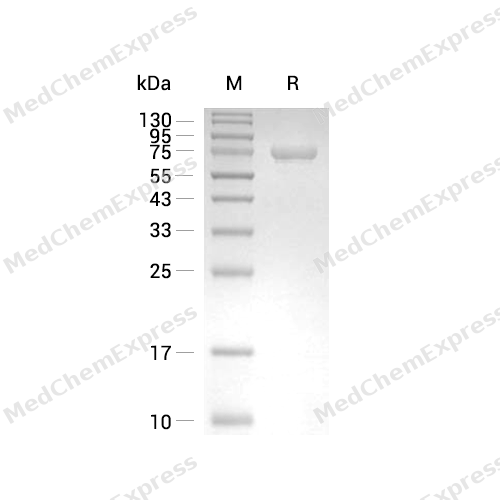
Purity - SDS-PAGE


Technical Parameters
-
Species Human
-
Source HEK293
-
Tag C-6*His
-
Accession
P13667 (V21-L645)
-
Molecular Construction
-
N-term
-
PDIA4 (V21-L645)
Accession # P13667 -
6*His
-
C-term
-
-
Protein Length
Full Length of Mature Protein
-
Synonyms
PDIA4; ER Protein 72; Protein Disulfide Isomerase Family A Member 4; ERp-72; ERP70; Protein Disulfide Isomerase Related Protein (Calcium-Binding Protein, Intestinal-Related); ERP72; Protein Disulfide Isomerase Family A, Member 4; Endoplasmic Reticulum Res
-
AA Sequence
VAGAEGPDEDSSNRENAIEDEEEEEEEDDDEEEDDLEVKEENGVLVLNDANFDNFVADKDTVLLEFYAPWCGHCKQFAPEYEKIANILKDKDPPIPVAKIDATSASVLASRFDVSGYPTIKILKKGQAVDYEGSRTQEEIVAKVREVSQPDWTPPPEVTLVLTKENFDEVVNDADIILVEFYAPWCGHCKKLAPEYEKAAKELSKRSPPIPLAKVDATAETDLAKRFDVSGYPTLKIFRKGRPYDYNGPREKYGIVDYMIEQSGPPSKEILTLKQVQEFLKDGDDVIIIGVFKGESDPAYQQYQDAANNLREDYKFHHTFSTEIAKFLKVSQGQLVVMQPEKFQSKYEPRSHMMDVQGSTQDSAIKDFVLKYALPLVGHRKVSNDAKRYTRRPLVVVYYSVDFSFDYRAATQFWRSKVLEVAKDFPEYTFAIADEEDYAGEVKDLGLSESGEDVNAAILDESGKKFAMEPEEFDSDTLREFVTAFKKGKLKPVIKSQPVPKNNKGPVKVVVGKTFDSIVMDPKKDVLIEFYAPWCGHCKQLEPVYNSLAKKYKGQKGLVIAKMDATANDVPSDRYKVEGFPTIYFAPSGDKKNPVKFEGGDRDLEHLSKFIEEHATKLSRTKEEL
-
Predicted Molecular Mass
71.7 kDa
-
Molecular Weight
Approximately 75 kDa, based on SDS-PAGE under reducing conditions.
-
Purity
≥ 95%, as determined by reducing SDS-PAGE.


Product Properties
Solution
1.Supplied as a 0.22 μm filtered solution of 20 mM Tris-HCl, 150 mM NaCl, 10% glycerol, pH 7.5.
2.Supplied as a 0.22 μm filtered solution in PBS, pH 7.4.
Please refer to the lot-specific COA for specific buffer information.
Note: For SPR assay, please replace the buffer. Primary amine components (e.g., Tris, imidazole) can affect protein-coupled chips.
<1 EU/μg, determined by LAL method.
Stored at -80°C for 1 year from date of receipt. It is stable at -20°C for 3 months after opening. It is recommended to freeze aliquots at -80°C for extended storage. Avoid repeated freeze-thaw cycles.
Shipping with dry ice.


Documentation
-
Data Sheet (239 KB)
-
SDS (251 KB)
- English - EN (251 KB)
- Français - FR (251 KB)
- Deutsch - DE (251 KB)
- Norwegian - NO (251 KB)
- Español - ES (251 KB)
- Swedish - SV (251 KB)
- Italian - IT (251 KB)
- Korean - KR (251 KB)
- Portuguese - PT (251 KB)
-
Handling Instructions (2659 KB)

Calculators
Concentration (start) × Volume (start) = Concentration (final) × Volume (final)


 Powered by Bioz

