



PRDX1 Protein, Mouse (His)

Based on 1 Customer Validation
The PRDX1 protein is a thiol-specific peroxidase that catalyzes the reduction of hydrogen peroxide and organic hydroperoxides to water and alcohols.Its key role in cellular protection against oxidative stress includes detoxifying superoxide and acting as a sensor of hydrogen peroxide-mediated signaling events.PRDX1 Protein, Mouse (His) is the recombinant mouse-derived PRDX1 protein, expressed by E.coli , with C-His labeled tag.
- Species: Mouse
- Source: E. coli
-
Storage:Stored at -80°C for 1 year from date of receipt. It is stable at -20°C for 3 months after opening. It is recommended to freeze aliquots at -80°C for extended storage. Avoid repeated freeze-thaw cycles.


To place orders, for customer services and technical support, please contact: MedChemExpress USA
Tel: 609-228-6898 E-mail: [email protected] [email protected]


-
 Biological Activity
-
Technical Parameters
-
Product Properties
- Documentation
- Help & FAQs




Biological Activity
Description
The PRDX1 protein is a thiol-specific peroxidase that catalyzes the reduction of hydrogen peroxide and organic hydroperoxides to water and alcohols.Its key role in cellular protection against oxidative stress includes detoxifying superoxide and acting as a sensor of hydrogen peroxide-mediated signaling events.PRDX1 Protein, Mouse (His) is the recombinant mouse-derived PRDX1 protein, expressed by E.coli , with C-His labeled tag.
Background
PRDX1, a thiol-specific peroxidase, functions as a catalyst for the reduction of hydrogen peroxide and organic hydroperoxides, converting them into water and alcohols, respectively. Its pivotal role in cell protection against oxidative stress involves detoxifying peroxides and acting as a sensor for hydrogen peroxide-mediated signaling events. Additionally, PRDX1 may contribute to the signaling cascades initiated by growth factors and tumor necrosis factor-alpha, exerting control over intracellular H(2)O(2) concentrations. Notably, PRDX1 exhibits the ability to reduce an intramolecular disulfide bond in GDPD5, thereby modulating GDPD5's capacity to drive postmitotic motor neuron differentiation. These diverse functions underscore the versatile and intricate regulatory roles of PRDX1 in cellular processes associated with redox signaling and differentiation.
Verified Bioactivity
Defined as the amount of hydroperoxide that 1μg of PRDX1 can reduce at 25℃ for 1 minute. The specific activity is 7064.257 pmol/min/μg, as measured under the described conditions.
MCE Validation Data
-
Purity - SDS-PAGE
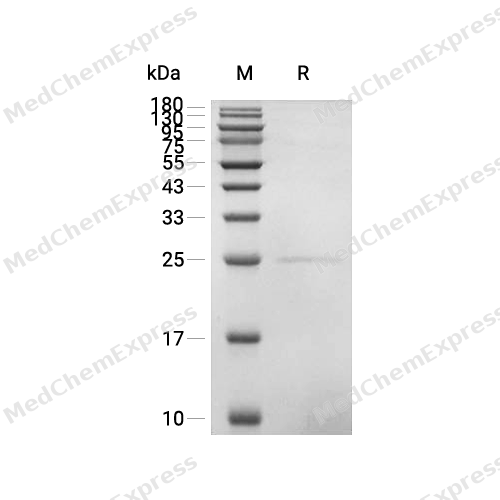
Purity - SDS-PAGE

Assay Procedure
Materials
30% H2O2
PRDX1 Protein, Mouse (His) (HY-P73713)
Procedure
1. Dilute 30% H2O2 to concentrations of 0.3058, 0.1529, 0.076, 0.038, 0.019, 0.0096, 0.0047, and 0 mol/L. Add 100 μL of each concentration to the wells and measure the absorbance at 240 nm.
2. Dilute H2O2 to 0.4 mol/L.
3. Dilute Mouse PRDX1 to 166 μg/mL.
4. In a 96-well plate, add 50 μL of 0.4 mol/L hydrogen peroxide and 50 μL Mouse PRDX1.
5. Read the initial absorbance at 240 nm.
6. Incubate at room temperature for 20 minutes and read the absorbance again.
7. Calculate specific activity:
Specific Activity (pmol/min/μg) = | Adjusted Abs * (OD) x Conversion Factor ** (pmol/RFU) |
| Incubation time (min) x amount of enzyme (μg) |
*Adjusted for Substrate Blank
**Derived using calibration standard
Per Well:
Mouse PRDX1: 8.3 μg
H2O2: 0.2 M


Technical Parameters
-
Species Mouse
-
Source E. coli
-
Tag C-His
-
Accession
P35700 (M1-K199)
-
Molecular Construction
-
N-term
-
PRDX1 (M1-K199)
Accession # P35700 -
His
-
C-term
-
-
Protein Length
Full Length
-
Synonyms
PRDX1; TDPX2; Prev. PAGA; PAG; Thioredoxin-Dependent Peroxide Reductase 2; Epididymis Secretory Sperm Binding Protein; Thioredoxin-Dependent Peroxiredoxin 1; Thioredoxin-Dependent Peroxiredoxin; Thioredoxin Peroxidase 2; Natural Killer-Enhancing Factor A;
-
AA Sequence
MSSGNAKIGYPAPNFKATAVMPDGQFKDISLSEYKGKYVVFFFYPLDFTFVCPTEIIAFSDRADEFKKLNCQVIGASVDSHFCHLAWINTPKKQGGLGPMNIPLISDPKRTIAQDYGVLKADEGISFRGLFIIDDKGILRQITINDLPVGRSVDEIIRLVQAFQFTDKHGEVCPAGWKPGSDTIKPDVNKSKEYFSKQK
-
Predicted Molecular Mass
23.5 kDa
-
Molecular Weight
Approximately 27 kDa, based on SDS-PAGE under reducing conditions.
-
Purity
≥ 85%, as determined by reducing SDS-PAGE.


Product Properties
Solution
Supplied as a 0.22 μm filtered solution of PBS, 10% glycerol, pH 7.4.
<1 EU/μg, determined by LAL method.
Stored at -80°C for 1 year from date of receipt. It is stable at -20°C for 3 months after opening. It is recommended to freeze aliquots at -80°C for extended storage. Avoid repeated freeze-thaw cycles.
Shipping with dry ice.


Documentation
-
Data Sheet (236 KB)
-
SDS (251 KB)
- English - EN (251 KB)
- Français - FR (251 KB)
- Deutsch - DE (251 KB)
- Norwegian - NO (251 KB)
- Español - ES (251 KB)
- Swedish - SV (251 KB)
- Italian - IT (251 KB)
- Korean - KR (251 KB)
- Portuguese - PT (251 KB)
-
Handling Instructions (2659 KB)

Calculators
Concentration (start) × Volume (start) = Concentration (final) × Volume (final)


 Powered by Bioz

