



PKM2 Protein, Human (420a.a, His)
Based on 1 publication(s) in Google Scholar
PKM2 Protein, Human (420a.a, His) is a multifunctional protein, is exclusively expressed in embryonic and adult dividing/tumor cells. PKM2 can catabolize glucose and involved in many nonglycolytic pathways.
- Species: Human
- Source: E. coli
-
Storage:Stored at -80°C for 1 year from date of receipt. It is stable at -20°C for 3 months after opening. It is recommended to freeze aliquots at -80°C for extended storage. Avoid repeated freeze-thaw cycles.


To place orders, for customer services and technical support, please contact: MedChemExpress USA
Tel: 609-228-6898 E-mail: [email protected] [email protected]


-
 Biological Activity
-
Technical Parameters
-
Product Properties
- Documentation
- References
- Help & FAQs




Biological Activity
Description
PKM2 Protein, Human (420a.a, His) is a multifunctional protein, is exclusively expressed in embryonic and adult dividing/tumor cells. PKM2 can catabolize glucose and involved in many nonglycolytic pathways[1].
Background
Pyruvate Kinase M2 (PKM2), a multifunctional protein, is exclusively expressed in embryonic and adult dividing/tumor cells. PKM2 is a ubiquitous prototype enzyme present in all tissues during the embryonic stage and is gradually replaced by other isozymic forms in specific tissues during development. Although the primary function of PKM2 is to catabolize glucose, it is involved in many nonglycolytic pathways, influencing the cellular physiology[1].
Verified Bioactivity
Measured by its ability to couple reaction catalyzed by PKM2 and LDH, detect the consumption of NADH by pyruvate, the product of phosphate (enol) pyruvate monosodium salt hydrate (PEP). Specific activity is ≥12.13 pmol/min/μg was measured under the conditions described.
MCE Validation Data
-
Purity - SDS-PAGE
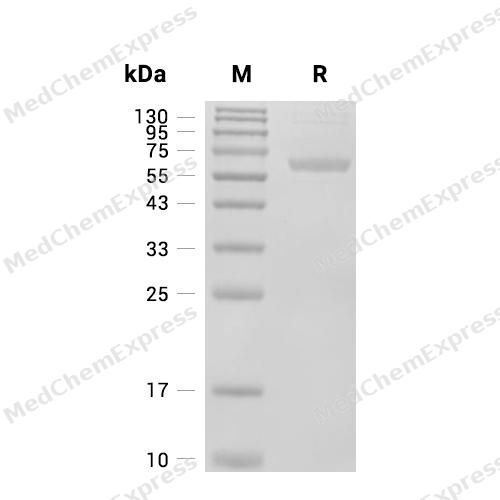
Purity - SDS-PAGE


Publications (1)
-
Journal Impact Factor
-
Most Recent
-
Fitoterapia
Discovery of PKM2 activators from Aconiti Lateralis Radix Praeparata via computer-aided drug design and experimental validation. [Abstract]2025 Oct:186:106793. PMID: 40789458


Technical Parameters
-
Species Human
-
Source E. coli
-
Tag His
-
Accession
P14618-1 (L61-E480)
-
Protein Length
Partial
-
Synonyms
PKM; Tumor M2-PK; Prev. PKM2; P58; THBP1; Thyroid Hormone-Binding Protein, Cytosolic; OIP3; Epididymis Secretory Protein Li 30; PK3; Pyruvate Kinase Isozymes M1/M2; Pyruvate Kinase Muscle Isozyme; OPA-Interacting Protein 3; Cytosolic Thyroid Hormone-Bindi
-
AA Sequence
LKEMIKSGMNVARLNFSHGTHEYHAETIKNVRTATESFASDPILYRPVAVALDTKGPEIRTGLIKGSGTAEVELKKGATLKITLDNAYMEKCDENILWLDYKNICKVVEVGSKIYVDDGLISLQVKQKGADFLVTEVENGGSLGSKKGVNLPGAAVDLPAVSEKDIQDLKFGVEQDVDMVFASFIRKASDVHEVRKVLGEKGKNIKIISKIENHEGVRRFDEILEASDGIMVARGDLGIEIPAEKVFLAQKMMIGRCNRAGKPVICATQMLESMIKKPRPTRAEGSDVANAVLDGADCIMLSGETAKGDYPLEAVRMQHLIAREAEAAIYHLQLFEELRRLAPITSDPTEATAVGAVEASFKCCSGAIIVLTKSGRSAHQVARYRPRAPIIAVTRNPQTARQAHLYRGIFPVLCKDPVQE
-
Molecular Weight
Approximately 55 kDa, based on SDS-PAGE under reducing conditions.
-
Purity
≥ 90%, as determined by reducing SDS-PAGE.


Product Properties
Solution
Supplied as a 0.22 μm filtered solution of 50 mM Tris, 1 mM EDTA, trace Imidazole and DTT, pH 7.4.
Note: For SPR assay, please replace the buffer. Primary amine components (e.g., Tris, imidazole) can affect protein-coupled chips.
<1 EU/μg, determined by LAL method.
Stored at -80°C for 1 year from date of receipt. It is stable at -20°C for 3 months after opening. It is recommended to freeze aliquots at -80°C for extended storage. Avoid repeated freeze-thaw cycles.
Shipping with dry ice.


Documentation
-
Data Sheet (262 KB)
-
SDS (252 KB)
- English - EN (252 KB)
- Français - FR (252 KB)
- Deutsch - DE (252 KB)
- Norwegian - NO (252 KB)
- Español - ES (252 KB)
- Swedish - SV (252 KB)
- Italian - IT (252 KB)
- Korean - KR (252 KB)
- Portuguese - PT (252 KB)
-
Handling Instructions (2659 KB)


References

Calculators
Concentration (start) × Volume (start) = Concentration (final) × Volume (final)


 Powered by Bioz

