



POLD2 Protein, Human (His)

Based on 1 Customer Validation
The POLD2 protein is a key component of DNA polymerase delta (Pol-delta) and DNA polymerase zeta (Pol-zeta) complexes, which are essential for genome replication fidelity and repair. In Pol-delta3 and Pol-delta4 forms, POLD2 contributes to high-fidelity lagging strand synthesis. POLD2 Protein, Human (His) is the recombinant human-derived POLD2, expressed by E. coli, with C-6*His labeled tag.
- Species: Human
- Source: E. coli
-
Storage:Stored at -20°C for 2 years from date of receipt. After reconstitution, it is stable at 4°C for 1 week or -20°C for longer (with carrier protein). It is recommended to freeze aliquots at -20°C or -80°C for extended storage.


To place orders, for customer services and technical support, please contact: MedChemExpress USA
Tel: 609-228-6898 E-mail: [email protected] [email protected]


-
 Biological Activity
-
Technical Parameters
-
Product Properties
- Documentation
- Help & FAQs




Biological Activity
Description
The POLD2 protein is a key component of DNA polymerase delta (Pol-delta) and DNA polymerase zeta (Pol-zeta) complexes, which are essential for genome replication fidelity and repair. In Pol-delta3 and Pol-delta4 forms, POLD2 contributes to high-fidelity lagging strand synthesis. POLD2 Protein, Human (His) is the recombinant human-derived POLD2, expressed by E. coli, with C-6*His labeled tag.
Background
POLD2, an integral component of both the DNA polymerase delta (Pol-delta) complex and the DNA polymerase zeta (Pol-zeta) complex, plays a pivotal role in genome replication fidelity and repair processes. Within the trimeric and tetrameric forms of Pol-delta (Pol-delta3 and Pol-delta4), POLD2 contributes to high-fidelity lagging strand synthesis and participates in the replication and repair of the genome. Notably, the catalytic activities and substrate preferences of Pol-delta3 and Pol-delta4 vary, with Pol-delta3 exhibiting superior proofreading capabilities. POLD2 is crucial for nucleotide excision repair (NER) synthesis following UV irradiation and is involved in translesion synthesis (TLS) of damaged templates. Additionally, POLD2, along with POLD3, enhances the efficiency and processivity of DNA synthesis in the Pol-zeta complex, impacting various cellular functions related to DNA replication and repair. Furthermore, POLD2 interacts with a range of proteins, such as WRNIP1, KCTD13/PDIP1, and KCTD10, underscoring its regulatory role in DNA polymerase activities and cellular responses to DNA damage.
MCE Validation Data
-
Purity - SDS-PAGE
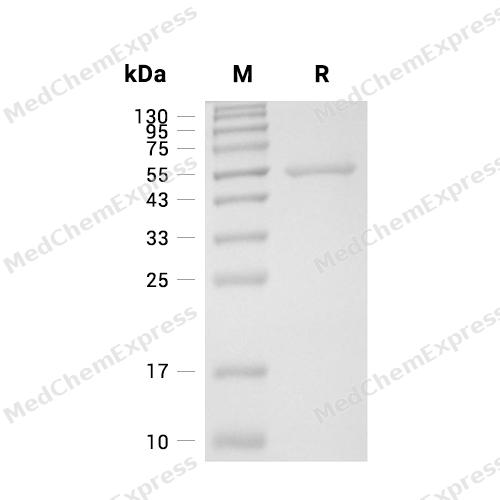
Purity - SDS-PAGE


Technical Parameters
-
Species Human
-
Source E. coli
-
Tag C-6*His
-
Accession
P49005 (M1-P469)
-
Molecular Construction
-
N-term
-
POLD2 (M1-P469)
Accession # P49005 -
6*His
-
C-term
-
-
Protein Length
Full Length
-
Synonyms
POLD2; Polymerase (DNA) Delta 2, Accessory Subunit; DNA Polymerase Delta 2, Accessory Subunit; Pol Delta B Subunit (P50); DNA Polymerase Delta Subunit P50; Polymerase (DNA Directed), Delta 2, Regulatory Subunit (50kD); DNA Polymerase Delta Subunit 2; Poly
-
AA Sequence
MFSEQAAQRAHTLLSPPSANNATFARVPVATYTNSSQPFRLGERSFSRQYAHIYATRLIQMRPFLENRAQQHWGSGVGVKKLCELQPEEKCCVVGTLFKAMPLQPSILREVSEEHNLLPQPPRSKYIHPDDELVLEDELQRIKLKGTIDVSKLVTGTVLAVFGSVRDDGKFLVEDYCFADLAPQKPAPPLDTDRFVLLVSGLGLGGGGGESLLGTQLLVDVVTGQLGDEGEQCSAAHVSRVILAGNLLSHSTQSRDSINKAKYLTKKTQAASVEAVKMLDEILLQLSASVPVDVMPGEFDPTNYTLPQQPLHPCMFPLATAYSTLQLVTNPYQATIDGVRFLGTSGQNVSDIFRYSSMEDHLEILEWTLRVRHISPTAPDTLGCYPFYKTDPFIFPECPHVYFCGNTPSFGSKIIRGPEDQTVLLVTVPDFSATQTACLVNLRSLACQPISFSGFGAEDDDLGGLGLGP
-
Predicted Molecular Mass
52.1 kDa
-
Molecular Weight
Approximately 53 kDa, based on SDS-PAGE under reducing conditions.
-
Purity
≥ 95%, as determined by reducing SDS-PAGE.


Product Properties
Lyophilized powder.
Lyophilized from a 0.22 μm filtered solution of PBS, pH 7.4, 0.1% SKL.
<1 EU/μg, determined by LAL method.
It is not recommended to reconstitute to a concentration less than 100 μg/mL in ddH2O. For long term storage it is recommended to add a carrier protein (0.1% BSA, 5% HSA, 10% FBS or 5% Trehalose).
Stored at -20°C for 2 years from date of receipt. After reconstitution, it is stable at 4°C for 1 week or -20°C for longer (with carrier protein). It is recommended to freeze aliquots at -20°C or -80°C for extended storage.
Room temperature in continental US; may vary elsewhere.


Documentation
-
Data Sheet (238 KB)
-
SDS (252 KB)
- English - EN (252 KB)
- Français - FR (252 KB)
- Deutsch - DE (252 KB)
- Norwegian - NO (252 KB)
- Español - ES (252 KB)
- Swedish - SV (252 KB)
- Italian - IT (252 KB)
- Korean - KR (252 KB)
- Portuguese - PT (252 KB)
-
Handling Instructions (2659 KB)

Calculators
Concentration (start) × Volume (start) = Concentration (final) × Volume (final)


 Powered by Bioz

