



PPID Protein, Human (His)

Based on 1 Customer Validation
PPID protein is a peptidyl prolyl cis-trans isomerase (PPIase) that catalyzes the isomerization of prolyl imide peptide bonds and contributes to protein folding. It serves as a co-chaperone in the HSP90 complex, contributing to dynamic regulation and may favor the estrogen receptor complex. PPID Protein, Human (His) is the recombinant human-derived PPID protein, expressed by E. coli , with N-6*His, C-6*His labeled tag.
- Species: Human
- Source: E. coli
-
Storage:Stored at -20°C for 2 years from date of receipt. After reconstitution, it is stable at 4°C for 1 week or -20°C for longer (with carrier protein). It is recommended to freeze aliquots at -20°C or -80°C for extended storage.


To place orders, for customer services and technical support, please contact: MedChemExpress USA
Tel: 609-228-6898 E-mail: [email protected] [email protected]


-
 Biological Activity
-
Technical Parameters
-
Product Properties
- Documentation
- Help & FAQs




Biological Activity
Description
PPID protein is a peptidyl prolyl cis-trans isomerase (PPIase) that catalyzes the isomerization of prolyl imide peptide bonds and contributes to protein folding. It serves as a co-chaperone in the HSP90 complex, contributing to dynamic regulation and may favor the estrogen receptor complex. PPID Protein, Human (His) is the recombinant human-derived PPID protein, expressed by E. coli , with N-6*His, C-6*His labeled tag.
Background
PPID Protein serves as a peptidyl-prolyl cis-trans isomerase (PPIase), catalyzing the cis-trans isomerization of proline imidic peptide bonds in oligopeptides and potentially aiding in protein folding processes. Proposed to act as a co-chaperone in HSP90 complexes, particularly in unligated steroid receptors heterocomplexes, PPID contributes to the dynamic regulation of HSP90-co-chaperone-receptor complexes. This involvement suggests a role in tissue-specific control of receptor activity, with a potential preference for estrogen receptor complexes over glucocorticoid receptor complexes. Moreover, PPID may participate in the cytoplasmic dynein-dependent movement of receptors from the cytoplasm to the nucleus. Notably, it is implicated in regulating MYB by inhibiting its DNA-binding activity and plays a role in AHR signaling by promoting the formation of the AHR:ARNT dimer, independently of HSP90 but requiring chaperone activity. Additionally, PPID is involved in the regulation of UV radiation-induced apoptosis and promotes cell viability in anaplastic lymphoma kinase-positive anaplastic large-cell lymphoma (ALK+ ALCL) cell lines. In the context of microbial infection, PPID may be associated with hepatitis C virus (HCV) replication and release.
Verified Bioactivity
Measured by its ability to convert 3 mM substrate, Suc-AAPF-pNA (HY-P2573), from Cis to Trans formation. That incubate at 37°C temperature in kinetic mode for 1 minutes. The specific activity is 1536.201 pmol/min/μg.
MCE Validation Data
-
Purity - SDS-PAGE
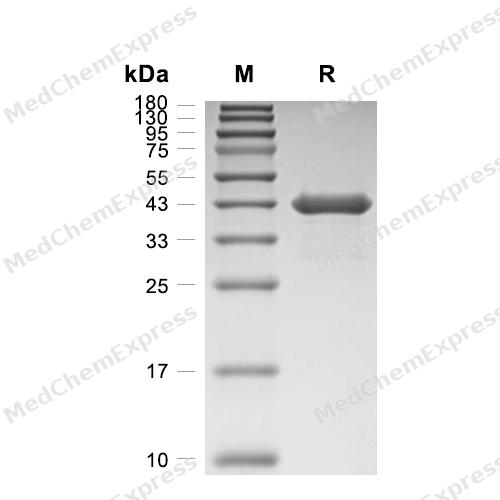
Purity - SDS-PAGE


Technical Parameters
-
Species Human
-
Source E. coli
-
Tag C-6*His;N-6*His
-
Accession
Q08752 (M1-A370)
-
Gene ID5481
-
Molecular Construction
-
N-term
-
6*His
-
PPID (M1-A370)
Accession # Q08752 -
6*His
-
C-term
-
-
Protein Length
Full Length
-
Synonyms
PPID; PPIase D; Peptidylprolyl Isomerase D; 40 KDa Peptidyl-Prolyl Cis-Trans Isomerase D; CYP-40; Peptidylprolyl Isomerase D (Cyclophilin D); Peptidyl-Prolyl Cis-Trans Isomerase D; Peptidyl-Prolyl Cis-Trans Isomerase; Rotamase D; Testicular Tissue Protein
-
AA Sequence
MSHPSPQAKPSNPSNPRVFFDVDIGGERVGRIVLELFADIVPKTAENFRALCTGEKGIGHTTGKPLHFKGCPFHRIIKKFMIQGGDFSNQNGTGGESIYGEKFEDENFHYKHDREGLLSMANAGRNTNGSQFFITTVPTPHLDGKHVVFGQVIKGIGVARILENVEVKGEKPAKLCVIAECGELKEGDDGGIFPKDGSGDSHPDFPEDADIDLKDVDKILLITEDLKNIGNTFFKSQNWEMAIKKYAEVLRYVDSSKAVIETADRAKLQPIALSCVLNIGACKLKMSNWQGAIDSCLEALELDPSNTKALYRRAQGWQGLKEYDQALADLKKAQGIAPEDKAIQAELLKVKQKIKAQKDKEKAVYAKMFA
-
Predicted Molecular Mass
40.8 kDa
-
Molecular Weight
Approximately 43 kDa, based on SDS-PAGE under reducing conditions.
-
Purity
≥ 95%, as determined by reducing SDS-PAGE.


Product Properties
Lyophilized powder.
Lyophilized from a 0.22 μm filtered solution of PBS, pH 8.0, 8% trehalose.
<1 EU/μg, determined by LAL method.
It is not recommended to reconstitute to a concentration less than 100 μg/mL in ddH2O.
Stored at -20°C for 2 years from date of receipt. After reconstitution, it is stable at 4°C for 1 week or -20°C for longer (with carrier protein). It is recommended to freeze aliquots at -20°C or -80°C for extended storage.
Room temperature in continental US; may vary elsewhere.


Documentation
-
Data Sheet (237 KB)
-
SDS (251 KB)
- English - EN (251 KB)
- Français - FR (251 KB)
- Deutsch - DE (251 KB)
- Norwegian - NO (251 KB)
- Español - ES (251 KB)
- Swedish - SV (251 KB)
- Italian - IT (251 KB)
- Korean - KR (251 KB)
- Portuguese - PT (251 KB)
-
Handling Instructions (2659 KB)

Calculators
Concentration (start) × Volume (start) = Concentration (final) × Volume (final)


 Powered by Bioz

