



PRELP Protein, Human (HEK293)

Based on 1 Customer Validation
The PRELP protein may be an anchoring factor that plays a crucial role in connecting the basement membrane and connective tissue, contributing to structural integrity. Its interaction with the heparan sulfate proteoglycan perlecan and type I and type II collagen emphasizes its versatile binding ability. PRELP Protein, Human (HEK293) is the recombinant human-derived PRELP protein, expressed by HEK293 , with tag free.
- Species: Human
- Source: HEK293
-
Storage:Stored at -20°C for 2 years from date of receipt. After reconstitution, it is stable at 4°C for 1 week or -20°C for longer (with carrier protein). It is recommended to freeze aliquots at -20°C or -80°C for extended storage.


To place orders, for customer services and technical support, please contact: MedChemExpress USA
Tel: 609-228-6898 E-mail: [email protected] [email protected]


-
 Biological Activity
-
Technical Parameters
-
Product Properties
- Documentation
- Help & FAQs




Biological Activity
Description
The PRELP protein may be an anchoring factor that plays a crucial role in connecting the basement membrane and connective tissue, contributing to structural integrity. Its interaction with the heparan sulfate proteoglycan perlecan and type I and type II collagen emphasizes its versatile binding ability. PRELP Protein, Human (HEK293) is the recombinant human-derived PRELP protein, expressed by HEK293 , with tag free.
Background
PRELP Protein emerges as a potential anchoring factor linking basement membranes to the underlying connective tissue, suggesting a crucial role in structural integrity. This function implies its involvement in maintaining the stability and organization of extracellular matrices. PRELP specifically interacts with the basement membrane heparan sulfate proteoglycan perlecan and triple helical collagens type I and type II, underscoring its versatile binding capabilities and its significance in mediating molecular connections within the extracellular environment. The protein's dual ability to anchor to perlecan and collagens hints at its role in orchestrating the intricate composition of basement membranes, reflecting its potential contributions to tissue architecture and homeostasis. Further exploration of PRELP's interactions and functions may unveil its specific mechanisms in basement membrane anchoring and provide insights into its broader implications in connective tissue biology.
MCE Validation Data
-
Purity - SDS-PAGE
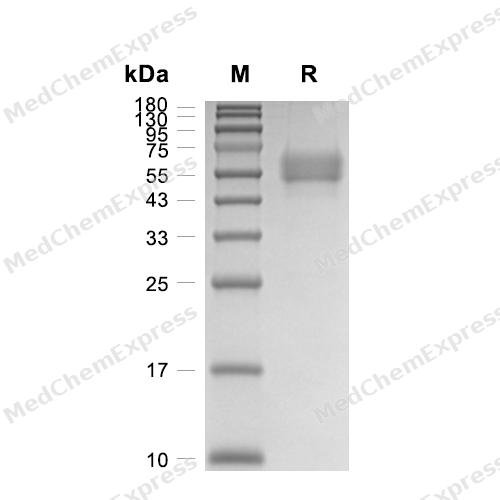
Purity - SDS-PAGE


Technical Parameters
-
Species Human
-
Source HEK293
-
Tag Tag Free
-
Accession
P51888/NP_002716.1 (Q21-I382)
-
Molecular Construction
-
N-term
-
PRELP (Q21-I382)
Accession # P51888 -
C-term
-
-
Protein Length
Full Length of Mature Protein
-
Synonyms
PRELP; 55 KDa Leucine-Rich Repeat Protein Of Articular Cartilage; Proline And Arginine Rich End Leucine Rich Repeat Protein; Proline Arginine-Rich End Leucine-Rich Repeat Protein; Prolargin; PRELP Protein; SLRR2A; MSTP161; Proline-Arginine-Rich End Leucin
-
AA Sequence
QPTRRPRPGTGPGRRPRPRPRPTPSFPQPDEPAEPTDLPPPLPPGPPSIFPDCPRECYCPPDFPSALYCDSRNLRKVPVIPPRIHYLYLQNNFITELPVESFQNATGLRWINLDNNRIRKIDQRVLEKLPGLVFLYMEKNQLEEVPSALPRNLEQLRLSQNHISRIPPGVFSKLENLLLLDLQHNRLSDGVFKPDTFHGLKNLMQLNLAHNILRKMPPRVPTAIHQLYLDSNKIETIPNGYFKSFPNLAFIRLNYNKLTDRGLPKNSFNISNLLVLHLSHNRISSVPAINNRLEHLYLNNNSIEKINGTQICPNDLVAFHDFSSDLENVPHLRYLRLDGNYLKPPIPLDLMMCFRLLQSVVI
-
Molecular Weight
Approximately 54 kDa, based on SDS-PAGE under reducing conditions.
-
Glycosylation
Yes
-
Purity
≥ 95%, as determined by reducing SDS-PAGE.


Product Properties
Lyophilized powder.
Lyophilized from a 0.2 μm filtered solution of PBS, pH 7.4, 8% trehalose.
<1 EU/μg, determined by LAL method.
It is not recommended to reconstitute to a concentration less than 100 μg/mL in ddH2O.
Stored at -20°C for 2 years from date of receipt. After reconstitution, it is stable at 4°C for 1 week or -20°C for longer (with carrier protein). It is recommended to freeze aliquots at -20°C or -80°C for extended storage.
Room temperature in continental US; may vary elsewhere.


Documentation
-
Data Sheet (237 KB)
-
SDS (252 KB)
- English - EN (252 KB)
- Français - FR (252 KB)
- Deutsch - DE (252 KB)
- Norwegian - NO (252 KB)
- Español - ES (252 KB)
- Swedish - SV (252 KB)
- Italian - IT (252 KB)
- Korean - KR (252 KB)
- Portuguese - PT (252 KB)
-
Handling Instructions (2659 KB)

Calculators
Concentration (start) × Volume (start) = Concentration (final) × Volume (final)


 Powered by Bioz

