



PRKN Protein, Human (His, SUMO)

Based on 1 Customer Validation
PRKN Protein, Human (His, SUMO) is the recombinant human-derived PRKN, expressed by E. coli , with N-SUMO, N-6*His labeled tag.
- Species: Human
- Source: E. coli
-
Storage:Stored at -20°C for 2 years from date of receipt. After reconstitution, it is stable at 4°C for 1 week or -20°C for longer (with carrier protein). It is recommended to freeze aliquots at -20°C or -80°C for extended storage.


To place orders, for customer services and technical support, please contact: MedChemExpress USA
Tel: 609-228-6898 E-mail: [email protected] [email protected]


-
 Biological Activity
-
Technical Parameters
-
Product Properties
- Documentation
- Help & FAQs




Biological Activity
Description
PRKN Protein, Human (His, SUMO) is the recombinant human-derived PRKN, expressed by E. coli , with N-SUMO, N-6*His labeled tag.
Background
Parkin is a component of a multiprotein E3 ubiquitin ligase complex that catalyzes the covalent attachment of ubiquitin moieties to substrate proteins, including SYT11, VDAC1, BCL2, CCNE1, GPR37, RHOT1/MIRO1, MFN1, MFN2, STUB1, SNCAIP, SEPTIN5, TOMM20, USP30, ZNF746, MIRO1, and AIMP2. It mediates monoubiquitination as well as context-dependent 'Lys-6'-, 'Lys-11'-, 'Lys-48'-, and 'Lys-63'-linked polyubiquitination. Parkin participates in the removal or detoxification of misfolded or damaged proteins by mediating 'Lys-63'-linked polyubiquitination, leading to their recruitment to aggresomes and subsequent degradation. It also plays a role in Lewy-body formation through 'Lys-63'-linked polyubiquitination of SNCAIP. During cellular stress, Parkin acts downstream of PINK1 to protect mitochondrial function by coordinating quality control mechanisms, ranging from preventing apoptosis and stimulating mitochondrial biogenesis to regulating dynamics and eliminating damaged mitochondria via mitophagy. Together with PINK1, Parkin mediates the decision between mitophagy and apoptosis inhibition by ubiquitinating VDAC1. It regulates mitochondrial motility by ubiquitinating and degrading MIRO1 and MIRO2 and promotes mitochondrial biogenesis by degrading the transcriptional repressor ZNF746/PARIS via 'Lys-48'-linked polyubiquitination. Parkin also limits reactive oxygen species (ROS) production, regulates cyclin-E during neuronal apoptosis, and independently of its ubiquitin ligase activity, protects against apoptosis by transcriptionally repressing p53/TP53.
Verified Bioactivity
Immobilized Human PRKN at 2.5 μg/mL (100μl/well) on the plate can bind Anti-PRKN Antibody. The ED50 for this effect is 79.06 ng/mL.
MCE Validation Data
-
Purity - SDS-PAGE
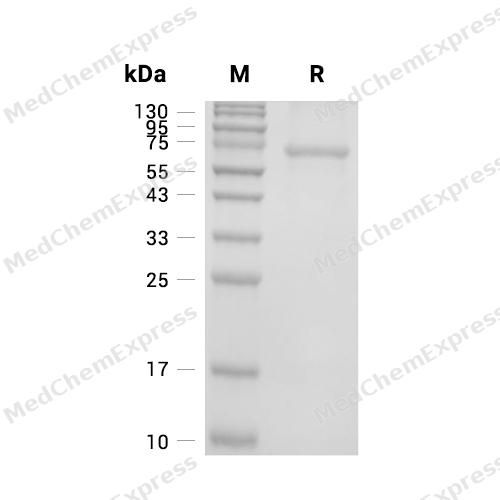
Purity - SDS-PAGE
-
Bioactivity - ELISA
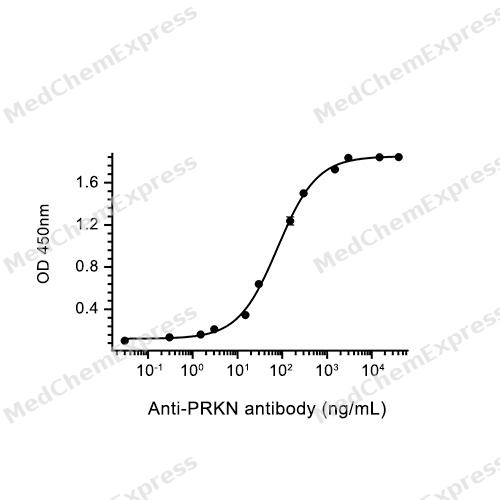
Bioactivity - ELISA


Technical Parameters
-
Species Human
-
Source E. coli
-
Tag N-SUMO;N-6*His
-
Accession
O60260-1 (M1-V465)
-
Gene ID5071
-
Molecular Construction
-
N-term
-
6*His-SUMO
-
PRKN (M1-V465)
Accession # O60260-1 -
C-term
-
-
Protein Length
Full Length of Isoform-1
-
Synonyms
PRKN; Parkinson Juvenile Disease Protein 2; Prev. PARK2; Parkinson Protein 2 E3 Ubiquitin Protein Ligase; E3 Ubiquitin-Protein Ligase Parkin; Truncated Parkin Variant SV3,8,9DEL; Parkin; Truncated Parkin Variant SV4,8DEL; AR-JP; Truncated Parkin Variant S
-
AA Sequence
MIVFVRFNSSHGFPVEVDSDTSIFQLKEVVAKRQGVPADQLRVIFAGKELRNDWTVQNCDLDQQSIVHIVQRPWRKGQEMNATGGDDPRNAAGGCEREPQSLTRVDLSSSVLPGDSVGLAVILHTDSRKDSPPAGSPAGRSIYNSFYVYCKGPCQRVQPGKLRVQCSTCRQATLTLTQGPSCWDDVLIPNRMSGECQSPHCPGTSAEFFFKCGAHPTSDKETSVALHLIATNSRNITCITCTDVRSPVLVFQCNSRHVICLDCFHLYCVTRLNDRQFVHDPQLGYSLPCVAGCPNSLIKELHHFRILGEEQYNRYQQYGAEECVLQMGGVLCPRPGCGAGLLPEPDQRKVTCEGGNGLGCGFAFCRECKEAYHEGECSAVFEASGTTTQAYRVDERAAEQARWEAASKETIKKTTKPCPRCHVPVEKNGGCMHMKCPQPQCRLEWCWNCGCEWNRVCMGDHWFDV
-
Predicted Molecular Mass
63.6 kDa
-
Molecular Weight
Approximately 70 kDa, based on SDS-PAGE under reducing conditions.
-
Purity
≥ 95%, as determined by reducing SDS-PAGE.


Product Properties
Lyophilized powder
Lyophilized from a 0.22 μm filtered solution of 50 mM Tris-HCl, 200 mM NaCl, pH 8.0, 1 mM TCEP, 0.1% Brij-35, 5% Glycerol.
Note: For SPR assay, please replace the buffer. Primary amine components (e.g., Tris, imidazole) can affect protein-coupled chips.
<1 EU/μg, determined by LAL method.
It is not recommended to reconstitute to a concentration less than 100 μg/mL in ddH2O. For long term storage it is recommended to add a carrier protein (0.1% BSA, 5% HSA, 10% FBS or 5% Trehalose).
Stored at -20°C for 2 years from date of receipt. After reconstitution, it is stable at 4°C for 1 week or -20°C for longer (with carrier protein). It is recommended to freeze aliquots at -20°C or -80°C for extended storage.
Room temperature in continental US; may vary elsewhere.


Documentation
-
Data Sheet (239 KB)
-
SDS (252 KB)
- English - EN (252 KB)
- Français - FR (252 KB)
- Deutsch - DE (252 KB)
- Norwegian - NO (252 KB)
- Español - ES (252 KB)
- Swedish - SV (252 KB)
- Italian - IT (252 KB)
- Korean - KR (252 KB)
- Portuguese - PT (252 KB)
-
Handling Instructions (2659 KB)

Calculators
Concentration (start) × Volume (start) = Concentration (final) × Volume (final)


 Powered by Bioz

