



Prokineticin-1/EG-VEGF Protein, Human
Based on 1 Customer Validation
Prokineticin-1/EG-VEGF protein is a potent regulator of gastrointestinal smooth muscle contraction and affects intestinal motility. Its multifaceted effects extend to capillary endothelial cells, inducing proliferation, migration, and fenestration and are specific to certain cell types. Prokineticin-1/EG-VEGF Protein, Human is the recombinant human-derived Prokineticin-1/EG-VEGF protein, expressed by E. coli , with tag free.
- Species: Human
- Source: E. coli
-
Storage:Stored at -20°C for 2 years from date of receipt. After reconstitution, it is stable at 4°C for 1 week or -20°C for longer (with carrier protein). It is recommended to freeze aliquots at -20°C or -80°C for extended storage.


To place orders, for customer services and technical support, please contact: MedChemExpress USA
Tel: 609-228-6898 E-mail: [email protected] [email protected]


-
 Biological Activity
-
Technical Parameters
-
Product Properties
- Documentation
- Help & FAQs




Biological Activity
Description
Prokineticin-1/EG-VEGF protein is a potent regulator of gastrointestinal smooth muscle contraction and affects intestinal motility. Its multifaceted effects extend to capillary endothelial cells, inducing proliferation, migration, and fenestration and are specific to certain cell types. Prokineticin-1/EG-VEGF Protein, Human is the recombinant human-derived Prokineticin-1/EG-VEGF protein, expressed by E. coli , with tag free.
Background
Prokineticin-1/EG-VEGF Protein stands out as a potent regulator of gastrointestinal (GI) smooth muscle contraction, highlighting its role in modulating gut motility. Beyond its influence on smooth muscle, this protein exhibits a multifaceted impact on capillary endothelial cells derived from endocrine glands, inducing proliferation, migration, and fenestration. Importantly, Prokineticin-1/EG-VEGF demonstrates specificity by having little or no effect on various other endothelial and non-endothelial cell types. Its role extends to the enteric neural crest cells, where it induces proliferation and differentiation. In neuroblastoma progression, this protein directly influences the proliferation and migration of neuroblastoma cells, implicating its involvement in tumor dynamics. Additionally, Prokineticin-1/EG-VEGF positively regulates PTGS2 expression and prostaglandin synthesis, suggesting a potential role in inflammatory responses. With implications in placentation and normal as well as pathological testis angiogenesis, Prokineticin-1/EG-VEGF emerges as a versatile signaling molecule with diverse cellular effects across various physiological and pathological contexts.
Verified Bioactivity
Measured by its binding ability in a functional ELISA. Immobilized Human EG-VEGF at 2 μg/mL can bind Anti-EG-VEGF antibody. The ED50 for this effect is 42.32 ng/mL.
MCE Validation Data
-
Purity - SDS-PAGE
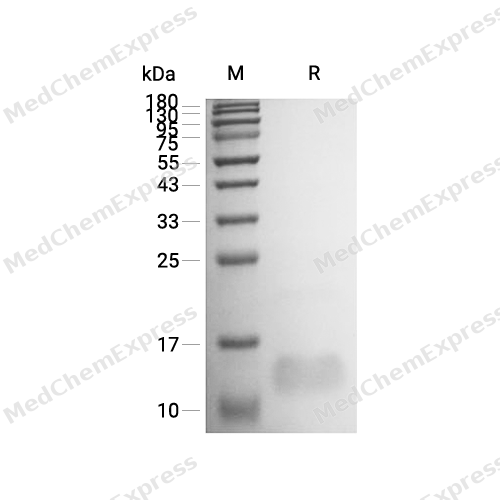
Purity - SDS-PAGE
-
Bioactivity - ELISA
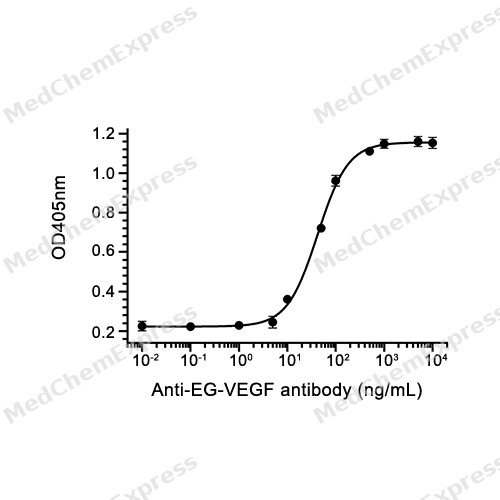
Bioactivity - ELISA


Technical Parameters
-
Species Human
-
Source E. coli
-
Tag Tag Free
-
Accession
P58294 (A20-F105)
-
Molecular Construction
-
N-term
-
EG-VEGF (A20-F105)
Accession # P58294 -
C-term
-
-
Protein Length
Full Length of Mature Protein
-
Synonyms
PROK1; PK1; Prokineticin 1; Endocrine-Gland-Derived Vascular Endothelial Growth Factor; EG-VEGF; Black Mamba Toxin-Related Protein; Mambakine; Prokineticin-1; EGVEGF; Endocrine Gland-Derived Vascular Endothelial Growth Factor; PRK1
-
AA Sequence
AVITGACERDVQCGAGTCCAISLWLRGLRMCTPLGREGEECHPGSHKVPFFRKRKHHTCPCLPNLLCSRFPDGRYRCSMDLKNINF
-
Predicted Molecular Mass
9.7 kDa
-
Molecular Weight
Approximately 12 kDa, based on SDS-PAGE under reducing conditions.
-
Purity
≥ 95%, as determined by reducing SDS-PAGE.


Product Properties
Lyophilized powder
Lyophilized from a 0.22 μm filtered solution of PBS, pH 7.4, 0.02% Tween20, 8% trehalose.
<1 EU/μg, determined by LAL method.
It is not recommended to reconstitute to a concentration less than 100 μg/mL in ddH2O.
Stored at -20°C for 2 years from date of receipt. After reconstitution, it is stable at 4°C for 1 week or -20°C for longer (with carrier protein). It is recommended to freeze aliquots at -20°C or -80°C for extended storage.
Room temperature in continental US; may vary elsewhere.


Documentation
-
Data Sheet (235 KB)
-
SDS (252 KB)
- English - EN (252 KB)
- Français - FR (252 KB)
- Deutsch - DE (252 KB)
- Norwegian - NO (252 KB)
- Español - ES (252 KB)
- Swedish - SV (252 KB)
- Italian - IT (252 KB)
- Korean - KR (252 KB)
- Portuguese - PT (252 KB)
-
Handling Instructions (2659 KB)

Calculators
Concentration (start) × Volume (start) = Concentration (final) × Volume (final)


 Powered by Bioz

