



PTP1B Protein, Human (His)
Based on 1 publication(s) in Google Scholar
PTP1B is an important tyrosine protein phosphatase that regulates the endoplasmic reticulum unfolded protein response by dephosphorylating EIF2AK3/PERK and inhibiting its kinase activity. It affects the signaling cascade induced by CKII and p60c-src, and may regulate the EFNA5-EPHA3 pathway, affecting cell reorganization. PTP1B Protein, Human (His) is the recombinant human-derived PTP1B protein, expressed by E. coli , with N-His labeled tag.
- Species: Human
- Source: E. coli
-
Storage:Stored at -80°C for 1 year from date of receipt. It is stable at -20°C for 3 months after opening. It is recommended to freeze aliquots at -80°C for extended storage. Avoid repeated freeze-thaw cycles.


To place orders, for customer services and technical support, please contact: MedChemExpress USA
Tel: 609-228-6898 E-mail: [email protected] [email protected]


-
 Biological Activity
-
Technical Parameters
-
Product Properties
- Documentation
- Help & FAQs




Biological Activity
Description
PTP1B is an important tyrosine protein phosphatase that regulates the endoplasmic reticulum unfolded protein response by dephosphorylating EIF2AK3/PERK and inhibiting its kinase activity. It affects the signaling cascade induced by CKII and p60c-src, and may regulate the EFNA5-EPHA3 pathway, affecting cell reorganization. PTP1B Protein, Human (His) is the recombinant human-derived PTP1B protein, expressed by E. coli , with N-His labeled tag.
Background
PTP1B, a tyrosine-protein phosphatase, serves as a key regulator of the endoplasmic reticulum unfolded protein response. It acts by mediating the dephosphorylation of EIF2AK3/PERK, thereby inactivating the protein kinase activity of EIF2AK3/PERK. PTP1B is implicated in potential roles within CKII- and p60c-src-induced signal transduction cascades. Moreover, it may exert regulatory influence over the EFNA5-EPHA3 signaling pathway, involved in cell reorganization and cell-cell repulsion. Additionally, PTP1B is suggested to modulate the hepatocyte growth factor receptor signaling pathway through its ability to dephosphorylate MET. These multifaceted functions underscore the versatility of PTP1B in orchestrating diverse cellular processes and signaling pathways.
Verified Bioactivity
1.Measured by its ability to dephosphorylate a phosphotyrosine residue in an EGF receptor (aa988-998) phosphopeptide substrate and the specific activity is >15 nmol/min/μg.
2.Measured by its ability to catalyzes the hydrolysis of the pNPP substrate that incubate at 37°C for 20 min. The specific activity is >10,000 nmol/min/μg.
MCE Validation Data
-
Purity - SDS-PAGE
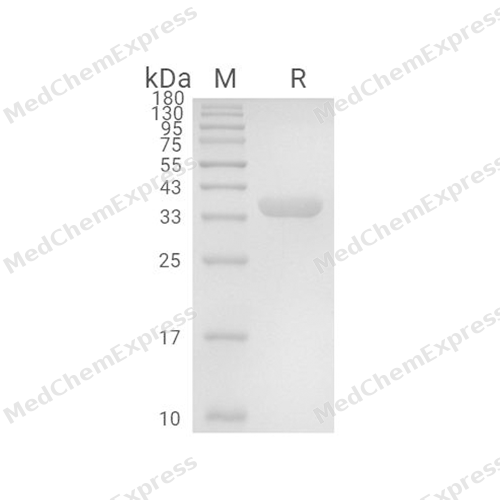
Purity - SDS-PAGE


Publications (1)
-
Journal Impact Factor
-
Most Recent
-
Nat Commun
2025 Sep 30;16(1):8684. PMID: 41028750


Technical Parameters
-
Species Human
-
Source E. coli
-
Tag N-6*His
-
Accession
P18031 (E2-N321)
-
Molecular Construction
-
N-term
-
6*His
-
PTP1B (E2-N321)
Accession # P18031 -
C-term
-
-
Protein Length
Partial
-
Synonyms
PTPN1; Protein-Tyrosine Phosphatase 1B; Prev. PTP1B; Protein Tyrosine Phosphatase, Placental; Tyrosine-Protein Phosphatase Non-Receptor Type 1; PTP-1B; Protein Tyrosine Phosphatase Non-Receptor Type 1; Tyrosine-Protein Phosphatase Non-Receptor Type
-
AA Sequence
EMEKEFEQIDKSGSWAAIYQDIRHEASDFPCRVAKLPKNKNRNRYRDVSPFDHSRIKLHQEDNDYINASLIKMEEAQRSYILTQGPLPNTCGHFWEMVWEQKSRGVVMLNRVMEKGSLKCAQYWPQKEEKEMIFEDTNLKLTLISEDIKSYYTVRQLELENLTTQETREILHFHYTTWPDFGVPESPASFLNFLFKVRESGSLSPEHGPVVVHCSAGIGRSGTFCLADTCLLLMDKRKDPSSVDIKKVLLEMRKFRMGLIQTADQLRFSYLAVIEGAKFIMGDSSVQDQWKELSHEDLEPPPEHIPPPPRPPKRILEPHN
-
Molecular Weight
Approximately 38 kDa, based on SDS-PAGE under reducing conditions.
-
Purity
≥ 95%, as determined by reducing SDS-PAGE.


Product Properties
Solution
Supplied as a 0.22 μm filtered solution of 10 mM HEPES, 150 mM NaCl, 1 mM DTT, pH 7.5.
<1 EU/μg, determined by LAL method.
Stored at -80°C for 1 year from date of receipt. It is stable at -20°C for 3 months after opening. It is recommended to freeze aliquots at -80°C for extended storage. Avoid repeated freeze-thaw cycles.
Shipping with dry ice.


Documentation
-
Data Sheet (236 KB)
-
SDS (252 KB)
- English - EN (252 KB)
- Français - FR (252 KB)
- Deutsch - DE (252 KB)
- Norwegian - NO (252 KB)
- Español - ES (252 KB)
- Swedish - SV (252 KB)
- Italian - IT (252 KB)
- Korean - KR (252 KB)
- Portuguese - PT (252 KB)
-
Handling Instructions (2659 KB)

Calculators
Concentration (start) × Volume (start) = Concentration (final) × Volume (final)


 Powered by Bioz

