



SHP-1 Protein, Human (His)
Based on 1 publication(s) in Google Scholar
SHP-1 Protein modulates signaling from tyrosine-phosphorylated cell surface receptors, including KIT and EGFR. It enhances the inhibition of mast cell activation via the Lilrb4a receptor. The SH2 regions interact with cellular components to regulate its phosphatase activity. In collaboration with MTUS1, it induces UBE2V2 expression upon angiotensin II stimulation. SHP-1 plays a crucial role in hematopoiesis. SHP-1 Protein, Human (His) is the recombinant human-derived SHP-1 protein, expressed by E. coli , with C-6*His labeled tag.
- Species: Human
- Source: E. coli
-
Storage:Stored at -80°C for 1 year from date of receipt. It is stable at -20°C for 3 months after opening. It is recommended to freeze aliquots at -80°C for extended storage. Avoid repeated freeze-thaw cycles.


To place orders, for customer services and technical support, please contact: MedChemExpress USA
Tel: 609-228-6898 E-mail: [email protected] [email protected]


-
 Biological Activity
-
Technical Parameters
-
Product Properties
- Documentation
- Help & FAQs




Biological Activity
Description
SHP-1 Protein modulates signaling from tyrosine-phosphorylated cell surface receptors, including KIT and EGFR. It enhances the inhibition of mast cell activation via the Lilrb4a receptor. The SH2 regions interact with cellular components to regulate its phosphatase activity. In collaboration with MTUS1, it induces UBE2V2 expression upon angiotensin II stimulation. SHP-1 plays a crucial role in hematopoiesis. SHP-1 Protein, Human (His) is the recombinant human-derived SHP-1 protein, expressed by E. coli , with C-6*His labeled tag.
Background
SHP-1 protein acts as a critical modulator of signaling pathways initiated by tyrosine phosphorylated cell surface receptors, including KIT and the EGF receptor/EGFR. Additionally, it enhances the inhibition of mast cell activation mediated by the Lilrb4a receptor. The SH2 regions of SHP-1 may engage with other cellular components, influencing its phosphatase activity against interacting substrates. Notably, in collaboration with MTUS1, SHP-1 induces UBE2V2 expression in response to angiotensin II stimulation. Beyond these regulatory functions, SHP-1 plays a key role in hematopoiesis, further emphasizing its significance in the intricate network of cellular processes and signaling events.
MCE Validation Data
-
Purity - SDS-PAGE
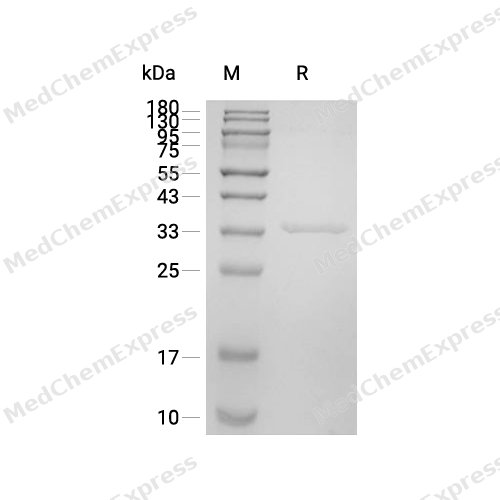
Purity - SDS-PAGE


Publications (1)
-
Journal Impact Factor
-
Most Recent
-
Nat Commun
2025 Sep 30;16(1):8684. PMID: 41028750


Technical Parameters
-
Species Human
-
Source E. coli
-
Tag C-6*His
-
Accession
AAH02523.1 (K243-I541)
-
Molecular Construction
-
N-term
-
SHP-1 (K243-I541)
Accession # AAH02523.1 -
6*His
-
C-term
-
-
Protein Length
Partial
-
Synonyms
PTPN6; Protein-Tyrosine Phosphatase SHP-1; Protein Tyrosine Phosphatase Non-Receptor Type 6; Protein-Tyrosine Phosphatase 1C; PTP-1C; SH-PTP1; HCP; Tyrosine-Protein Phosphatase Non-Receptor Type; SHP-1; Hematopoietic Cell Phosphatase; HCPH; Protein-Tyrosi
-
AA Sequence
KAGFWEEFESLQKQEVKNLHQRLEGQRPENKGKNRYKNILPFDHSRVILQGRDSNIPGSDYINANYIKNQLLGPDENAKTYIASQGCLEATVNDFWQMAWQENSRVIVMTTREVEKGRNKCVPYWPEVGMQRAYGPYSVTNCGEHDTTEYKLRTLQVSPLDNGDLIREIWHYQYLSWPDHGVPSEPGGVLSFLDQINQRQESLPHAGPIIVHCSAGIGRTGTIIVIDMLMENISTKGLDCDIDIQKTIQMVRAQRSGMVQTEAQYKFIYVAIAQFIETTKKKLEVLQSQKGQESEYGNI
-
Predicted Molecular Mass
35.4 kDa
-
Molecular Weight
Approximately 34 kDa, based on SDS-PAGE under reducing conditions.
-
Purity
≥ 95%, as determined by reducing SDS-PAGE.


Product Properties
Solution
Supplied as a 0.22 μm filtered solution of 25 mM Tris-HCl, 500 mM NaCl, 2 mM 2-Mercaptoethanol, 1 mM EDTA, 1 mM DTT, 20% glycerol, pH 7.5.
Note: For SPR assay, please replace the buffer. Primary amine components (e.g., Tris, imidazole) can affect protein-coupled chips.
<1 EU/μg, determined by LAL method.
Stored at -80°C for 1 year from date of receipt. It is stable at -20°C for 3 months after opening. It is recommended to freeze aliquots at -80°C for extended storage. Avoid repeated freeze-thaw cycles.
Shipping with dry ice.


Documentation
-
Data Sheet (236 KB)
-
SDS (252 KB)
- English - EN (252 KB)
- Français - FR (252 KB)
- Deutsch - DE (252 KB)
- Norwegian - NO (252 KB)
- Español - ES (252 KB)
- Swedish - SV (252 KB)
- Italian - IT (252 KB)
- Korean - KR (252 KB)
- Portuguese - PT (252 KB)
-
Handling Instructions (2659 KB)

Calculators
Concentration (start) × Volume (start) = Concentration (final) × Volume (final)


 Powered by Bioz

