



SULT1C2 Protein, Human (His)

Based on 1 Customer Validation
The SULT1C2 protein utilizes PAPS to catalyze sulfate conjugation and has specific affinity for sulfonated p-nitrophenol. It selectively avoids sulfonated steroids, dopamine, acetaminophen or alpha-naphthol. SULT1C2 Protein, Human (His) is the recombinant human-derived SULT1C2 protein, expressed by E. coli , with N-6*His labeled tag.
- Species: Human
- Source: E. coli
-
Storage:Stored at -80°C for 1 year from date of receipt. It is stable at -20°C for 3 months after opening. It is recommended to freeze aliquots at -80°C for extended storage. Avoid repeated freeze-thaw cycles.


To place orders, for customer services and technical support, please contact: MedChemExpress USA
Tel: 609-228-6898 E-mail: [email protected] [email protected]


-
 Biological Activity
-
Technical Parameters
-
Product Properties
- Documentation
- Help & FAQs




Biological Activity
Description
The SULT1C2 protein utilizes PAPS to catalyze sulfate conjugation and has specific affinity for sulfonated p-nitrophenol. It selectively avoids sulfonated steroids, dopamine, acetaminophen or alpha-naphthol. SULT1C2 Protein, Human (His) is the recombinant human-derived SULT1C2 protein, expressed by E. coli , with N-6*His labeled tag.
Background
SULT1C2 protein, a sulfotransferase utilizing 3'-phospho-5'-adenylyl sulfate (PAPS) as its sulfonate donor, plays a pivotal role in catalyzing sulfate conjugation, with a specific affinity for sulfonating p-nitrophenol, a small phenolic compound. Notably, SULT1C2 exhibits selectivity in its substrate preferences, as it does not sulfonate steroids, dopamine, acetaminophen, or alpha-naphthol. Additionally, this sulfotransferase catalyzes the sulfonation of N-Hydroxy-2-acetylaminofluorene, a carcinogenic compound, leading to the formation of highly reactive intermediates capable of generating DNA adducts. This enzymatic activity raises concerns about potential mutagenesis, emphasizing the intricate role of SULT1C2 in the metabolism of xenobiotic compounds and its implications for cellular processes associated with mutagenic risk.
Verified Bioactivity
Measured by its ability to transfer sulfate from PAPS to 4-nitrophenol. The specific activity is 49.5 pmol/min/μg that incubate at 37 °C for 20 minutes.
MCE Validation Data
-
Purity - SDS-PAGE
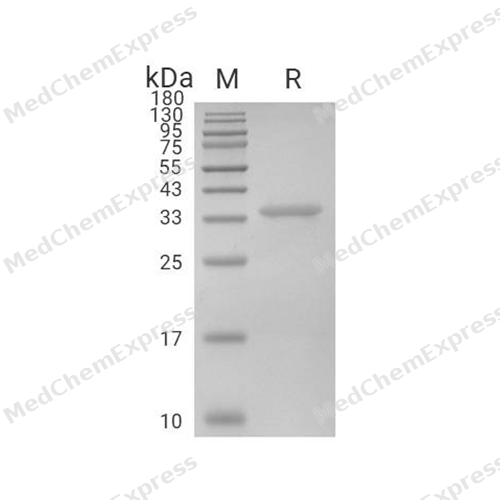
Purity - SDS-PAGE


Technical Parameters
-
Species Human
-
Source E. coli
-
Tag N-6*His
-
Accession
O00338 (M1-L296)
-
Molecular Construction
-
N-term
-
6*His
-
SULT1C2 (M1-L296)
Accession # O00338 -
C-term
-
-
Protein Length
Full Length
-
Synonyms
SULT1C2; Sulfotransferase 1C2; Prev. SULT1C1; HumSULTC2; ST1C1; SULT1C#1; Sulfotransferase Family, Cytosolic, 1C, Member 1; ST1C2; Sulfotransferase Family, Cytosolic, 1C, Member 2; Sulfotransferase; Sulfotransferase Family 1C Member 2; Sulfotransferase 1C
-
AA Sequence
MALTSDLGKQIKLKEVEGTLLQPATVDNWSQIQSFEAKPDDLLICTYPKAGTTWIQEIVDMIEQNGDVEKCQRAIIQHRHPFIEWARPPQPSGVEKAKAMPSPRILKTHLSTQLLPPSFWENNCKFLYVARNAKDCMVSYYHFQRMNHMLPDPGTWEEYFETFINGKVVWGSWFDHVKGWWEMKDRHQILFLFYEDIKRDPKHEIRKVMQFMGKKVDETVLDKIVQETSFEKMKENPMTNRSTVSKSILDQSISSFMRKGTVGDWKNHFTVAQNERFDEIYRRKMEGTSINFCMEL
-
Molecular Weight
Approximately 30-37 kDa, based on SDS-PAGE under reducing conditions.
-
Purity
≥ 90%, as determined by reducing SDS-PAGE.


Product Properties
Solution
1.Supplied as a 0.22 μm filtered solution of 20 mM Tris, 100 mM NaCl, pH 8.5.
2.Supplied as a 0.22 μm filtered solution in 20 mM Tris-HCl, 100 mM NaCl, pH 8.0, 1 mM DTT, 20% glycerol.
Please refer to the lot-specific COA for specific buffer information.
Note: For SPR assay, please replace the buffer. Primary amine components (e.g., Tris, imidazole) can affect protein-coupled chips.
<1 EU/μg, determined by LAL method.
Stored at -80°C for 1 year from date of receipt. It is stable at -20°C for 3 months after opening. It is recommended to freeze aliquots at -80°C for extended storage. Avoid repeated freeze-thaw cycles.
Shipping with dry ice.


Documentation
-
Data Sheet (237 KB)
-
SDS (251 KB)
- English - EN (251 KB)
- Français - FR (251 KB)
- Deutsch - DE (251 KB)
- Norwegian - NO (251 KB)
- Español - ES (251 KB)
- Swedish - SV (251 KB)
- Italian - IT (251 KB)
- Korean - KR (251 KB)
- Portuguese - PT (251 KB)
-
Handling Instructions (2659 KB)

Calculators
Concentration (start) × Volume (start) = Concentration (final) × Volume (final)


 Powered by Bioz

