



Tau-D/0N4R Protein, Human (133a.a, His)
Based on 1 publication(s) in Google Scholar
Microtubule-associated protein tau is a microtubule-associated protein found in large numbers in neurons of the central nervous system (CNS). MAPT promotes microtubule assembly and stability and may be involved in the establishment and maintenance of neuronal polarity. Overexpression of MAPT is associated with a poor prognosis of prostate cancer. MAPT has been linked to neurological disorders such as Alzheimer's and Parkinson's disease. Tau-D/0N4R Protein, Human (133a.a, His) is the recombinant human-derived Tau-D/0N4R protein, expressed by E. coli , with C-6*His labeled tag.
- Species: Human
- Source: E. coli
-
Storage:Stored at -20°C for 2 years from date of receipt. After reconstitution, it is stable at 4°C for 1 week or -20°C for longer (with carrier protein). It is recommended to freeze aliquots at -20°C or -80°C for extended storage.


To place orders, for customer services and technical support, please contact: MedChemExpress USA
Tel: 609-228-6898 E-mail: [email protected] [email protected]


-
 Biological Activity
-
Technical Parameters
-
Product Properties
- Documentation
- References
- Help & FAQs




Biological Activity
Description
Microtubule-associated protein tau is a microtubule-associated protein found in large numbers in neurons of the central nervous system (CNS). MAPT promotes microtubule assembly and stability and may be involved in the establishment and maintenance of neuronal polarity. Overexpression of MAPT is associated with a poor prognosis of prostate cancer. MAPT has been linked to neurological disorders such as Alzheimer's and Parkinson's disease. Tau-D/0N4R Protein, Human (133a.a, His) is the recombinant human-derived Tau-D/0N4R protein, expressed by E. coli , with C-6*His labeled tag.
Background
Microtubule-associated protein tau is a microtubule-associated protein that is found in large quantities in neurons of the central nervous system (CNS). MAPT promotes microtubule assembly and stability and may be involved in the establishment and maintenance of neuronal polarity. MAPT can bind axon microtubules at the C end and neurotic membrane components at the N end, acting as a connexion between the two. Defects in MAPT can lead to neurological diseases such as Alzheimer's and Parkinson's. Overexpression of MAPT is associated with a poor prognosis of prostate cancer. Tau protein S262/S356 can be phosphorylated by AMPK-related kinase[1][2][3][4].
MCE Validation Data
-
Purity - SDS-PAGE
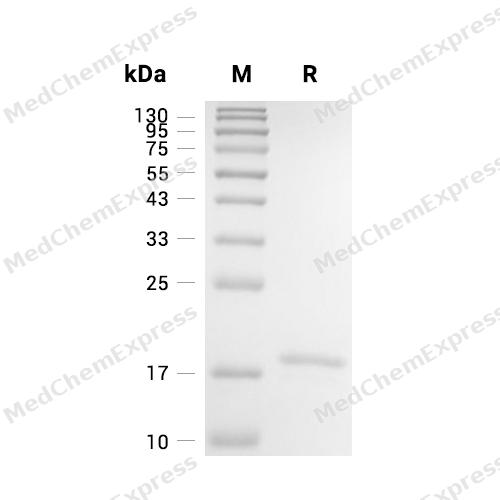
Purity - SDS-PAGE


Publications (1)
-
Journal Impact Factor
-
Most Recent
-
Anal Chem
Determination of Small-Sized α-Synuclein Oligomers Using Solid-State Nanopore Assisted with Circular Single-Stranded DNA Frame. [Abstract]2026 May 19;98(19):14183-14191. PMID: 42091235


Technical Parameters
-
Species Human
-
Source E. coli
-
Tag C-6*His
-
Accession
P10636-6 (Q249-Q381)
-
Molecular Construction
-
N-term
-
Tau-D (Q249-Q381)
Accession # P10636-6 -
6*His
-
C-term
-
-
Protein Length
Partial
-
Synonyms
MAPT; Tau-Derived Paired Helical Filament Hexapeptide; Prev. MAPTL; Microtubule-Associated Protein Tau; Prev. DDPAC; Neurofibrillary Tangle Protein; MTBT1; Paired Helical Filament-Tau; PPP1R103; MGC138549; Tau-PHF6; FLJ31424; FTDP-17; PHF-Tau; Tau-40; Mic
-
AA Sequence
QIVYKPVDLSKVTSKCGSLGNIHHKPGGGQVEVKSEKLDFKDRVQSKIGSLDNITHVPGGGNKKIETHKLTFRENAKAKTDHGAEIVYKSPVVSGDTSPRHLSNVSSTGSIDMVDSPQLATLADEVSASLAKQ
-
Molecular Weight
Approximately 16 kDa, based on SDS-PAGE under reducing conditions.
-
Purity
≥ 90%, as determined by reducing SDS-PAGE.


Product Properties
Lyophilized powder
Lyophilized from a 0.2 μm filtered solution of PBS, 1 mM PMSF, pH 7.4.
<1 EU/μg, determined by LAL method.
It is not recommended to reconstitute to a concentration less than 100 μg/mL in ddH2O. For long term storage it is recommended to add a carrier protein (0.1% BSA, 5% HSA, 10% FBS or 5% Trehalose).
Stored at -20°C for 2 years from date of receipt. After reconstitution, it is stable at 4°C for 1 week or -20°C for longer (with carrier protein). It is recommended to freeze aliquots at -20°C or -80°C for extended storage.
Room temperature in continental US; may vary elsewhere.


Documentation
-
Data Sheet (262 KB)
-
SDS (252 KB)
- English - EN (252 KB)
- Français - FR (252 KB)
- Deutsch - DE (252 KB)
- Norwegian - NO (252 KB)
- Español - ES (252 KB)
- Swedish - SV (252 KB)
- Italian - IT (252 KB)
- Korean - KR (252 KB)
- Portuguese - PT (252 KB)
-
Handling Instructions (2659 KB)


References
[1]. Yoshida H, et al. Phosphorylation of microtubule-associated protein tau by AMPK-related kinases. J Neurochem. 2012 Jan;120(1):165-76. [Content Brief]
[2]. Sandberg A, et al. Fibrillation and molecular characteristics are coherent with clinical and pathological features of 4-repeat tauopathy caused by MAPT variant G273R. Neurobiol Dis. 2020 Dec;146:105079. [Content Brief]
[3]. Sekino Y, et al. Microtubule-associated protein tau (MAPT) promotes bicalutamide resistance and is associated with survival in prostate cancer. Urol Oncol. 2020 Oct;38(10):795.e1-795.e8. [Content Brief]
[4]. O'Connor A, et al. Tau accumulation in autosomal dominant Alzheimer's disease: a longitudinal [18F] flortaucipir study. Alzheimers Res Ther. 2023 May 25;15(1):99. [Content Brief]

Calculators
Concentration (start) × Volume (start) = Concentration (final) × Volume (final)


 Powered by Bioz

