



TCblR/CD320 Protein, Mouse (HEK293, His)

Based on 1 Customer Validation
The TCblR/CD320 protein is a receptor for cobalamin-saturated transcobalamin (TCbl) that plays a key role in cobalamin uptake and is expressed on the plasma membrane, especially on follicular dendritic cells (FDCs). As a costimulator, TCblR promotes B cell responses, promoting differentiation and proliferation. TCblR/CD320 Protein, Mouse (HEK293, His) is the recombinant mouse-derived TCblR/CD320 protein, expressed by HEK293 , with C-His labeled tag.
- Species: Mouse
- Source: HEK293
-
Storage:Stored at -80°C for 1 year from date of receipt. It is stable at -20°C for 3 months after opening. It is recommended to freeze aliquots at -80°C for extended storage. Avoid repeated freeze-thaw cycles.


To place orders, for customer services and technical support, please contact: MedChemExpress USA
Tel: 609-228-6898 E-mail: [email protected] [email protected]


-
 Biological Activity
-
Technical Parameters
-
Product Properties
- Documentation
- Help & FAQs




Biological Activity
Description
The TCblR/CD320 protein is a receptor for cobalamin-saturated transcobalamin (TCbl) that plays a key role in cobalamin uptake and is expressed on the plasma membrane, especially on follicular dendritic cells (FDCs). As a costimulator, TCblR promotes B cell responses, promoting differentiation and proliferation. TCblR/CD320 Protein, Mouse (HEK293, His) is the recombinant mouse-derived TCblR/CD320 protein, expressed by HEK293 , with C-His labeled tag.
Background
TCblR/CD320 Protein, serving as the receptor for transcobalamin saturated with cobalamin (TCbl), assumes a pivotal role in cobalamin uptake. Positioned on the plasma membrane, it is notably expressed on follicular dendritic cells (FDC), facilitating interactions with germinal center B cells. Functioning as a costimulator, TCblR promotes B cell responses to antigenic stimuli, thereby fostering B cell differentiation and proliferation. Particularly influential in the differentiation of germinal center-B (GC-B) cells into memory B-cells and plasma cells (PC), TCblR engages in collaborative interactions with T-cells and follicular dendritic cells (FDC). Its involvement extends to augmenting the proliferation of PC precursors generated by IL-10. The interaction of CD320 with TCN2, mediated through its LDL-receptor class A domains, underscores its significance in cobalamin homeostasis and cellular processes.
Verified Bioactivity
Measured by its binding ability in a functional ELISA. Immobilized mouse CD320-His at 10 μg/mL (100 μl/well) can bind biotinylated mouse TCN2-His , The EC50 of biotinylated mouse TCN2-His is 0.10-0.24 μg/mL.
MCE Validation Data
-
Purity - SDS-PAGE
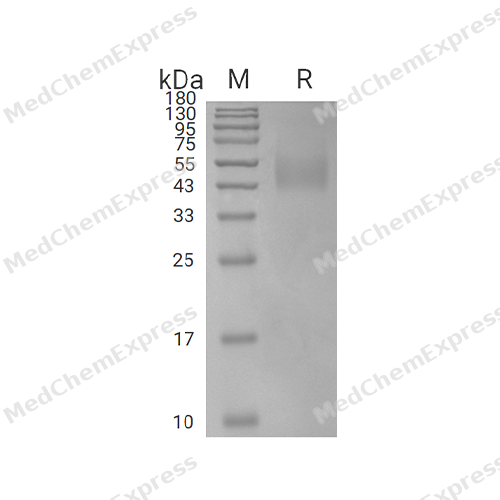
Purity - SDS-PAGE


Technical Parameters
-
Species Mouse
-
Source HEK293
-
Tag C-His
-
Accession
Q9Z1P5-1 (M1-G208)
-
Molecular Construction
-
N-term
-
CD320 (M1-G208)
Accession # Q9Z1P5-1 -
His
-
C-term
-
-
Protein Length
Partial
-
Synonyms
CD320; TCII-R; CD320 Molecule; TCN2R; TCblR; 8D6; 8D6A; FDC-Signaling Molecule 8D6; Transcobalamin Receptor; Transcobalamin 2 Receptor; CD320 Antigen; Soluble CD320; 8D6 Antigen; FDC-SM-8D6; SCD320
-
AA Sequence
MARGGAGRAVALGLVLRLLFGLRTGLEAAPAPAHTRVQVSGSRADSCPTDTFQCLTSGYCVPLSWRCDGDQDCSDGSDEEDCRIESCAQNGQCQPQSALPCSCDNISGCSDVSDKNLNCSRPPCQESELHCILDDVCIPHTWRCDGHPDCLDSSDELSCDTDTEIDKIFQEENATTTRISTTMENETSFRNVTFTSAGDSSRNPSAYG
-
Predicted Molecular Mass
21 kDa
-
Molecular Weight
Approximately 43-50 kDa, based on SDS-PAGE under reducing conditions.
-
Glycosylation
Yes
-
Purity
≥ 90%, as determined by reducing SDS-PAGE.


Product Properties
Solution
Supplied as a 0.22 μm filtered solution of PBS, pH 7.4, 5% trehalose, 5% mannitol and 0.01% Tween 80.
<1 EU/μg, determined by LAL method.
Stored at -80°C for 1 year from date of receipt. It is stable at -20°C for 3 months after opening. It is recommended to freeze aliquots at -80°C for extended storage. Avoid repeated freeze-thaw cycles.
Shipping with dry ice.


Documentation
-
Data Sheet (236 KB)
-
SDS (252 KB)
- English - EN (252 KB)
- Français - FR (252 KB)
- Deutsch - DE (252 KB)
- Norwegian - NO (252 KB)
- Español - ES (252 KB)
- Swedish - SV (252 KB)
- Italian - IT (252 KB)
- Korean - KR (252 KB)
- Portuguese - PT (252 KB)
-
Handling Instructions (2659 KB)

Calculators
Concentration (start) × Volume (start) = Concentration (final) × Volume (final)


 Powered by Bioz

