



TFF3 Protein, Human (HEK293, His)

Based on 1 Customer Validation
Trefoil factor 3 (TFF3) is a small peptide (59 amino acids; 7 kDa) that is a member of the trefoil family and a stable secretory protein expressed in gastrointestinal mucosa, playing a role in restitution and regeneration of epithelia. The mode of action of Tff3 ranges from a simple increase in mucous viscosity, cytoprotection, and antiapoptotic and chemotactic effects to more complex immune regulatory functions, and has a strong association with tumorigenesis. TFF3 Protein, Human (HEK293, His) is the recombinant human-derived TFF3 protein, expressed by HEK293 , with C-His labeled tag.
- Species: Human
- Source: HEK293
-
Storage:Stored at -20°C for 2 years from date of receipt. After reconstitution, it is stable at 4°C for 1 week or -20°C for longer (with carrier protein). It is recommended to freeze aliquots at -20°C or -80°C for extended storage.


To place orders, for customer services and technical support, please contact: MedChemExpress USA
Tel: 609-228-6898 E-mail: [email protected] [email protected]


-
 Biological Activity
-
Technical Parameters
-
Product Properties
- Documentation
- Help & FAQs




Biological Activity
Description
Trefoil factor 3 (TFF3) is a small peptide (59 amino acids; 7 kDa) that is a member of the trefoil family and a stable secretory protein expressed in gastrointestinal mucosa, playing a role in restitution and regeneration of epithelia. The mode of action of Tff3 ranges from a simple increase in mucous viscosity, cytoprotection, and antiapoptotic and chemotactic effects to more complex immune regulatory functions, and has a strong association with tumorigenesis. TFF3 Protein, Human (HEK293, His) is the recombinant human-derived TFF3 protein, expressed by HEK293 , with C-His labeled tag.
Background
Trefoil factor 3 (TFF3) is a small peptide (59 amino acids; 7 kDa) that is a member of the trefoil family which are characterized by having at least one copy of the trefoil motif, a 40-amino acid domain that contains three conserved disulfides with three-loop structure. TFF3 is a stable secretory protein expressed in gastrointestinal mucosa, playing a role in restitution (cell migration to heal superficial lesions) and regeneration (differentiation and proliferation as repair) of epithelia, being involved in the maintenance and repair of the intestinal mucosa and promotes the mobility of epithelial cells in healing processes. The mode of action of Tff3 ranges from a simple increase in mucous viscosity, cytoprotection, and antiapoptotic and chemotactic effects to more complex immune regulatory functions. Tff expression patterns are altered in various tumors, implying a strong association with tumorigenesis. Tff3 presents in the bloodstream and various other organs, including the liver, brain, pancreas, and lymphoid tissue[1][2][3].
Verified Bioactivity
Measured by its ability to induce ERK1/ERK2 phosphorylation in Jurkat human acute T cell leukemia cells. 5-15 μg/mL of Recombinant Human TFF3 can effectively induce ERK1/2 phosphorylation.
MCE Validation Data
-
Purity - SDS-PAGE
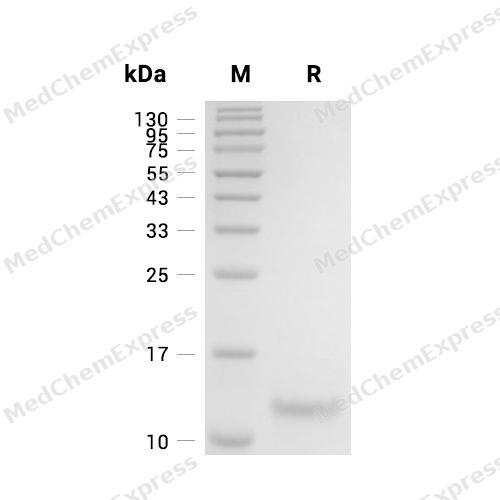
Purity - SDS-PAGE
-
Bioactivity - Cell-Based Assay
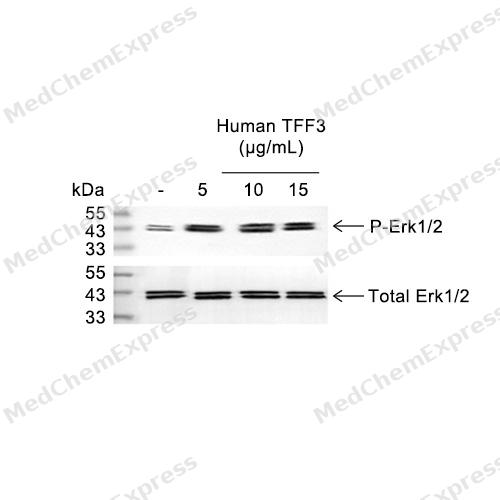
Bioactivity - Cell-Based Assay


Technical Parameters
-
Species Human
-
Source HEK293
-
Tag C-6*His
-
Accession
Q07654 (E22-F80)
-
Molecular Construction
-
N-term
-
TFF3 (E36-F94)
Accession # NP_003217.3 -
6*His
-
C-term
-
-
Protein Length
Full Length of Mature Protein
-
Synonyms
TFF3; Polypeptide P1.B; Trefoil Factor 3; TFI; ITF; Intestinal Trefoil Factor; HITF; HP1.B; Trefoil Factor 3 (Intestinal); P1B
-
AA Sequence
EEYVGLSANQCAVPAKDRVDCGYPHVTPKECNNRGCCFDSRIPGVPWCFKPLQEAECTF
-
Predicted Molecular Mass
8 kDa
-
Molecular Weight
Approximately 12 kDa, based on SDS-PAGE under reducing conditions.
-
Structure/Form
Disulfide-linked homodimer
-
Purity
≥ 95%, as determined by reducing SDS-PAGE.


Product Properties
Lyophilized powder
Lyophilized from a 0.22 μm filtered solution of PBS, pH 7.4, 8% trehalose.
<1 EU/μg, determined by LAL method.
It is not recommended to reconstitute to a concentration less than 100 μg/mL in ddH2O.
Stored at -20°C for 2 years from date of receipt. After reconstitution, it is stable at 4°C for 1 week or -20°C for longer (with carrier protein). It is recommended to freeze aliquots at -20°C or -80°C for extended storage.
Room temperature in continental US; may vary elsewhere.


Documentation
-
Data Sheet (236 KB)
-
SDS (252 KB)
- English - EN (252 KB)
- Français - FR (252 KB)
- Deutsch - DE (252 KB)
- Norwegian - NO (252 KB)
- Español - ES (252 KB)
- Swedish - SV (252 KB)
- Italian - IT (252 KB)
- Korean - KR (252 KB)
- Portuguese - PT (252 KB)
-
Handling Instructions (2659 KB)

Calculators
Concentration (start) × Volume (start) = Concentration (final) × Volume (final)


 Powered by Bioz

