



TMED1 Protein, Human (HEK293, His)
Based on 1 Customer Validation
The TMED1 protein may facilitate vesicular protein trafficking in the early secretory pathway, acting as a cargo receptor on the luminal side to incorporate secretory cargo into transport vesicles. It is involved in the formation of the vesicle shell on the cytoplasmic side and positively affects IL-33-mediated IL-8 and IL-6 production by interacting with IL1RL1. TMED1 Protein, Human (HEK293, His) is the recombinant human-derived TMED1 protein, expressed by HEK293 , with C-10*His labeled tag.
- Species: Human
- Source: HEK293
-
Storage:Stored at -20°C for 2 years from date of receipt. After reconstitution, it is stable at 4°C for 1 week or -20°C for longer (with carrier protein). It is recommended to freeze aliquots at -20°C or -80°C for extended storage.


To place orders, for customer services and technical support, please contact: MedChemExpress USA
Tel: 609-228-6898 E-mail: [email protected] [email protected]


-
 Biological Activity
-
Technical Parameters
-
Product Properties
- Documentation
- Help & FAQs




Biological Activity
Description
The TMED1 protein may facilitate vesicular protein trafficking in the early secretory pathway, acting as a cargo receptor on the luminal side to incorporate secretory cargo into transport vesicles. It is involved in the formation of the vesicle shell on the cytoplasmic side and positively affects IL-33-mediated IL-8 and IL-6 production by interacting with IL1RL1. TMED1 Protein, Human (HEK293, His) is the recombinant human-derived TMED1 protein, expressed by HEK293 , with C-10*His labeled tag.
Background
The TMED1 protein potentially plays a role in vesicular protein trafficking, particularly in the early secretory pathway. It may act as a cargo receptor on the lumenal side to facilitate the incorporation of secretory cargo molecules into transport vesicles, and it is also implicated in vesicle coat formation on the cytoplasmic side. Additionally, TMED1 has been shown to have a positive influence on IL-33-mediated IL-8 and IL-6 production by interacting with the interleukin-33 receptor IL1RL1. Furthermore, it is involved in the modulation of innate immune signaling through the cGAS-STING pathway via its interaction with RNF26. TMED1 forms homodimers in the endoplasmic reticulum, endoplasmic reticulum-Golgi intermediate compartment, and cis-Golgi network. It interacts with IL1RL1 and RNF26, with the latter interaction being particularly important for modulating innate immune signaling through the cGAS-STING pathway.
Verified Bioactivity
Immobilized Human TMED1 at 10 μg/mL (100 μL/well) can bind Biotinylated ST2 protein. The ED50 for this effect is 79.64 ng/mL, corresponding to a specific activity is 1.26×10^4 Unit/mg.
MCE Validation Data
-
Purity - SDS-PAGE
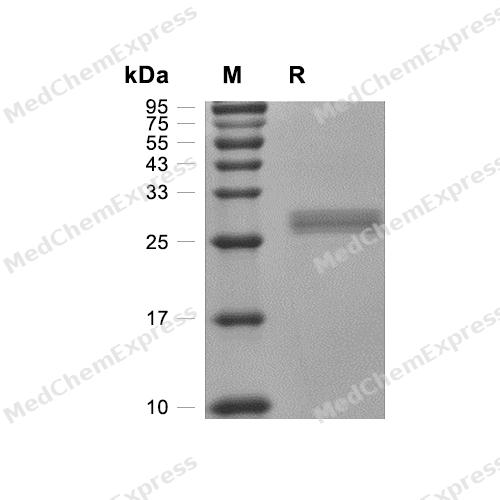
Purity - SDS-PAGE
-
Bioactivity - ELISA
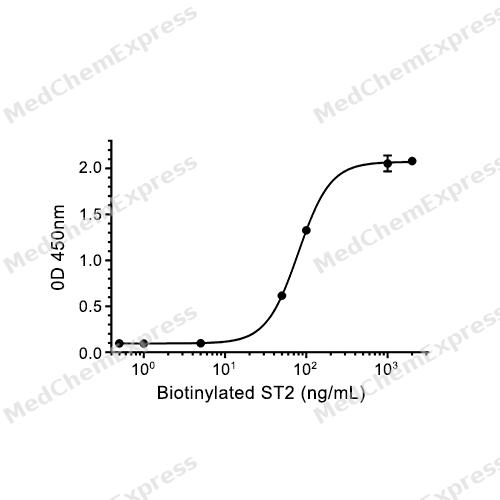
Bioactivity - ELISA


Technical Parameters
-
Species Human
-
Source HEK293
-
Tag C-10*His
-
Accession
Q13445 (A24-N194)
-
Molecular Construction
-
N-term
-
TMED1 (A24-N194)
Accession # Q13445 -
10*His
-
C-term
-
-
Protein Length
Extracellular Domain
-
Synonyms
TMED1; P24 Family Protein Gamma-1; Transmembrane P24 Trafficking Protein 1; MGC1270; IL1RL1LG; ST2L; P24gamma1; Tp24; Il1rl1l; Transmembrane Emp24 Domain Containing 1; P24g1; Interleukin 1 Receptor-Like 1 Ligand; Transmembrane Emp24 Protein Transport Doma
-
AA Sequence
AGPPPIQDGEFTFLLPAGRKQCFYQSAPANASLETEYQVIGGAGLDVDFTLESPQGVLLVSESRKADGVHTVEPTEAGDYKLCFDNSFSTISEKLVFFELIFDSLQDDEEVEGWAEAVEPEEMLDVKMEDIKESIETMRTRLERSIQMLTLLRAFEARDRNLQEGNLERVN
-
Predicted Molecular Mass
20.6 kDa
-
Molecular Weight
Approximately 28 kDa, based on SDS-PAGE under reducing conditions.
-
Purity
≥ 95%, as determined by reducing SDS-PAGE.


Product Properties
Lyophilized powder.
Lyophilized from a 0.22 μm filtered solution of PBS, pH 7.4.
<1 EU/μg, determined by LAL method.
It is not recommended to reconstitute to a concentration less than 100 μg/mL in ddH2O. For long term storage it is recommended to add a carrier protein (0.1% BSA, 5% HSA, 10% FBS or 5% Trehalose).
Stored at -20°C for 2 years from date of receipt. After reconstitution, it is stable at 4°C for 1 week or -20°C for longer (with carrier protein). It is recommended to freeze aliquots at -20°C or -80°C for extended storage.
Room temperature in continental US; may vary elsewhere.


Documentation
-
Data Sheet (236 KB)
-
SDS (251 KB)
- English - EN (251 KB)
- Français - FR (251 KB)
- Deutsch - DE (251 KB)
- Norwegian - NO (251 KB)
- Español - ES (251 KB)
- Swedish - SV (251 KB)
- Italian - IT (251 KB)
- Korean - KR (251 KB)
- Portuguese - PT (251 KB)
-
Handling Instructions (2659 KB)

Calculators
Concentration (start) × Volume (start) = Concentration (final) × Volume (final)


 Powered by Bioz

