



RANK/TNFRSF11A Protein, Human
Based on 1 Customer Validation
RANK/TNFRSF11A protein is the receptor of TNFSF11/RANKL and is critical for RANKL-induced osteoclastogenesis. It interacts with EEIG1 to promote osteoclast formation by promoting NFATC1 transcription and activating PLCG2. RANK/TNFRSF11A Protein, Human is the recombinant human-derived RANK/TNFRSF11A protein, expressed by E. coli , with tag free.
- Species: Human
- Source: E. coli
-
Storage:Stored at -20°C for 2 years from date of receipt. After reconstitution, it is stable at 4°C for 1 week or -20°C for longer (with carrier protein). It is recommended to freeze aliquots at -20°C or -80°C for extended storage.


To place orders, for customer services and technical support, please contact: MedChemExpress USA
Tel: 609-228-6898 E-mail: [email protected] [email protected]


-
 Biological Activity
-
Technical Parameters
-
Product Properties
- Documentation
- Help & FAQs




Biological Activity
Description
RANK/TNFRSF11A protein is the receptor of TNFSF11/RANKL and is critical for RANKL-induced osteoclastogenesis. It interacts with EEIG1 to promote osteoclast formation by promoting NFATC1 transcription and activating PLCG2. RANK/TNFRSF11A Protein, Human is the recombinant human-derived RANK/TNFRSF11A protein, expressed by E. coli , with tag free.
Background
The RANK/TNFRSF11A protein functions as the receptor for TNFSF11/RANKL/TRANCE/OPGL, playing a crucial role in the essential process of RANKL-mediated osteoclastogenesis. Interacting with EEIG1, it promotes osteoclast formation by facilitating the transcription of NFATC1 and activating PLCG2. Beyond its role in bone metabolism, RANK/TNFRSF11A is involved in regulating interactions between T-cells and dendritic cells. The protein binds to the clefts between the subunits of the TNFSF11 ligand trimer, forming a heterohexamer. It is also a key component of a complex comprising EEIG1, TNFRSF11A/RANK, PLCG2, GAB2, TEC, and BTK, with complex formation increasing in the presence of TNFSF11/RANKL. Additionally, RANK/TNFRSF11A interacts with TRAF family members (TRAF1, TRAF2, TRAF3, TRAF5, and TRAF6) and GAB2, further contributing to its regulatory functions in diverse cellular processes.
Verified Bioactivity
Measured by its binding ability in a functional ELISA. Immobilized Human RANK/TNFRSF11A at 2 μg/mL (100 μL/well) can bind Human RANKL/TNFSF11, Human (HY-P73387). The ED50 for this effect is 7.235 ng/mL.
MCE Validation Data
-
Purity - SDS-PAGE
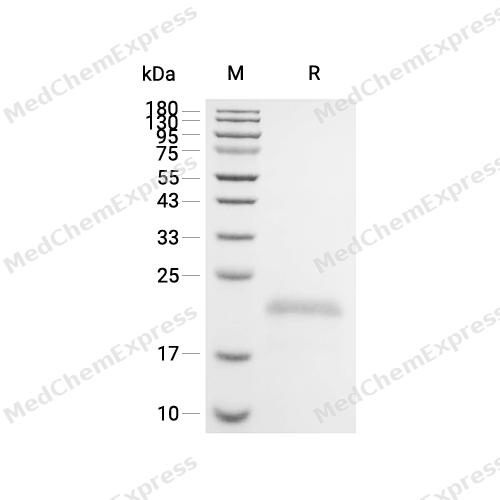
Purity - SDS-PAGE
-
Bioactivity - ELISA
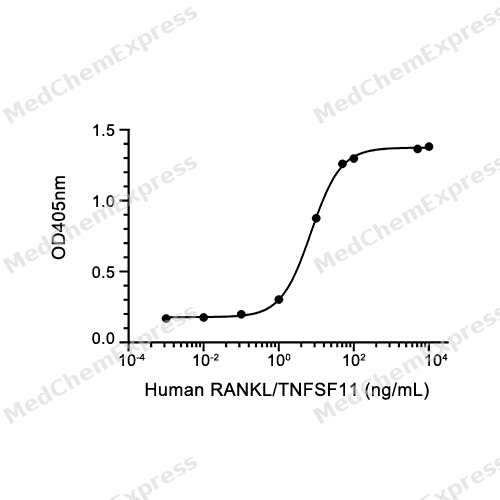
Bioactivity - ELISA


Technical Parameters
-
Species Human
-
Source E. coli
-
Tag Tag Free
-
Accession
Q9Y6Q6-1 (Q29-K202)
-
Molecular Construction
-
N-term
-
RANK (Q29-K202)
Accession # Q9Y6Q6-1 -
C-term
-
-
Protein Length
Partial Extracellular Domain
-
Synonyms
TNFRSF11A; Familial Expansile Osteolysis; Prev. LOH18CR1; Paget Disease Of Bone 2; Prev. PDB2; TRANCE Receptor; RANK; Tumor Necrosis Factor Receptor Superfamily, Member 11a, Activator Of NFKB; ODFR; Receptor Activator Of Nuclear Factor Kappa B; Osteoclast
-
AA Sequence
QIAPPCTSEKHYEHLGRCCNKCEPGKYMSSKCTTTSDSVCLPCGPDEYLDSWNEEDKCLLHKVCDTGKALVAVVAGNSTTPRRCACTAGYHWSQDCECCRRNTECAPGLGAQHPLQLNKDTVCKPCLAGYFSDAFSSTDKCRPWTNCTFLGKRVEHHGTEKSDAVCSSSLPARK
-
Predicted Molecular Mass
19.1 kDa
-
Molecular Weight
Approximately 20 kDa, based on SDS-PAGE under reducing conditions.
-
Purity
≥ 95%, as determined by reducing SDS-PAGE.


Product Properties
Lyophilized powder
Lyophilized from a 0.22 μm filtered solution of 20 mM Tris-HCl, 150 mM NaCl, pH 8.0.
Note: For SPR assay, please replace the buffer. Primary amine components (e.g., Tris, imidazole) can affect protein-coupled chips.
<1 EU/μg, determined by LAL method.
It is not recommended to reconstitute to a concentration less than 100 μg/mL in ddH2O.
Stored at -20°C for 2 years from date of receipt. After reconstitution, it is stable at 4°C for 1 week or -20°C for longer (with carrier protein). It is recommended to freeze aliquots at -20°C or -80°C for extended storage.
Room temperature in continental US; may vary elsewhere.


Documentation
-
Data Sheet (236 KB)
-
SDS (252 KB)
- English - EN (252 KB)
- Français - FR (252 KB)
- Deutsch - DE (252 KB)
- Norwegian - NO (252 KB)
- Español - ES (252 KB)
- Swedish - SV (252 KB)
- Italian - IT (252 KB)
- Korean - KR (252 KB)
- Portuguese - PT (252 KB)
-
Handling Instructions (2659 KB)

Calculators
Concentration (start) × Volume (start) = Concentration (final) × Volume (final)


 Powered by Bioz

