



TYRO3/DTK Protein, Human (388a.a, HEK293, His)
Based on 1 Customer Validation
TYRO3/DTK protein is a receptor tyrosine kinase that transduces signals by binding to ligands such as TULP1 or GAS6. TYRO3 is activated by ligand binding and regulates cell survival, migration, and differentiation, leading to dimerization and intracellular autophosphorylation to create docking sites for downstream signaling molecules. TYRO3/DTK Protein, Human (388a.a, HEK293, His) is the recombinant human-derived TYRO3/DTK protein, expressed by HEK293 , with C-6*His labeled tag.
- Species: Human
- Source: HEK293
-
Storage:Stored at -20°C for 2 years from date of receipt. After reconstitution, it is stable at 4°C for 1 week or -20°C for longer (with carrier protein). It is recommended to freeze aliquots at -20°C or -80°C for extended storage.


To place orders, for customer services and technical support, please contact: MedChemExpress USA
Tel: 609-228-6898 E-mail: [email protected] [email protected]


-
 Biological Activity
-
Technical Parameters
-
Product Properties
- Documentation
- Help & FAQs




Biological Activity
Description
TYRO3/DTK protein is a receptor tyrosine kinase that transduces signals by binding to ligands such as TULP1 or GAS6. TYRO3 is activated by ligand binding and regulates cell survival, migration, and differentiation, leading to dimerization and intracellular autophosphorylation to create docking sites for downstream signaling molecules. TYRO3/DTK Protein, Human (388a.a, HEK293, His) is the recombinant human-derived TYRO3/DTK protein, expressed by HEK293 , with C-6*His labeled tag.
Background
The TYRO3/DTK protein is a receptor tyrosine kinase that transmits signals from the extracellular matrix to the cytoplasm by binding to ligands such as TULP1 or GAS6. It regulates various physiological processes including cell survival, migration, and differentiation. When ligands bind to TYRO3 at the cell surface, it leads to dimerization and autophosphorylation of its intracellular domain, creating docking sites for downstream signaling molecules. This activation also interacts with PIK3R1, enhancing PI3-kinase activity and activating the AKT survival pathway. This pathway includes nuclear translocation of NF-kappa-B and up-regulation of NF-kappa-B-regulated genes. TYRO3 signaling is involved in protecting neurons from excitotoxic injury, promoting platelet aggregation, and reorganizing the cytoskeleton. Additionally, TYRO3 plays a crucial role in inhibiting the innate immune response triggered by Toll-like receptors (TLRs) by activating STAT1, which selectively induces the production of suppressors of cytokine signaling SOCS1 and SOCS3. It is also noteworthy that TYRO3 functions as a receptor for lassa virus and lymphocytic choriomeningitis virus, potentially through GAS6 binding to phosphatidyl-serine on the surface of the virion envelope.
Verified Bioactivity
1.This product does not contain protein kinase domain.
2.Immobilized Mouse TYRO3 at 1 μg/mL (100 μL/well) can bind Biotinylated Mouse GAS6 protein (HY-P75174A). The ED50 for this effect is 1.236 μg/mL, corresponding to a specific activity is 809.061 Unit/mg.
3.Immobilized Recombinant Human Dtk (C-6His) at 5 μg/mL (100 μL/well) can bind Recombinant Human GAS6 (C-Fc). The ED50 of Recombinant Human GAS6 (C-Fc) is 95.53 ng/mL.
MCE Validation Data
-
Purity - SDS-PAGE
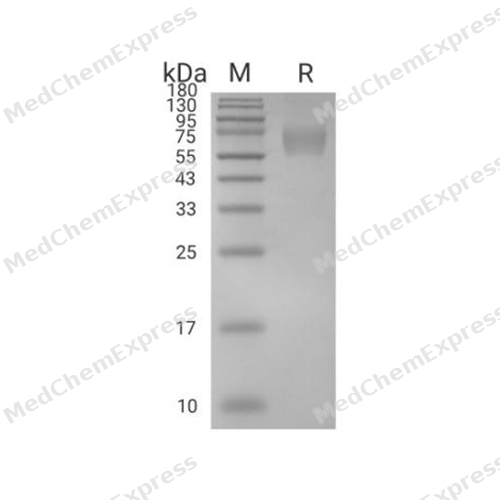
Purity - SDS-PAGE
-
Bioactivity - ELISA
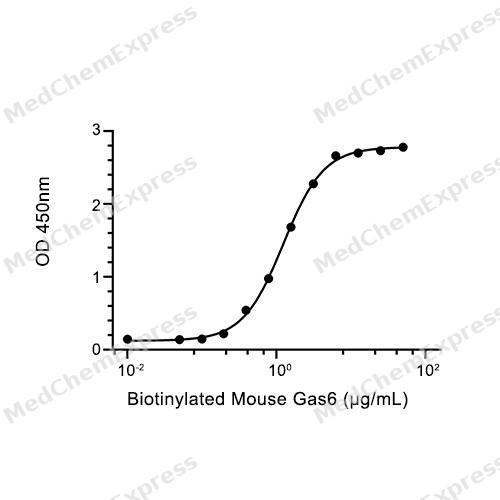
Bioactivity - ELISA


Technical Parameters
-
Species Human
-
Source HEK293
-
Tag C-6*His
-
Accession
Q06418 (A41-S428)
-
Molecular Construction
-
N-term
-
TYRO3 (A41-S428)
Accession # Q06418 -
6*His
-
C-term
-
-
Protein Length
Extracellular Domain
-
Synonyms
TYRO3; BYK; DTK; RSE; SKY; TIF; Tyrosine-protein kinase receptor TYRO3 ; EC 2.7.10.1 ; Tyrosine-protein kinase BYK ; Tyrosine-protein kinase DTK ; Tyrosine-protein kinase RSE ; Tyrosine-protein kinase SKY ; Tyrosine-protein kinase TIF; Tyrosine-Protein Ki
-
AA Sequence
AGLKLMGAPVKLTVSQGQPVKLNCSVEGMEEPDIQWVKDGAVVQNLDQLYIPVSEQHWIGFLSLKSVERSDAGRYWCQVEDGGETEISQPVWLTVEGVPFFTVEPKDLAVPPNAPFQLSCEAVGPPEPVTIVWWRGTTKIGGPAPSPSVLNVTGVTQSTMFSCEAHNLKGLASSRTATVHLQALPAAPFNITVTKLSSSNASVAWMPGADGRALLQSCTVQVTQAPGGWEVLAVVVPVPPFTCLLRDLVPATNYSLRVRCANALGPSPYADWVPFQTKGLAPASAPQNLHAIRTDSGLILEWEEVIPEAPLEGPLGPYKLSWVQDNGTQDELTVEGTRANLTGWDPQKDLIVRVCVSNAVGCGPWSQPLVVSSHDRAGQQGPPHSRTS
-
Predicted Molecular Mass
42.4 kDa
-
Molecular Weight
Approximately 55-70 kDa, based on SDS-PAGE under reducing conditions.
-
Glycosylation
Yes
-
Purity
≥ 95%, as determined by reducing SDS-PAGE.


Product Properties
Lyophilized powder
Lyophilized from a 0.22 μm filtered solution of PBS, pH 7.4.
<1 EU/μg, determined by LAL method.
It is not recommended to reconstitute to a concentration less than 100 μg/mL in ddH2O. For long term storage it is recommended to add a carrier protein (0.1% BSA, 5% HSA, 10% FBS or 5% Trehalose).
Stored at -20°C for 2 years from date of receipt. After reconstitution, it is stable at 4°C for 1 week or -20°C for longer (with carrier protein). It is recommended to freeze aliquots at -20°C or -80°C for extended storage.
Room temperature in continental US; may vary elsewhere.


Documentation
-
Data Sheet (239 KB)
-
SDS (251 KB)
- English - EN (251 KB)
- Français - FR (251 KB)
- Deutsch - DE (251 KB)
- Norwegian - NO (251 KB)
- Español - ES (251 KB)
- Swedish - SV (251 KB)
- Italian - IT (251 KB)
- Korean - KR (251 KB)
- Portuguese - PT (251 KB)
-
Handling Instructions (2659 KB)

Calculators
Concentration (start) × Volume (start) = Concentration (final) × Volume (final)


 Powered by Bioz

