



Uteroglobin/SCGB1A1 Protein, Human
Based on 1 Customer Validation
Uteroglobin/SCGB1A1 Protein displays diverse binding, including phosphatidylcholine, phosphatidylinositol, polychlorinated biphenyls (PCB), and weakly binds progesterone. It acts as a robust inhibitor of phospholipase A2, structurally forming a disulfide-linked antiparallel homodimer. Controversy surrounds its interaction with LMBR1L, necessitating further investigation. Uteroglobin/SCGB1A1 Protein, Human is the recombinant human-derived Uteroglobin/SCGB1A1 protein, expressed by E. coli , with tag free.
- Species: Human
- Source: E. coli
-
Storage:Stored at -20°C for 2 years from date of receipt. After reconstitution, it is stable at 4°C for 1 week or -20°C for longer (with carrier protein). It is recommended to freeze aliquots at -20°C or -80°C for extended storage.


To place orders, for customer services and technical support, please contact: MedChemExpress USA
Tel: 609-228-6898 E-mail: [email protected] [email protected]


-
 Biological Activity
-
Technical Parameters
-
Product Properties
- Documentation
- Help & FAQs




Biological Activity
Description
Uteroglobin/SCGB1A1 Protein displays diverse binding, including phosphatidylcholine, phosphatidylinositol, polychlorinated biphenyls (PCB), and weakly binds progesterone. It acts as a robust inhibitor of phospholipase A2, structurally forming a disulfide-linked antiparallel homodimer. Controversy surrounds its interaction with LMBR1L, necessitating further investigation. Uteroglobin/SCGB1A1 Protein, Human is the recombinant human-derived Uteroglobin/SCGB1A1 protein, expressed by E. coli , with tag free.
Background
The Uteroglobin/SCGB1A1 protein exhibits versatile binding capabilities, including the ability to bind phosphatidylcholine, phosphatidylinositol, polychlorinated biphenyls (PCB), and weakly binds progesterone. Additionally, it functions as a potent inhibitor of phospholipase A2. Structurally, this protein forms an antiparallel homodimer that is disulfide-linked. While there is some controversy surrounding its interaction with LMBR1L, further investigation is required to clarify this aspect.
Verified Bioactivity
Measured by the ability of the immobilized protein to support the adhesion of the A549 human lung carcinoma cells. The ED50 for this effect is typically < 1 μg/mL.
MCE Validation Data
-
Purity - SDS-PAGE
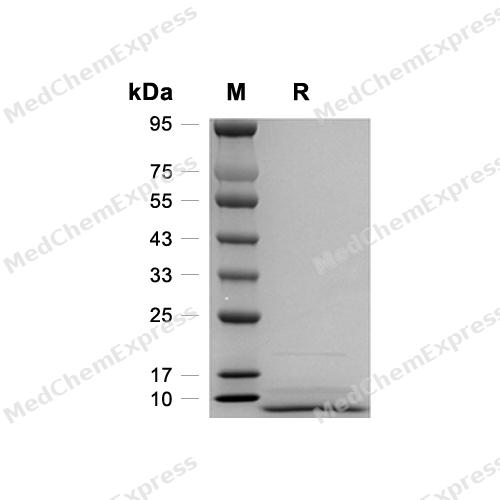
Purity - SDS-PAGE
-
Bioactivity - Cell-Based Assay
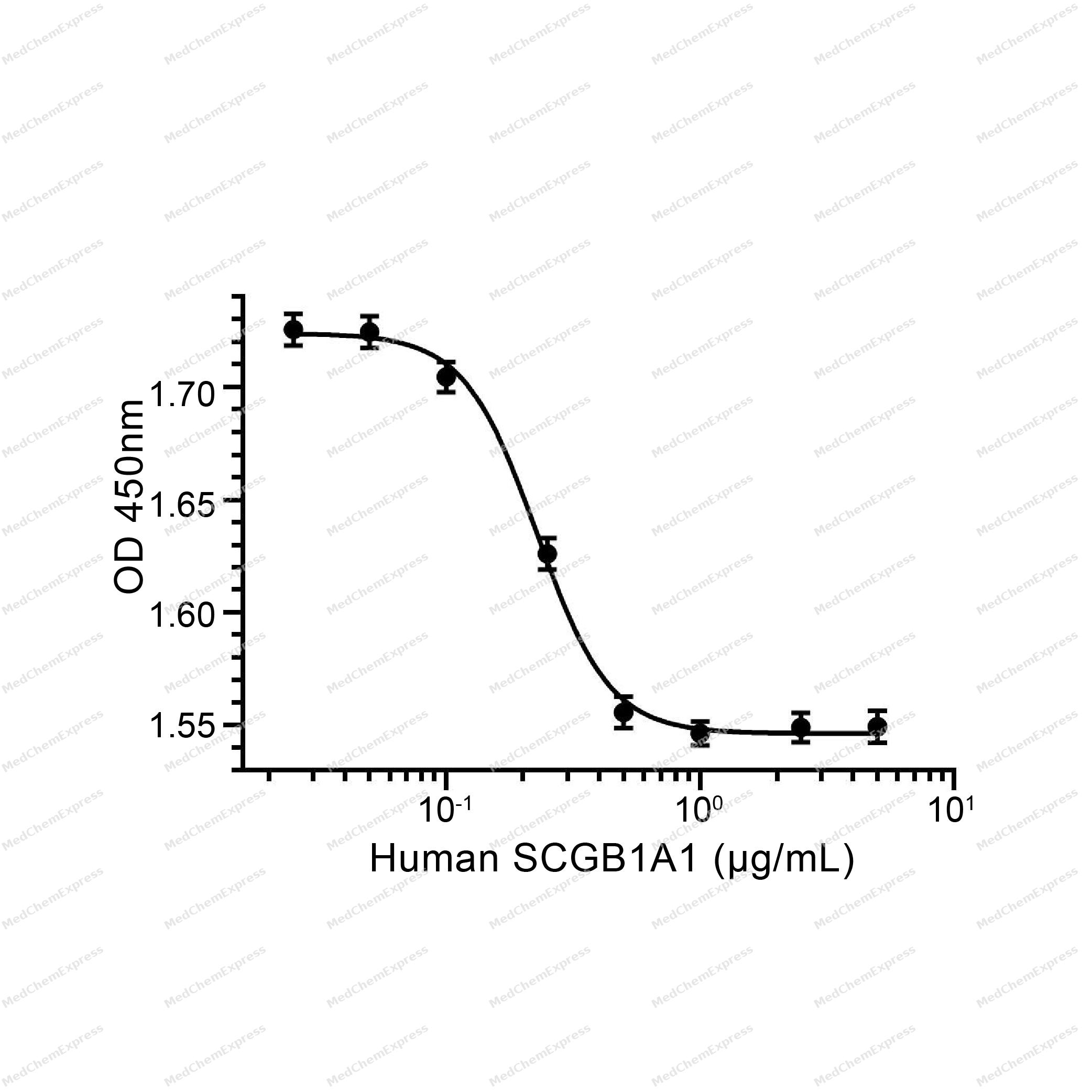
Bioactivity - Cell-Based Assay


Technical Parameters
-
Species Human
-
Source E. coli
-
Tag Tag Free
-
Accession
P11684 (E22-N91)
-
Molecular Construction
-
N-term
-
SCGB1A1 (E22-N91)
Accession # P11684 -
C-term
-
-
Protein Length
Full Length of Mature Protein
-
Synonyms
SCGB1A1; Urinary Protein 1; Prev. UGB; CCPBP; Uteroglobin; UP-1; CC10; UP1; CCSP; Secretoglobin, Family 1A, Member 1 (Uteroglobin); CC16; Uteroglobin (Clara Cell Specific 10-KD Protein); Club Cell Phospholipid-Binding Protein; Uteroglobin (Club-Cell Speci
-
AA Sequence
EICPSFQRVIETLLMDTPSSYEAAMELFSPDQDMREAGAQLKKLVDTLPQKPRESIIKLMEKIAQSSLCN
-
Molecular Weight
Approximately 8 kDa, based on SDS-PAGE under reducing conditions.
-
Purity
≥ 95%, as determined by reducing SDS-PAGE.


Product Properties
Lyophilized powder.
Lyophilized from a 0.22 μm filtered solution of PBS, pH 7.4.
<1 EU/μg, determined by LAL method.
It is not recommended to reconstitute to a concentration less than 100 μg/mL in ddH2O. For long term storage it is recommended to add a carrier protein (0.1% BSA, 5% HSA, 10% FBS or 5% Trehalose).
Stored at -20°C for 2 years from date of receipt. After reconstitution, it is stable at 4°C for 1 week or -20°C for longer (with carrier protein). It is recommended to freeze aliquots at -20°C or -80°C for extended storage.
Room temperature in continental US;may vary elsewhere.


Documentation
-
Data Sheet (235 KB)
-
SDS (254 KB)
- English - EN (254 KB)
- Français - FR (254 KB)
- Deutsch - DE (254 KB)
- Norwegian - NO (254 KB)
- Español - ES (254 KB)
- Swedish - SV (254 KB)
- Italian - IT (254 KB)
- Korean - KR (254 KB)
- Portuguese - PT (254 KB)
-
Handling Instructions (2659 KB)

Calculators
Concentration (start) × Volume (start) = Concentration (final) × Volume (final)


 Powered by Bioz

