



WARS Protein, Human (His)

Based on 1 Customer Validation
WARS includes isomer 1, isomer 2, T1-TrpRS and T2-TrpRS, and has aminoacylation activity, except T2-TrpRS. Unlike isoform 1, isoform 2, T1-TrpRS and T2-TrpRS, exhibit vasostatic activity. WARS Protein, Human (His) is the recombinant human-derived WARS protein, expressed by E. coli , with N-6*His labeled tag.
- Species: Human
- Source: E. coli
-
Storage:Stored at -20°C for 2 years from date of receipt. After reconstitution, it is stable at 4°C for 1 week or -20°C for longer (with carrier protein). It is recommended to freeze aliquots at -20°C or -80°C for extended storage.


To place orders, for customer services and technical support, please contact: MedChemExpress USA
Tel: 609-228-6898 E-mail: [email protected] [email protected]


-
 Biological Activity
-
Technical Parameters
-
Product Properties
- Documentation
- Help & FAQs




Biological Activity
Description
WARS includes isomer 1, isomer 2, T1-TrpRS and T2-TrpRS, and has aminoacylation activity, except T2-TrpRS. Unlike isoform 1, isoform 2, T1-TrpRS and T2-TrpRS, exhibit vasostatic activity. WARS Protein, Human (His) is the recombinant human-derived WARS protein, expressed by E. coli , with N-6*His labeled tag.
Background
WARS, encompassing Isoform 1, Isoform 2, T1-TrpRS, and T2-TrpRS, displays aminoacylation activity, with T2-TrpRS being the exception as it lacks this enzymatic function. In terms of angiostatic activity, Isoform 2, T1-TrpRS, and T2-TrpRS exhibit this property, while Isoform 1 does not possess angiostatic capabilities. Particularly, T2-TrpRS stands out by inhibiting fluid shear stress-activated responses in endothelial cells. WARS plays a pivotal role in regulating key signaling pathways, including ERK, Akt, and eNOS activation, which are associated with angiogenesis, cytoskeletal reorganization, and the expression of genes responsive to shear stress. This multifaceted functionality underscores WARS's involvement in intricate cellular processes and its potential impact on vascular responses.
MCE Validation Data
-
Purity - SDS-PAGE
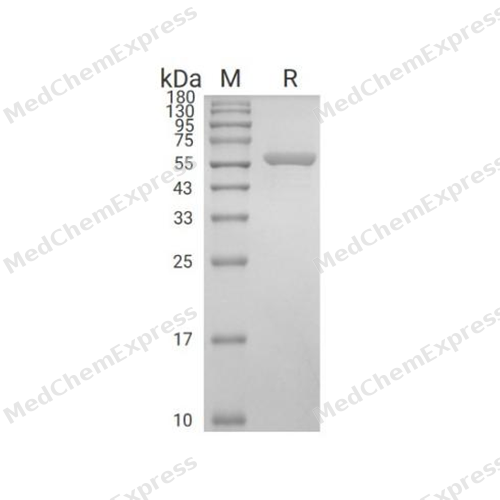
Purity - SDS-PAGE


Technical Parameters
-
Species Human
-
Source E. coli
-
Tag N-6*His
-
Accession
P23381 (M1-Q471)
-
Molecular Construction
-
N-term
-
6*His
-
WARS (M1-Q471)
Accession # P23381 -
C-term
-
-
Protein Length
Full Length
-
Synonyms
WARS1; Tryptophanyl-TRNA Synthetase 1; IFI53; WARS; IFP53; Tryptophan--TRNA Ligase, Cytoplasmic; Tryptophanyl-TRNA Synthetase; Tryptophan TRNA Ligase 1, Cytoplasmic; Interferon-Induced Protein 53; TrpRS; HWRS; Epididymis Secretory Sperm Binding Protein; T
-
AA Sequence
MPNSEPASLLELFNSIATQGELVRSLKAGNASKDEIDSAVKMLVSLKMSYKAAAGEDYKADCPPGNPAPTSNHGPDATEAEEDFVDPWTVQTSSAKGIDYDKLIVRFGSSKIDKELINRIERATGQRPHHFLRRGIFFSHRDMNQVLDAYENKKPFYLYTGRGPSSEAMHVGHLIPFIFTKWLQDVFNVPLVIQMTDDEKYLWKDLTLDQAYSYAVENAKDIIACGFDINKTFIFSDLDYMGMSSGFYKNVVKIQKHVTFNQVKGIFGFTDSDCIGKISFPAIQAAPSFSNSFPQIFRDRTDIQCLIPCAIDQDPYFRMTRDVAPRIGYPKPALLHSTFFPALQGAQTKMSASDPNSSIFLTDTAKQIKTKVNKHAFSGGRDTIEEHRQFGGNCDVDVSFMYLTFFLEDDDKLEQIRKDYTSGAMLTGELKKALIEVLQPLIAEHQARRKEVTDEIVKEFMTPRKLSFDFQ
-
Predicted Molecular Mass
55.3 kDa
-
Molecular Weight
Approximately 60 kDa, based on SDS-PAGE under reducing conditions.
-
Purity
≥ 95%, as determined by reducing SDS-PAGE.


Product Properties
Lyophilized powder.
Lyophilized from a 0.22 μm filtered solution of 20 mM PB, 8% trehalose, 4% mannitol, 50 mM NaCl, 0.05% Tween 80, pH 7.5.
<1 EU/μg, determined by LAL method.
It is not recommended to reconstitute to a concentration less than 100 μg/mL in ddH2O.
Stored at -20°C for 2 years from date of receipt. After reconstitution, it is stable at 4°C for 1 week or -20°C for longer (with carrier protein). It is recommended to freeze aliquots at -20°C or -80°C for extended storage.
Room temperature in continental US;may vary elsewhere.


Documentation
-
Data Sheet (237 KB)
-
SDS (251 KB)
- English - EN (251 KB)
- Français - FR (251 KB)
- Deutsch - DE (251 KB)
- Norwegian - NO (251 KB)
- Español - ES (251 KB)
- Swedish - SV (251 KB)
- Italian - IT (251 KB)
- Korean - KR (251 KB)
- Portuguese - PT (251 KB)
-
Handling Instructions (2659 KB)

Calculators
Concentration (start) × Volume (start) = Concentration (final) × Volume (final)


 Powered by Bioz

