10 Results for "

1H-NMR

" in MedChemExpress (MCE) Product Catalog:
Products (10)

10 Results for "1H-NMR" in MCE Product Catalog:

1
1 Cited Publications
Cat. No.: HY-113048A
Purity:  97.5%
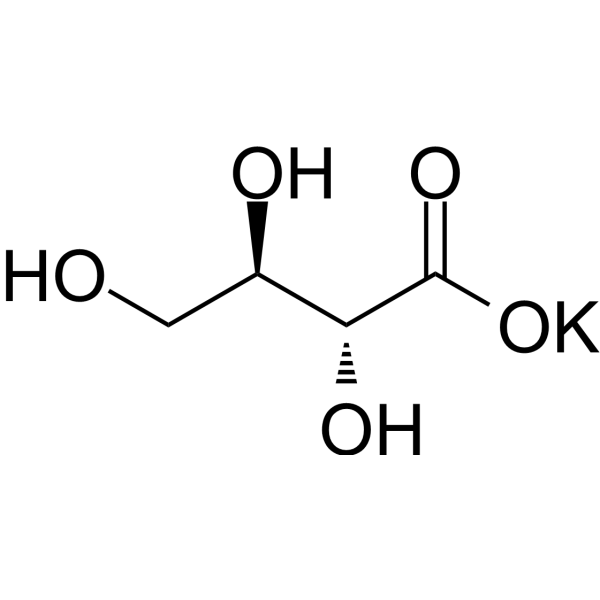
Erythronic acid potassium is a urinary metabolite that serves as a diagnostic marker for transaldolase (TALDO) deficiency. Erythronic acid potassium is a differential urinary metabolite associated with renal injury in hyperuricemic rats. Erythronic acid potassium can be used in studies related to transaldolase deficiency and hyperuricemia [1] .
loading...
    loading...
Cat. No.: HY-113048
CAS No.: 13752-84-6
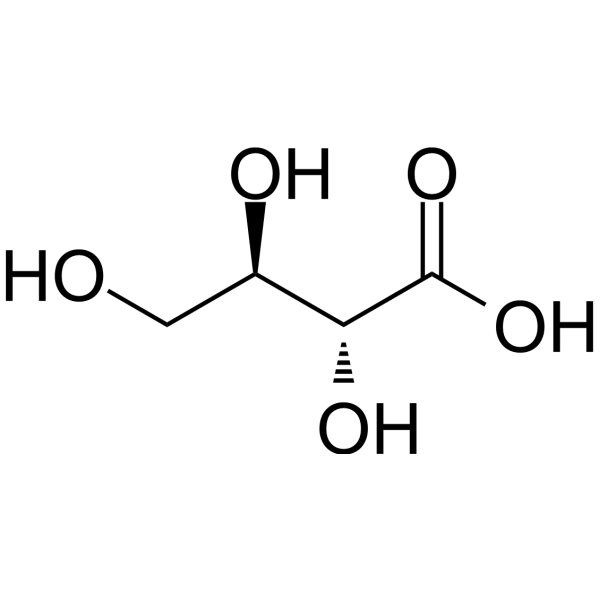
Erythronic acid is a urinary metabolite that serves as a diagnostic marker for transaldolase (TALDO) deficiency. Erythronic acid is a differential urinary metabolite associated with renal injury in hyperuricemic rats. Erythronic acid can be used in studies related to transaldolase deficiency and hyperuricemia [1] .
loading...
    loading...
Cat. No.: HY-W209558
CAS No.: 2020-90-8
Synonyms: 2,4,5-Trimethoxyphenylacetone
Acoramone (2,4,5-Trimethoxyphenylacetone) is a natural product that can be isolated from phenylpropane. Acoramone is one of the main metabolites identified in the 1H NMR spectrum of fraction b of the supernatant from the incubation of liver microsomes from Aroclor 1254-pretreated rats [1] .
loading...
    loading...
Cat. No.: HY-I1198
CAS No.: 2169998-23-4
Synonyms: Oxo-dapagliflozin
Target:  

Drug Metabolite

Research Areas:  

Inflammation/Immunology

Dapagliflozin keto impurity (Oxo-dapagliflozin) is an oxo metabolite and related impurity of Dapagliflozin (HY-10450). Dapagliflozin keto impurity can be characterized by 1H NMR, 13C NMR and HRMS, and can be used in studies related to Dapagliflozin impurities and metabolites [1].
loading...
    loading...
Cat. No.: HY-I1198R
CAS No.: 2169998-23-4
Synonyms: Oxo-dapagliflozin (Standard)
Dapagliflozin keto impurity (Standard) (Oxo-dapagliflozin (Standard)) is the analytical standard of Dapagliflozin keto impurity (HY-I1198). This product is intended for research and analytical applications. Dapagliflozin keto impurity (Oxo-dapagliflozin) is an oxo metabolite and related impurity of Dapagliflozin (HY-10450). Dapagliflozin keto impurity can be characterized by 1H NMR, 13C NMR and HRMS, and can be used in studies related to Dapagliflozin impurities and metabolites [1].
loading...
    loading...
Cat. No.: HY-N17441
CAS No.: 78259-41-3
(E)-Foeniculin is a natural product. (E)-Foeniculin can be isolated from the leaf oil of a chemovariety of Clausena anisata [1].
loading...
    loading...
Cat. No.: HY-N19831
CAS No.: 618904-80-6
Hylonoside I is a TMV inhibitor that inhibits the proliferation of TMV. Hylonoside I can be isolated from the leaves of Ilex hylonoma. Hylonoside I is applicable to the research of TMV infection [1] .
loading...
    loading...
Cat. No.: HY-N17258
CAS No.: 129235-39-8
Quercetin 3-O-(2G-β-D-xylopyranosylrutinoside) is an oviposition inhibitory factor. Quercetin 3-O-(2G-β-D-xylopyranosylrutinoside) can be isolated from the leaves of Orixa japonica. When presented together with the oviposition stimulant from Citrus unshiu (Satsuma mandarin), Quercetin 3-O-(2G-β-D-xylopyranosylrutinoside) inhibits oviposition by gravid female Papilio xuthus (Asian swallowtail) [1].
loading...
    loading...
Cat. No.: HY-182823
CAS No.: 155386-25-7
Research Areas:  

Infection

N-Nitrosovancomycin is an antibacterial agent and an N-terminal nitrosated derivative of vancomycin. N-Nitrosovancomycin exhibits antibacterial activity against Gram-positive bacteria in vitro, but shows no activity against Gram-negative E. coli. The modified N-terminal amino group of N-Nitrosovancomycin cannot be protonated, yet the compound still retains in vitro antibacterial activity. N-Nitrosovancomycin can be used in studies related to Gram-positive bacterial infections [1] .
loading...
    loading...
Cat. No.: HY-L0103V
680,000 compounds
UORSY Screening Compounds Library contains about 680,000 compounds. The library has extensively developed a polymerization synthesis method that provides a highly diverse chemical structure. More than 85% of the compounds in the library have drug-like physicochemical properties, and more than 35% of the compounds have lead-like properties.

