1. Search Result
Search Result
Results for "

Bacillus sp.

" in MedChemExpress (MCE) Product Catalog:

25

Inhibitors & Agonists

2

Peptides

18

Natural
Products

3

Recombinant Proteins

Cat. No. Product Name Target Research Areas Chemical Structure
  • HY-125863C

    G6PD, Bacillus sp.

    Endogenous Metabolite Others
    Glucose-6-phosphate dehydrogenase, Bacillus sp. catalyzes the conversion of glucose-6-phosphate into 6-phosphogluconolactone, and produces reduced nicotinamide adenine dinucleotide phosphate (NADPH) and ribose-5-phosphate in this process. Glucose-6-phosphate dehydrogenase, Bacillus sp. can be used in research about diabetic complications .
    Glucose-6-phosphate dehydrogenase, Bacillus sp.
  • HY-W016103

    Bacterial Drug Intermediate Infection
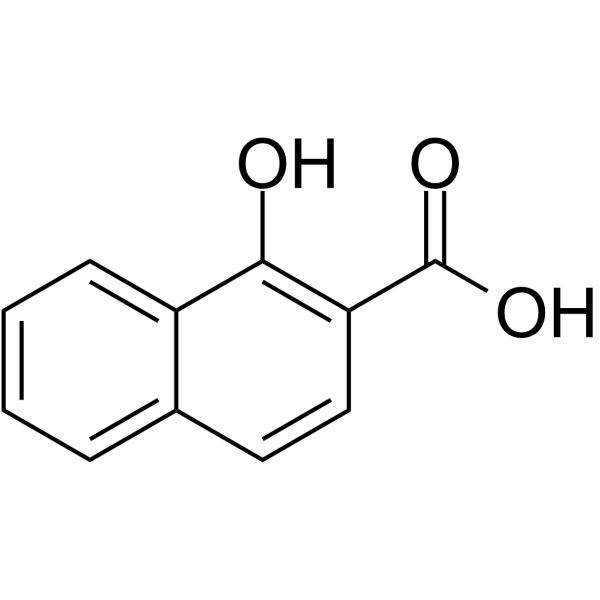
    1-Hydroxy-2-naphthoic acid is a ubiquitous bicyclic intermediate metabolite in the microbial degradation process of polycyclic aromatic hydrocarbons (PAHs). 1-Hydroxy-2-naphthoic acid can be converted into 1,2-naphthalenediol, which enters the naphthalene degradation pathway and participates in the tricarboxylic acid (TCA) cycle to achieve complete mineralization .
    1-Hydroxy-2-naphthoic acid
  • HY-N14257

    Bacterial Antibiotic Acetyl-CoA Carboxylase Infection
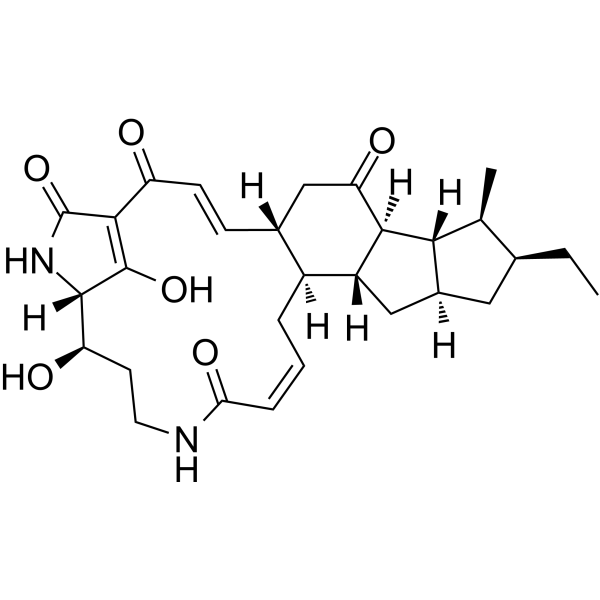
    Andrimid is a peptide Antibiotic and acetyl-CoA carboxylase inhibitor. Andrimid is produced by symbiotic bacteria of the genus *Enterobacter* residing in the brown planthopper Nilaparvata lugens. Andrimid exhibits strong specific activity against Xanthomonas campestris pv. oryzae. Andrimid shows no or only weak activity against Gram-positive and Gram-negative bacteria, including most plant pathogenic bacteria. Andrimid can be used in studies related to bacterial infections and rice bacterial blight .
    Andrimid
  • HY-P2776B

    Endogenous Metabolite Others
    Hexokinase, Bacillus sp. catalyzes the phosphorylation of glucose, and is involved in glycolysis. Hexokinase, Bacillus sp. participates is also related to energy production, protection of mitochondrial integrity, and cell survival .
    Hexokinase, Bacillus sp.
  • HY-P2724A

    PNP, Bacillus sp.

    Endogenous Metabolite Metabolic Disease
    Purine nucleoside phosphorylase, Bacillus sp. is a key enzyme in purine metabolism, involved in the purine salvage pathway. A deficiency in Purine nucleoside phosphorylase, Bacillus sp. can lead to impaired T-cell function. In the presence of inorganic phosphate as a second substrate, Purine nucleoside phosphorylase, Bacillus sp. catalyzes the cleavage of the glycosidic bond of ribonucleosides and deoxyribonucleosides, producing purine bases and ribose (or deoxyribose)-1-phosphate. Purine nucleoside phosphorylase, Bacillus sp. can be used for the determination of inorganic phosphate .
    Purine nucleoside phosphorylase, Bacillus sp.
  • HY-122955

    Fungal Infection
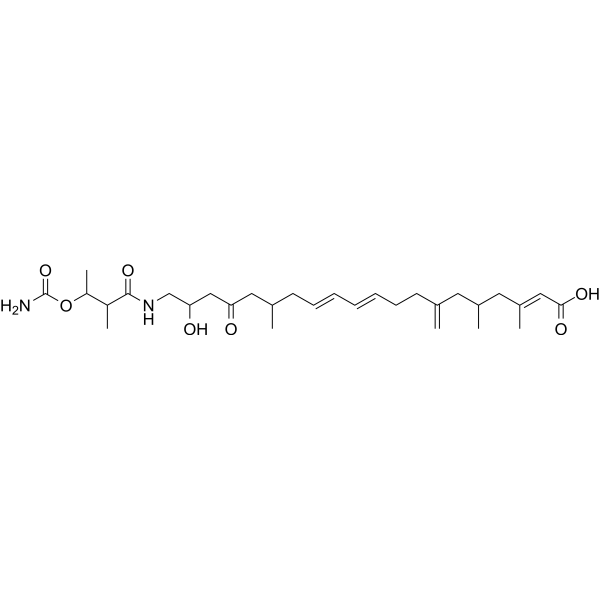
    Xanthobaccin A is a potent antimicrobial agent that can be isolated from the culture fluid of Stenotrophomonas sp. strain SB-K88. Xanthobaccin A exhibits activity against fungi, induces zoospore immobilization and lysis, inhibits mycelial growth. Xanthobaccin A can be used for the research of beet damping-off disease, bacterial and fungal infection .
    Xanthobaccin A
  • HY-158362A

    Endogenous Metabolite Neurological Disease Metabolic Disease Inflammation/Immunology
    Monoglyceride lipase, Bacillus sp., is a key enzyme involved in lipid metabolism. It catalyzes the hydrolysis of monoglycerides (particularly 2-AG, or 2-arachidonoylglycerol) into glycerol and free fatty acids. By regulating the levels of 2-AG, Monoglyceride lipase, Bacillus sp., can influence neural signaling, pain perception, inflammatory responses, and metabolic processes .
    Monoglyceride lipase, Bacillus sp.
  • HY-E70330

    Endogenous Metabolite Others
    Neutral Proteinase, Bacillus sp. is a biocatalyst and a key enzyme in new biocatalyst technology. Enzyme engineering focuses on enhancing enzyme reaction kinetics, substrate selectivity, and activity under harsh conditions such as low or high pH. By introducing stimulus responsiveness to these enzyme modifications, dynamic control of activity is also possible .
    Neutral Proteinase, Bacillus sp.
  • HY-P2859B

    Biochemical Assay Reagents Metabolic Disease
    Chitosanase, Bacillus sp (EC 3.2.1.132) is a chitosanase preparation produced by deep fermentation of Bacillus strains. Chitosanase, Bacillus sp (EC 3.2.1.132) catalyzes the decomposition of chitosan.
    Chitosanase, Bacillus sp
  • HY-N14100

    Antibiotic Bacterial Infection
    Pyloricidin D is an antibiotic against Helicobacter pylori found in Bacillus sp. HC-70 .
    Pyloricidin D
  • HY-N14099

    Antibiotic Bacterial Infection
    Pyloricidin C is an antibiotic against Helicobacter pylori found in Bacillus sp. HC-70 .
    Pyloricidin C
  • HY-P2768A

    Biochemical Assay Reagents Metabolic Disease
    Leucine dehydrogenase, Bacillus sp. (EC 1.4.1.9) is a carboxyl lyase that cleaves carbon-carbon bonds. L-Arginine Decarboxylase has one substrate, L-arginine, and two products, guanidine and CO2.
    Leucine dehydrogenase, Bacillus sp.
  • HY-N14074

    Bacterial Infection
    Pyloricidin A is an antibiotic against Helicobacter pylori found in Bacillus sp. HC-70. Pyloricidin A has strong anti-Helicobacter pylori activity. Pyloricidin A has no activity against other bacteria and yeast .
    Pyloricidin A
  • HY-N16401

    Bacterial Drug Derivative Infection
    Aspergillumarin B (Compound 2) is a derivative of dihydroisocoumarin. Aspergillumarin B can be isolated from the endophytic fungus Aspergillus sp.. Aspergillumarin B has a weak antibacterial activity against Staphylococcus aureus and Bacillus subtilis .
    Aspergillumarin B
  • HY-135535

    Endogenous Metabolite Bacterial Fungal Infection
    Sclerotioramine (Compound 1), a red pigment, is an antioxidant compound. Sclerotioramine can be isolated from the endolichenic fungus Penicillium sp.-strain 1322P. Sclerotioramine has potent antibacterial activity with MICs of 3.125, 3.125 and 6.25 μg/mL for Bacillus subtilis, Bacillus megaterium and Shigella dysentery, respectively. Sclerotioramine also has significant antifungal activity against Pestalotiopsis theae, Cochliobolus miyabeanus and Exserohilum turcicum .
    Sclerotioramine
  • HY-N14096

    Bacterial Infection
    Pyloricidin A1 is an antibiotic against Helicobacter pylori found in Bacillus sp. HC-70. Pyloricidin A1 has strong anti-Helicobacter pylori activity. Pyloricidin A1 has no activity against other bacteria and yeast .
    Pyloricidin A1
  • HY-N14097

    Bacterial Infection
    Pyloricidin A2 is an antibiotic against Helicobacter pylori found in Bacillus sp. HC-70. Pyloricidin A2 has strong anti-Helicobacter pylori activity. Pyloricidin A2 has no activity against other bacteria and yeast .
    Pyloricidin A2
  • HY-N14111

    Bacterial Fungal Infection
    Cuevaene A can be isolated from the strain of gdmAI-disrupted Streptomyces sp. LZ35 and. Cuevaene A displays moderate activity against Gram-positive bacteria (e.g., Bacillus subtilis strain ATCC 11060) and modest activity against fungi (e.g., Fusarium verticillioides strain S68 and Rhizoctonia solani strain GXE4) .
    Cuevaene A
  • HY-N14112

    Bacterial Fungal Infection
    Cuevaene B can be isolated from the strain of gdmAI-disrupted Streptomyces sp. LZ35 and. Cuevaene B displays moderate activity against Gram-positive bacteria (e.g., Bacillus subtilis strain ATCC 11060) and modest activity against fungi (e.g., Fusarium verticillioides strain S68 and Rhizoctonia solani strain GXE4) .
    Cuevaene B
  • HY-N14238

    Antibiotic Bacterial Infection Inflammation/Immunology Cancer
    Epoxyquinomicin B is an antibiotic that can be isolated from Amycolatopsis sp. Epoxyquinomicin B exhibits inhibitory activity against Micrococcus luteus, Bacillus subtilis, Pasteurella piscicida and Staphylococcus aureus with a MIC of 6.25-12.5 µg/mL. Epoxyquinomicin B exhibits cytotoxicity in cancer cell L1210 with IC50 of 16.3 µg/mL. Epoxyquinomicin B exhibits anti-inflammatory effects against collagen-induced arthritis .
    Epoxyquinomicin B
  • HY-N14237

    Antibiotic Bacterial Infection Inflammation/Immunology Cancer
    Epoxyquinomicin A is an antibiotic that can be isolated from Amycolatopsis sp. Epoxyquinomicin A exhibits inhibitory activity against Micrococcus luteus, Bacillus subtilis, Pasteurella piscicida and Staphylococcus aureus with a MIC of 3-12.5 µg/mL. Epoxyquinomicin A exhibits cytotoxicity in cancer cell L1210, B16 and S180 with IC50 of 2-8 µg/mL. Epoxyquinomicin A exhibits anti-inflammatory effects against collagen-induced arthritis .
    Epoxyquinomicin A
  • HY-N12230

    Bacterial Parasite Fungal Infection Cancer
    Penicolinate B is a picolinic acid derivative that can be isolated from Penicillium sp. Penicolinate B exhibits antimalarial activity (IC50: 1.40 μg/mL), antitubercular activity (MIC: 25.0 μg/mL), activity against Bacillus cereus (IC50: 25.0 μg/mL), and activity against Candida albicans (IC50: 1.45 μg/mL). Penicolinate B also has certain cytotoxicity against cancer cells such as MCF-7, KB, and NCI-H187. Penicolinate B can be used in research on malaria, tuberculosis, bacterial/fungal infections and tumors .
    Penicolinate B
  • HY-N11415

    Antibiotic Bacterial Infection
    Aurachin SS is a nature product that could be isolated from Streptomyces sp. NA04227. Aurachin SS is an antibiotic and has antibacterial activity .
    Aurachin SS
  • HY-N19829

    Others Others
    Lipoamide B is a lipoic acid amide present in marine Bacillus pumilus (SP21) .
    Lipoamide B
  • HY-N19828

    Others Others
    Lipoamide A is a natural lipoic acid product isolated from marine Bacillus pumilus (SP21) .
    Lipoamide A

Inquiry Online

Your information is safe with us. * Required Fields.

Salutation


Country or Region *

Applicant Name *


Organization Name *

Department *


Email Address *


Product Name *

Cat. No.


Requested quantity *

Phone Number *


Remarks

Inquiry Online

Inquiry Information

Product Name:
Cat. No.:
Quantity:
MCE Japan Authorized Agent:

