



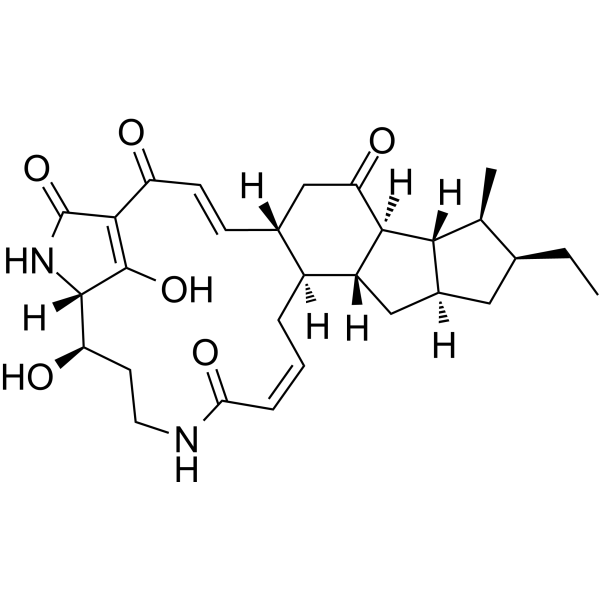
Xanthobaccin A
Xanthobaccin A is a potent antibiotic that can be isolated from the culture fluid of Stenotrophomonas sp. strain SB-K88. Xanthobaccin A exhibits activity against fungi and G+ bacteria, induces zoospore immobilization and lysis, inhibits mycelial growth. Xanthobaccin A can be used for the research of beet damping-off disease, bacterial and fungal infection.
For research use only. We do not sell to patients.
- CAS No.: 227596-81-8
- Formula: C29H38N2O6
- Molecular Weight:510.62
-
Storage:
Please store the product under the recommended conditions in the Certificate of Analysis.

To place orders, for customer services and technical support, please contact: MedChemExpress USA
Tel: 609-228-6898 E-mail: [email protected] [email protected]


-
 Biological Activity
-
Chemical Information
- Protocols
- Purity & Documentation
- References
-
 Help & FAQs


All Antibiotic Isoforms
More

Biological Activity
Description
In Vitro
Xanthobaccin A (0.001-10 μg/mL; 1-4 h) potently inhibits motility and induces lysis of Aphanomyces cochlioides zoospores in a dose- and time-dependent manner, with an MIC of 0.01 μg/mL[1].
Xanthobaccin A inhibits mycelial growth and induces abnormal morphological changes in Aphanomyces cochlioides hyphae[1].
Xanthobaccin A (0.1 μg/mL; 30 min) induces structural damage and lysis of Aphanomyces cochlioides zoospores within 30 min[1].
Xanthobaccin A (20 μg per disk; 2-7 days) potently inhibits the growth of multiple plant pathogenic fungi (Phytophthora vignae f. sp. adzukicola, Gaeumannomyces graminis var. tritici, Aphanomyces cochlioides and Pythium ultimum)[2].
Xanthobaccin A (1 μg/mL) inhibits the growth of Pythium ultimum with a MIC of 1 μg/mL[3].
Xanthobaccin A (20 µg; 24 h) inhibits the growth of Bacillus subtilis with an MIC of 10 μg/mL[4].
Xanthobaccin A acts as a ferric iron (Fe3+) metallophore, capable of chelating ferric iron ions[4].
MedChemExpress (MCE) has not independently confirmed the accuracy of these methods. They are for reference only.


Chemical Information
-
CAS No. 227596-81-8
-
Molecular Weight 510.62
-
Formula C29H38N2O6
-
SMILES
O=C1[C@@]2([H])[C@@]([C@H]3C)([H])[C@](C[C@@H]3CC)([H])C[C@]2([H])[C@](C/C=C\C(NCC[C@H]4O)=O)([H])[C@@](/C=C/C(C(C5=O)=C([C@@]4([H])N5)O)=O)([H])C1
-
Structure Classification
-
Initial Source
Stenotrophomonas sp. Strain SB-K88
-
Shipping
Room temperature in continental US; may vary elsewhere.
-
Storage
Please store the product under the recommended conditions in the Certificate of Analysis.


Purity & Documentation
References
[1]. Islam MT, et al. Suppression of damping-off disease in host plants by the rhizoplane bacterium Lysobacter sp. strain SB-K88 is linked to plant colonization and antibiosis against soilborne Peronosporomycetes. Appl Environ Microbiol. 2005;71(7):3786-3796. [Content Brief]
[2]. Nakayama T, et al. Possible role of xanthobaccins produced by Stenotrophomonas sp. strain SB-K88 in suppression of sugar beet damping-off disease. Appl Environ Microbiol. 1999;65(10):4334-4339. [Content Brief]
[3]. Nakayama T, et al. Possible role of xanthobaccins produced by Stenotrophomonas sp. strain SB-K88 in suppression of sugar beet damping-off disease. Appl Environ Microbiol. 1999 Oct;65(10):4334-9. [Content Brief]
[4]. Ding L, et al. Polycyclic Tetramate Macrolactams-A Group of Natural Bioactive Metallophores. Front Chem. 2021;9:772858. Published 2021 Nov 12. [Content Brief]

Calculators
Concentration (start) × Volume (start) = Concentration (final) × Volume (final)


Xanthobaccin A Related Classifications
HY-122955 Related Classifications
 Powered by Bioz
Keywords
- Xanthobaccin A
- 227596-81-8
- Antibiotic
- Fungal
- Bacterial
- Gaeumannomyces graminis var. tritici
- Streptomyces scabies
- Pyrenochaeta lycopersici
- Bacillus subtilis
- ferric iron
- Stenotrophomonas sp. strain SB-K88
- Pythium ultimum
- Phytophthora vignae f. sp. adzukicola
- Aphanomyces cochlioides
- Actinoalloteichus hymeniacidonis
- Inhibitor
- inhibitor
- inhibit