10 Results for "

FGFR1 degrader

" in MedChemExpress (MCE) Product Catalog:
Products (10)

10 Results for "FGFR1 degrader" in MCE Product Catalog:

  • Targets Recommended:
2
2 Cited Publications
Cat. No.: HY-111334
CAS No.: 105748-59-2
Purity:  99.74%
Synonyms: Brassinine
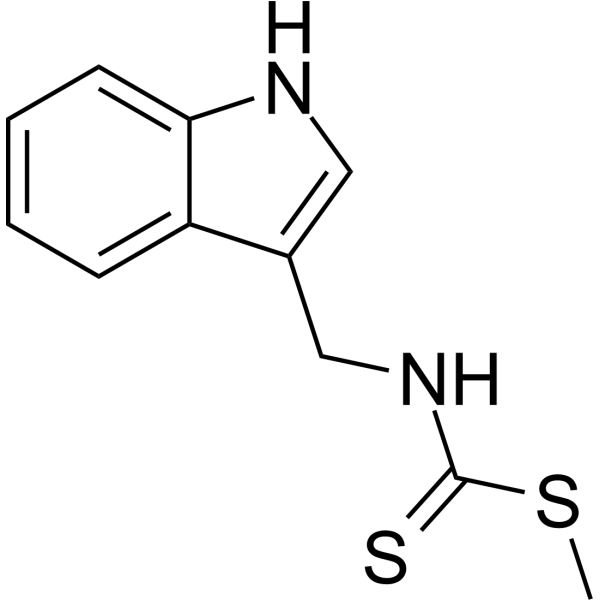
Brassinin is an indole derivative found in cruciferous plants. Brassinin acts as an IDO inhibitor (Ki = 97.7 μM). Brassinin inhibits angiogenesis and induces apoptosis, autophagy, paraptosis, ROS production, and ER stress. Brassinin selectively stimulates lysosomal degradation of Tie2 and promotes lysosomal and proteasomal degradation of FGFR1 in endothelial cells, downregulating AKT and ERK phosphorylation. Brassinin inhibits endothelial cell proliferation, migration, tube formation, spheroid sprouting, and angiogenesis. Brassinin inhibits PI3K/Akt/mTOR/S6K1 signaling, upregulates p21 and p27, and induces G1 phase cell cycle arrest through RB hypophosphorylation. Brassinin inhibits tyrosinase catalytic activity, reduces tyrosinase mRNA, and inhibits MITF nuclear translocation. Brassinin is used for research on triple-negative breast cancer, chronic myeloid leukemia, colon cancer, glioma, atherosclerosis, and skin cancer .
loading...
    loading...
Cat. No.: HY-148065
CAS No.: 2769753-07-1
Purity:  98.77%
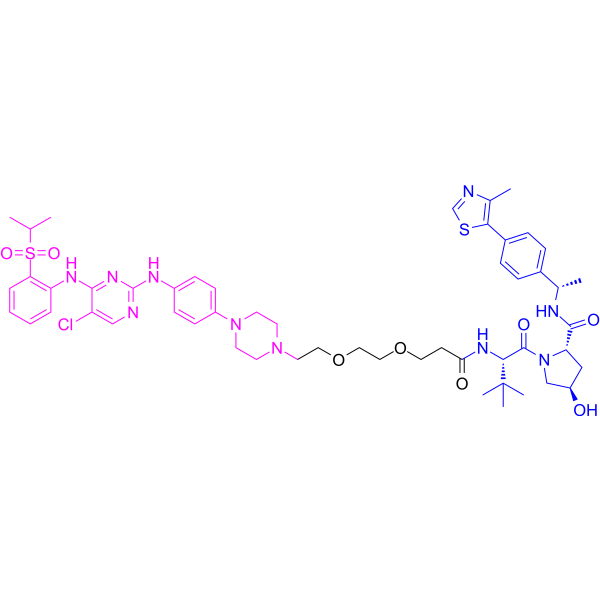
FMF-06-098-1 is a multi-target kinase PROTAC degrader. FMF-06-098-1 can be used to target degradation kinases which degrades AAK1, AΒL2, AURKA, AURKB, BUBIB, CDC7, CDK1, CDK12, CDK13, CDK2, CDK4, CDk6, CDK7, CDK9, CHEK1, CSNKID, EPHA1, PER, FGFR1, GAK, IRAK4, ITK, LIMK2, MAP4K2, MAP4K3, MAPK6, MAPK7, MARK4, MELK, PKN3, PLK4, PRKAA1, PTK2, PTK6, RPS6KA4, S1K2, STK35, TNK2, UHMK1, ULK1, and WEE1 .
loading...
    loading...
Cat. No.: HY-165298
CAS No.: 2504949-52-2
Target:  

PROTACs FGFR ERK

Research Areas:  

Cancer

DGY-09-192 is a PROTAC FGFR1/2 degrader (FGFR1: DC50 = 4.35 nM; FGFR2: DC50 = 70 nM). DGY-09-192 preferentially degrades wild-type FGFR1/2 and multiple FGFR2 fusion proteins (including FGFR2-PHGDH and FGFR2-OPTN). DGY-09-192 suppresses downstream FGFR signaling (reducing phosphorylation of FRS2 Y196 and ERK1/2 T202/Y204) in vitro and vivo. DGY-09-192 can be used for the study of FGFR-driven cancers .
loading...
    loading...
Cat. No.: HY-W007587
CAS No.: 41059-02-3
Target:  

PROTAC Linkers

Research Areas:  

Cancer

9-Bromononanoic acid is a PROTAC linker. 9-Bromononanoic acid can be used in synthesis PROTAC FGFR1 degrader-1 (HY-170869) .
loading...
    loading...
Cat. No.: HY-163705
Target:  

PROTACs FGFR

Research Areas:  

Cancer

BR-cpd7 is an orally active, selective PROTAC degrader targeting FGFR1 and FGFR2, with a DC50 of 2.2 nM against FGFR1. BR-cpd7 reduces FGFR signaling. BR-cpd7 induces cell cycle arrest and selectively blocks the proliferation of FGFR1/FGFR2-dependent tumor cells. BR-cpd7 exhibits significant antitumor efficacy in FGFR1-dependent lung cancer animal models, while achieving complete depletion of FGFR1. BR-cpd7 can be used for cancer-related research .
loading...
    loading...
Cat. No.: HY-170869
Target:  

PROTACs FGFR

Research Areas:  

Cancer

PROTAC FGFR1 degrader-1 is a PROTAC degrader targeting fibroblast growth factor receptor 1 (FGFR1), with a DC50 of 39.78 nM and an IC50 of 26.81 nM in KG1a cells. PROTAC FGFR1 degrader-1 selectively degrades FGFR1 via the ubiquitin-proteasome system, showing concentration- and time-dependent degradation in cancer cells. PROTAC FGFR1 degrader-1 can be used in studies related to leukemia and breast cancer .
loading...
    loading...
Cat. No.: HY-P11853
Research Areas:  

Cancer

cRY9M is a cyclic peptide that binds to FGFR1, with a KD value of 58 nM. cRY9M binds specifically to FGFR1, exhibits enhanced in vivo stability, and shows extremely low degradation in blood, urine and liver homogenate after injection. cRY9M displays significant specific uptake in FGFR1-positive tumor xenograft models, while its uptake decreases in FGFR1-negative tumor models and blocking models. The NOTA-chelated precursor of cRY9M can be labeled with 68Ga to obtain [ 68Ga]Ga-NOTA-cRY9M, which is used for research on non-invasive imaging of FGFR1 expression in non-small cell lung cancer .
loading...
    loading...
Cat. No.: HY-P11853A
Research Areas:  

Cancer

cRY9M acetate is a cyclic peptide that binds to FGFR1, with a KD value of 58 nM. cRY9M acetate binds specifically to FGFR1, exhibits enhanced in vivo stability, and shows extremely low degradation in blood, urine and liver homogenate after injection. cRY9M acetate displays significant specific uptake in FGFR1-positive tumor xenograft models, while its uptake decreases in FGFR1-negative tumor models and blocking models. The NOTA-chelated precursor of cRY9M acetate can be labeled with 68Ga to obtain [ 68Ga]Ga-NOTA-cRY9M, which is used for research on non-invasive imaging of FGFR1 expression in non-small cell lung cancer .
loading...
    loading...
Cat. No.: HY-184598
Research Areas:  

Cancer

CYB-5067 is a FGFR molecular glue degrader with a DC50 of 27 nM against FGFR2. CYB-5067 inhibits FGFR1, FGFR3, FGFR4 and downstream FGFR signaling pathways, induces antiproliferative activity in vitro, and exhibits sustained target protein inhibition in vivo without obvious hook effect. CYB-5067 shows significant tumor growth inhibitory activity in the ETV6-FGFR2 fusion Ba/F3 xenograft model. CYB-5067 can be used for the research of FGFR-driven cancers .
loading...
    loading...
Cat. No.: HY-184322
Research Areas:  

Cancer

LC-MG-10 is a selective molecular glue degrader targeting FGFR2, with a DC50 of 230.2 nM in KATO III cells. LC-MG-10 induces proteasomal degradation of FGFR2 via a covalent molecular glue mechanism. LC-MG-10 inhibits cancer cell proliferation. LC-MG-10 suppresses FGFR2-mediated PI3K/AKT and MAPK/ERK signaling pathways. LC-MG-10 can be used in studies related to gastric cancer .
loading...
    loading...

