1. Search Result
Search Result
Results for "

MDMX

" in MedChemExpress (MCE) Product Catalog:

22

Inhibitors & Agonists

7

Peptides

1

Recombinant Proteins

2

Antibodies

2

Oligonucleotides

Cat. No. Product Name Target Research Areas Chemical Structure
  • HY-P4210
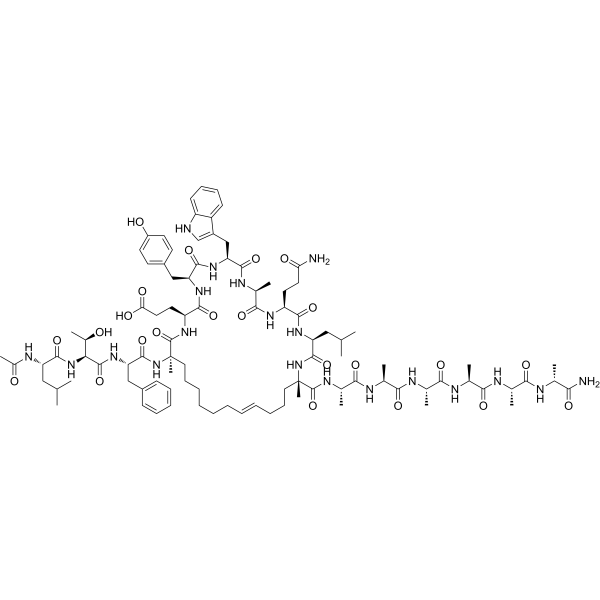
    Sulanemadlin
    1 Publications Verification

    ALRN-6924; MP-4897

    MDM-2/p53 Cancer
    Sulanemadlin (ALRN-6924) is a potent and cell-permeating p53-based peptidomimetic macrocycles. Sulanemadlin is a inhibitor of the p53-MDM2, p53-MDMX, or both p53 and MDM2 and MDMX protein-protein interactions. Sulanemadlin can be used for cancers research .
    Sulanemadlin
  • HY-108638
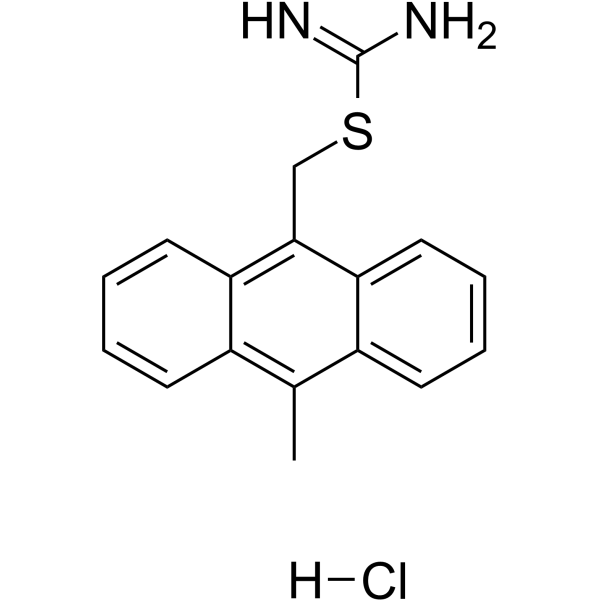
    NSC 146109 hydrochloride
    2 Publications Verification

    XI-011 hydrochloride

    MDM-2/p53 Apoptosis PARP Cancer
    NSC 146109 hydrochloride (XI-011 hydrochloride) is a p53 activator and MDMX inhibitor. NSC 146109 hydrochloride inhibits MDMX gene transcription, downregulates MDMX mRNA and protein levels, stabilizes p53 and activates the transcriptional activity of p53. NSC 146109 hydrochloride induces cancer cell apoptosis (apoptosis) and inhibits the growth of transformed cells. NSC 146109 hydrochloride inhibits the growth of xenograft tumors. NSC 146109 hydrochloride can be used in research related to breast cancer and cervical cancer .
    NSC 146109 hydrochloride
  • HY-141584

    MDM-2/p53 Cancer
    ATSP-7041, a selective dual peptide inhibitor of MDM2 and MDMX, effectively reactivates the p53 tumor suppressor pathway in a mechanism-dependent manner in p53-positive cancers .
    ATSP-7041
  • HY-16664
    SJ-172550
    2 Publications Verification

    MDM-2/p53 E1/E2/E3 Enzyme Cancer
    SJ-172550 is a small molecule inhibitor of MDMX; competes for the wild type p53 peptide binding to MDMX with an EC50 of 5 μM.
    SJ-172550
  • HY-120086
    RO-5963
    1 Publications Verification

    MDM-2/p53 E1/E2/E3 Enzyme Cancer
    RO-5963 is a dual p53-MDM2 and p53-MDMX inhibitor with IC50s of ~17 nM and ~24 nM, respectively .
    RO-5963
  • HY-14714
    NSC-207895
    2 Publications Verification

    XI-006

    MDM-2/p53 Cancer
    NSC-207895 (XI-006), a DNA damaging agent, is an anticancer agent and p53 activator .
    NSC-207895
  • HY-123950

    MDM-2/p53 Apoptosis Cancer
    MMRi64 disrupts Mdm2-MdmX interactions. MMRi64 downregulates Mdm2 and MdmX in leukemia cells. MMRi64 induces p53 accumulation, and induces the apoptotic arm of the p53 pathway in leukemia/lymphoma cells. MMRi64 can be used for cancer research .
    MMRi64
  • HY-148106

    Ligands for E3 Ligase Cancer
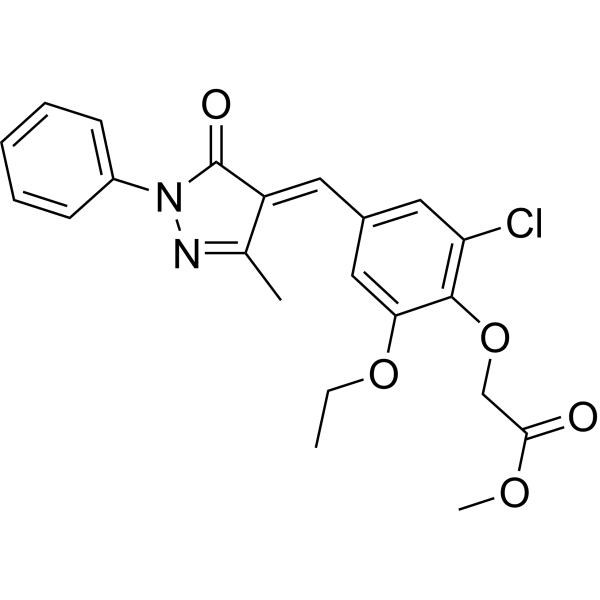
    MEL23 is a MDM2 E3 ligase inhibitor that blocks the E3 ligase activity of the MDM2-MDMX complex. MEL23 inhibits Mdm2 and p53 ubiquitination in cells, reduce viability of cells with wild-type p53. MEL23 stabilizes MDM2 via a mechanism independent of p53 transcription .
    MEL23
  • HY-149250

    MDM-2/p53 Apoptosis Cancer
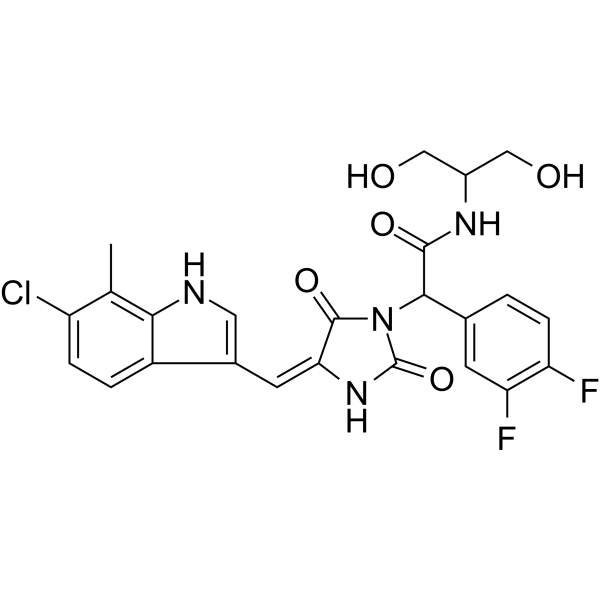
    MDMX/MDM2-IN-2 is a potent p53-MDM2/MDMX dual inhibitors with Kis of 0.23 μM and 2.45 μM for MDM2 and MDMX, respectively. MDMX/MDM2-IN-2 inhibits the binding of p53 and MDM2 proteins. MDMX/MDM2-IN-2 restores the function of p53 and enables cell cycle arrest and apoptosis. MDMX/MDM2-IN-2 inhibits cell migration and invasion. MDMX/MDM2-IN-2 has antitumor activity .
    MDMX/MDM2-IN-2
  • HY-124791

    MDM-2/p53 PARP Cancer
    MMRi6 is a Mdm2-MdmX RING domain inhibitor that can disrupt Mdm2-MdmX RING-RING interaction in vitro. MMRi6 inhibits MdmX-stimulated Mdm2 autoubiquitination and Mdm2-MdmX-mediated p53 polyubiquitination in vitro without affecting NEDD4-1 autoubiquitination. MMRi6 induces p53 stabilization and accumulation and induces PARP cleavage in wt-p53 Emu-myc lymphoma cells. MMRi6 inhibits the growth of wt-p53 and p53-null Emu-myc lymphoma cells with IC50s of approximately 0.5 μM and 3 μM, respectively. MMRi6 can be used for the study of leukemia/lymphoma .
    MMRi6
  • HY-P11256

    MDM-2/p53 Cancer
    pDI is a peptide. pDI inhibits MDM2-p53 and MDMX-p53 interactions with IC50s of 10 and 100 nM respectively. pDI can be used in the research of colorectal cancer .
    pDI
  • HY-P11255

    MDM-2/p53 Cancer
    SPDI-48-T1 is a lysine-stapled peptide. SPDI-48-T1 exhibits discernible binding affinities for MDM2 and MDMX, with Kd values of 396 nM and 456 nM, respectively. SPDI-48-T1 exhibits anticancer activity against breast cancer, colorectal cancer, non-small cell lung cancer, cervical cancer, and malignant melanoma .
    SPDI-48-T1
  • HY-107466

    MDM-2/p53 Cancer
    WK298 is a potent inhibitor of the MDM2/MDMX-p53 interaction with good anti-tumor activity. WK298 can fully activate the p53 pathway by inhibiting the binding of MDM2 and MDMX to p53. The development of WK298 benefited from a deep understanding of the key elements of the p53-MDM2/MDMX interaction structure .
    WK298
  • HY-RS16923

    Small Interfering RNA (siRNA) Others

    Mdm4 Mouse Pre-designed siRNA Set A contains three designed siRNAs for Mdm4 gene (Mouse), as well as a negative control, a positive control, and a FAM-labeled negative control.

    Mdm4 Mouse Pre-designed siRNA Set A
    Mdm4 Mouse Pre-designed siRNA Set A
  • HY-P10286

    MDM-2/p53 Cancer
    Phage-derived 12/1 peptide exhibits antitumor activity by targeting MDM2 and MDMX, an thus disrupt the MDM2-p53 and MDMX-p53 interaction, with IC50 of 0.15 and 1.25 μM .
    Phage-derived 12/1 peptide
  • HY-164550

    HDAC Cancer
    YF438 is an HDAC inhibitor with effective anticancer activity both in vitro and in vivo. YF438 inhibits the growth and metastasis of triple-negative breast cancer (TNBC) cells by blocking the interaction between HDAC and MDM2, inducing the dissociation of MDM2-MDMX, and promoting the degradation of MDM2 .
    YF438
  • HY-RS08267

    Small Interfering RNA (siRNA) Others

    MDM4 Human Pre-designed siRNA Set A contains three designed siRNAs for MDM4 gene (Human), as well as a negative control, a positive control, and a FAM-labeled negative control.

    MDM4 Human Pre-designed siRNA Set A
    MDM4 Human Pre-designed siRNA Set A
  • HY-163275

    MDM-2/p53 Apoptosis Cancer
    MDM2-IN-24 (compound A3f) exhibits MDM2-inhibiting and MDMX-activating properties in triple-negative breast cancer (TNBC) cells, with apoptotic and anti-proliferative activities .
    MDM2-IN-24
  • HY-P11490

    MDM-2/p53 Inflammation/Immunology Cancer
    DPMI-ω is a dual-specificity d-peptide antagonist of oncogenic proteins MDM2 and MDMX. DPMI-ω, upon fabrication on gold nanoparticles, efficiently traverses tumor cells and kills them by reactivating the p53 signaling pathway. DPMI-ω can disrupte the p53-MDM2/MDMX complex. DPMI-ω can inhibit B16 melanoma growth and induce cells G0/G1 phase arrest. DPMI-ω can augment the efficacy of immunotherapy by expanding CD3 +/CD8 + cytotoxic T cells and suppressing CD4 +/CD25 + regulatory T cells companied with anti-PD1 antibody. DPMI-ω can be used for research of melanoma .
    DPMI-ω
  • HY-P11635

    Drug Derivative MDM-2/p53 Cancer
    ATSP-7342 is a negative control analog of ATSP-7041. ATSP-7342 exhibits lower binding affinity to both MDM2 (Ki = 536 nM) and MDMX (Ki >1000 nM), compared with ATSP-7041 .
    ATSP-7342
  • HY-108638R

    XI-011 hydrochloride (Standard)

    Reference Standards MDM-2/p53 Apoptosis Cancer
    NSC 146109 hydrochloride (Standard) is the analytical standard of NSC 146109 (hydrochloride) (HY-108638). This product is intended for research and analytical applications. NSC 146109 hydrochloride is a small-molecule p53 activator that target MDMX and can be used for breast cancer research. NSC 146109 hydrochloride is a pseudourea derivative, promotes breast cancer cells to undergo apoptosis through activating p53 and inducing expression of proapoptotic genes .
    NSC 146109 hydrochloride (Standard)
  • HY-115797

    MDM-2/p53 Caspase c-Myc Apoptosis NF-κB Cancer
    LQFM030 is a novel small molecule MDM2 inhibitor. LQFM030 exhibits concentration dependent cytotoxicity in K562 cells (IC50 = 0.28 mM). LQFM030 induces cell apoptosis through G0/G1 phase cell cycle arrest and increased Caspase activity. LQFM030 downregulates the mRNA expression of MDM2, MDMX, p73, MYC, and NF-κB. LQFM030 is commonly used in research on cancers such as leukemia .
    LQFM030

Inquiry Online

Your information is safe with us. * Required Fields.

Salutation


Country or Region *

Applicant Name *


Organization Name *

Department *


Email Address *


Product Name *

Cat. No.


Requested quantity *

Phone Number *


Remarks

Inquiry Online

Inquiry Information

Product Name:
Cat. No.:
Quantity:
MCE Japan Authorized Agent:

